
 Worksheets
grade 5 Natural science ( kim)
Total questions: 90
Worksheet time: 1hrs 19mins
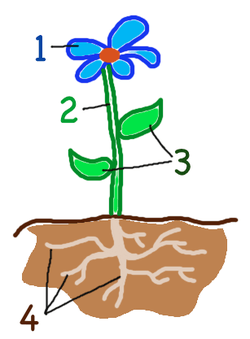
What is the function of part #2?
to reproduce the plant by making seeds
to do photosynthesis
to capture carbon dioxide from the air
to transport materials through the plant
What is a plant scientist called?
Ovule
Horticulturist
Botanist
Hydroponics
What is something that does NOT happen during photosynthesis?
CO2 is absorbed
Plants make glucose
Food is broken down for energy
Chlorophyll use light energy
Which of the following is not a part of a root?
Root Hairs
Root absorbers
Root Tip
Root Cap
What is NOT inside a plant's stem?
Xylem
Vascular bundle
Leaf
Phloem
What do leaves NOT do?
Capture sunlight's energy
Use water absorbed by the roots
Absorb water from the rain
Give out oxygen
How are vascular plants classified?
Roots vs No roots
Leaves vs no leaves
Seeds vs no seeds
Male vs female
What is a difference between Angiosperms and Gymnosperms?
Angiosperms produce flowers. Gymnosperms don't.
Angiosperms are vascular, Gymnosperms aren't.
Gymnosperms have seeds, Angiosperms don't.
Angiosperms are mosses, gymnosperms are trees.
What type of plant has tubes for water and food?
Non-vascular
Trees
Vascular
Bushes
What type of plants have Rhizoids
Green
Non-vascular
Vascular
Trees

What is the part labeled F
Plant
Root
Stem
Flower

What is the part labeled G
Flower
Roots
Stem
Stem system

What is the part labeled C
Stem
Leaf
Flower
Roots

What is part B
Shoot System
Underground part
Root System
Brown part

What is the part labeled A
Root System
Shoot System
Top part
Green part
Which of the following are pollinators ( can choose more that one options )
Bees
Butterfly
Worms
Pollination is important because it …….
Help us to make new plants
Helps us to make new animals
Wind pollinated flowers have to be very attractive
True
False
None
Biotic agents of pollination include birds , insects etc
True
False

Which of the following type of pollination is being done in the picture ?
Cross pollination
Self pollination
Abiotic
Nond
What are the two types of pollination ?
Biotic and abiotic
Cross and self pollination
None
Pollination is the transfer of pollen from the anther to the stigma of a flower
True
False
None
Which of the following is true ?
Pollen is produced by the anther which ( female part )
Pollen is produced by the anther ( male part )
None
Which two describe plants?
They make their own light
They put oxygen into the air
They eat insects and ungi
They make their own food
They break down dead organisms

Which identifies the role of the squirrel in this food web?
Carnivore
Omnivore
Herbivore
Producer

Which identifies the role of the coyote in this food web?
Carnivore
Omnivore
Herbivore
Producer
In an ocean food web, which of the following is a decomposer?
Lobster
Shark
Sponge
Bacteria

The diagram shows a simple food web that has not been completed.
Where does the plant belong?
1
2
3
4
In a desert food web, which of the following is a consumer?
Cactus
Snake
Shrub
Tree
Which do plants need for photosynthesis?
Sunlight
Oxygen
Pollen
Bees
Why do plants need water to germinate?
It keeps the seed cool and dark
It releases energy stored in the seed
It causes the seed to swell and break open
It allows the seed to make food for the young plant
Which do seeds need to germinate?
Soil
Water
Minerals
Sunlight
Which best identifies what plants receive from sunlight?
Energy
Nitrogen
Oxygen
Sugars
Which do plants need for photosynthesis?
Water
Soil
Flowers
Carbon monoxide

What are properties?
They give us an idea of what the object can do.
They describe the object.
They tell us what an object cannot do.
Example of a man-made object
Paper
Rock
Water
Sand
Where are metals found?
Ocean
Underground
Sky
All of the above
What is another word for brittle?
Flexible
Tough
Smooth
Fragile
Which is an example of a metal
Wood
Glass
Iron
Plastic
Where would you find a list of all of the Metals and Non-metals that scientists have discovered?
(a)
Non-metals are insulators, this means electricity ______ flow through them.
can
cannot
Non-Metals generally have ____ boiling points.
High
Low
Steel is an example of an
Metal
Non-Metal
Alloy
Which of these elements are a Non-Metal?
Copper
Gold
Oxygen
Have a high melting point
Metals
Non-Metals

What mineral is used in electrical wires?
fluorite
gold
copper
gypsum

Wood is a ___________ material.
Natural
Synthetic
The three states of matter are
solid, liquid and gas
solid, liquid and shape
shape, size and state
3 examples of minerals.
Magnesium,Copper,Clay
Bauxite,Magnesium,Clay
Tin,Iron,Bauxite
Bauxite,Magnesium,Copper
None of these

What are minerals?
They are a dispensable part of our lives. They are heterogeneous substances.
They are an indispensable part of our lives. They are homogeneous substances.
They are a dispensable part of our lives. They are homogeneous substances.
None of these.
Metals are good conductors of heat, true or false?
True
False
Which of these elements are a Non-Metal?
Copper
Gold
Oxygen
Which of the following are examples of metals?
Copper, gold, bronze, plastic
Wood, iron, steel, gold
Glass, rock, silver, aluminum
Silver, gold, titanium, iron
Which words best describe non-metals?
Soft
Brittle
Dull
Conducts heat
Conducts electricity
Properties of metal
Melt at high temperatures
Are shiny when polished
If we drop them, they will break
Metals are brittle
What does 'conducts' mean?
Able to be drawn into wires
Carries heat or electricity
Carries materials and metals
Coated metals
What is the reddish brown layer that forms when Iron combines with air and water called?
Alloy
Plating
Conductor
Rust
Ore

Is this animal a vertebrate or invertebrate?
invertebrates
vertebrates
What is the major difference between vertebrates and invertebrates?
Vertebrates have a backbone and invertebrates do not.
Invertebrates live in water and vertebrates do not.
Invertebrates have a backbone and vertebrates do not.
Invertebrates are smaller than vertebrates.
The ... connects the brain with the nerves.
Spinal cord
Cerebrum
Brainstem
What is our ability to detect and respond to changes in our environment?
Sensitivity
Stimulus
Response

Select those that belong in the South African Little Five
Elephant shrew and ant lion
Rhinoceros beetle
buffalo weaver
leopard tortoise
dung beetle

The big five can be seen at the Kruger National Park in Mpumalanga. Which animal doesn't belong in South Africa's big five?
Elephant
Lion
Tiger
Rhinoceros
Buffalo

What group of plants does the protea belong to?
Ferns
Aloes
Baobabs

Identify the plant that is shown in the centre of the coat of arms
Rose
Protea
Daisy

South Africa has a wide variety of indigenous plants and animals. Indigenous means
the place where they live or grow is its natural living place
belonging naturally in a particular place or habitat

Habitats can be
wet and dry
high or low
hot or cold
all of the above

Biodiversity is the term we use to describe
all the different plants and animals in a habitat
all the planets in the solar system
all the different insects found on earth

A plant or animals home is called it's
biodiversity
home
habitat
den