
 Worksheets
Electricity and Magnetism Unit Test Review
Total questions: 34
Worksheet time: 17mins
Name
Class
Date
1.
A proton has a positive charge. What is the charge of a particle that is attracted to a proton?
a)
negative
b)
neutral
c)
positive
d)
repulsive
2.
During a storm, Leah saw a flash of lightning hit a tree. Later, she observed that the lightning left a burn mark on the tree. Which of the following best describes what Leah can infer from what she saw?
a)
Static electricity can build up when water droplets rub against each other.
b)
Electrical energy can be transformed into light and produce heat.
c)
atoms usually have a neutral charge but can build up a positive or negative charge.
d)
electric current flows steadily along a path.
3.
Suppose you rub a balloon on your hair on a dry day. Your hair is attracted to the balloon. Then, you bring the balloon near another balloon that has not been rubbed. How would you describe what happens to the two balloons?
a)
They repel one another.
b)
They attract one another.
c)
They neither attract nor repel one another.
d)
Opposite charges make one balloon become larger and one become smaller.
4.
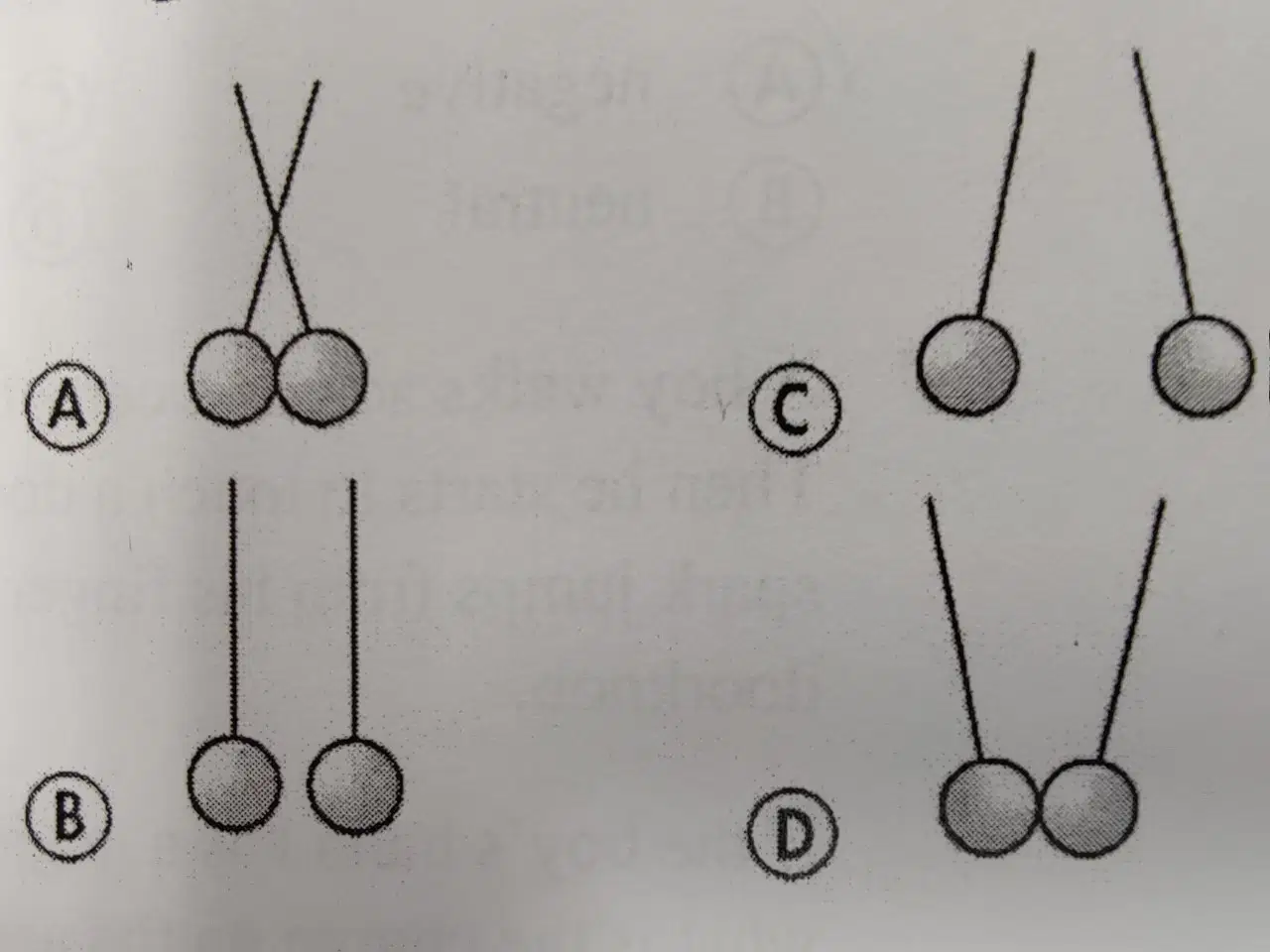
The pictures show objects that are charged and objects that are not charged. which shows two objects with the same charge?
a)
A
b)
B
c)
C
d)
D
5.

What additional item is needed to make a complete circuit?
a)
battery
b)
switch
c)
insulator
d)
conductor
6.
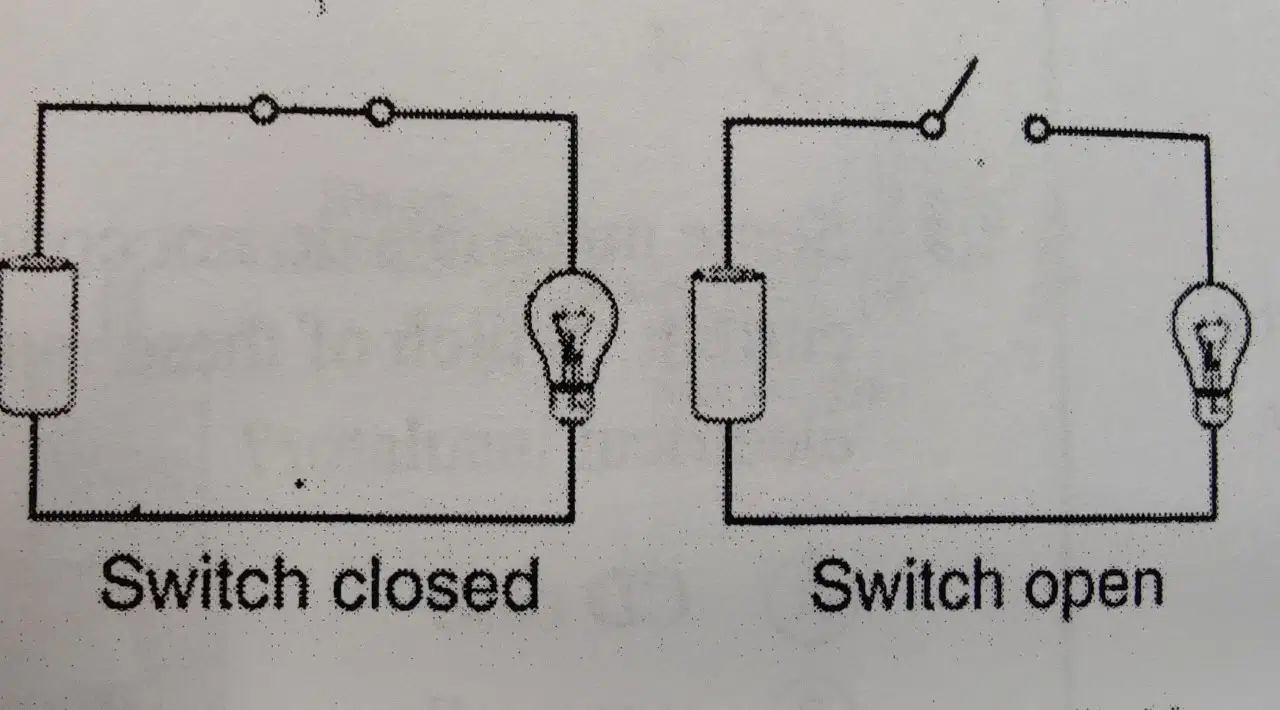
Alex makes an electric circuit that has a switch as one of its parts. The diagram below shows the circuit that he makes. What would happen if Alex changed the switch from closed to open?
a)
It would be duller.
b)
It would be brighter.
c)
It would stop glowing.
d)
It would start glowing.
7.
Which of the following items would work best to complete a circuit?
a)
metal coin
b)
glass bead
c)
plastic straw
d)
wooden toothpick
8.

What happens to lightbulbs A and C if B burns out?
a)
Both bulbs A and C will go out.
b)
Bulb A will go out, but bulb C will stay lit.
c)
Bulb C will go out, but bulb A will stay lit.
d)
Both bulbs A and C will stay lit.
9.

a)
So the wire can be bent and fit into the circuit.
b)
to prevent the circuit from becoming overloaded
c)
because the plastic make the wire too thick to use in a circuit
d)
so that electric current can pass between the copper wire and other parts of the circuit
10.

a)
0
b)
1
c)
2
d)
4
11.
A light bulb converts electrical energy into which of the following?
a)
light only
b)
light and sound
c)
light and heat
d)
light and motion
12.

a)
heat energy into electrical energy
b)
energy of motion into electrical energy
c)
electrical energy into energy of motion
d)
electrical energy into heat energy and energy and energy of motion
13.
When you wrap a wire around an iron nail and connect the wire to a battery, what have you built?
a)
a generator
b)
an electromagnet
c)
an electric nail
d)
a battery tester
14.
Which is NOT an advantage of electromagnets over permanent magnets?
a)
Electromagnets can be turned on and off.
b)
The strength of an electromagnet can be controlled by the amount of current.
c)
They are found in nature.
d)
They can be built as a big as necessary.
15.
What is the purpose of the battery in a circuit?
a)
to use the electric current
b)
to connect the components
c)
to provide a source of energy
d)
to slow the flow of electricity
16.
What is static electricity?
a)
a flow of electrons
b)
an electric discharge
c)
a repelling between electrons
d)
a buildup of electric charge on something
17.
Scooby wants to build an electric circuit with a device that can be turned on and off. Which list contains all of the materials he needs for his circuit?
a)
wire, ruler, switch, battery
b)
string, buzzer, battery, switch
c)
buzzer, wire, switch, light bulb
d)
battery, wire, light bulb, switch
18.
What happens when the north and south poles of different magnets get close to each other?
a)
they attract each other
b)
they repel each other
c)
they push each other away
d)
nothing
19.
Units of electricity
a)
electric charges
b)
electric cell
c)
insulator
d)
magnet
20.
material that charged particles can move through easily
a)
insulator
b)
resistor
c)
conductor
d)
motor
21.
an electric charge that builds up on a material
a)
current electricity
b)
static electricity
c)
insulator
d)
motor
22.
a circuit in which the parts are connected so that the electric current passes along more than one pathway
a)
series circuit
b)
parallel circuit
c)
electric cell
d)
electromagnet
23.
building blocks of matter
a)
electric charges
b)
magnets
c)
atoms
d)
circuits
24.
a subatomic particle that has a positive charge and is found in the nucleus of an atom
a)
proton
b)
neutron
c)
electon
d)
megatron
25.
a device that changes electrical energy into energy of motion
a)
circuit
b)
series circuit
c)
motor
d)
electromagnet
26.
circuit in which the parts are connected so that the electric current passes through each part along a single pathway
a)
parallel circuit
b)
series circuit
c)
electromagnet
d)
motor
27.
a strong temporary magnet that produces electromagnetism
a)
series circuit
b)
electromagnet
c)
generator
d)
parallel circuit
28.
a subatomic particle that has a negative charge
a)
proton
b)
neutron
c)
electron
d)
atom
29.
material that electric charges do not flow through easily
a)
generator
b)
circuit
c)
insulator
d)
conductor
30.
the pathway that electric current follows
a)
electric circuit
b)
insulator
c)
magnet
d)
electric cell
31.
True of False - In a series circuit, a break in the circuit causes the current to stop flowing.
a)
True
b)
False
32.
A circuit is made up of a battery, a small fan, a metal paper clip, and copper wire. When the metal paper clip is replaced with a plastic paper clip, the circuit continues to work. True or False.
a)
True
b)
False
33.
Lightning is a form of current electricity.
a)
true
b)
false
34.
The three components required to make an electromagnet are a conductor, iron core and a power source.
a)
True
b)
False
100 %

