wayground logo

Free Printable Worksheets

Font size

S
M
L
XL
Worksheets

US History 2 Pre-Test

Total questions: 25

Worksheet time: 13mins

Name
Class
Date
1.
How did World War II change the employment situation for women?
a)
The wartime standard of "equal pay for equal work" meant that women earned the same as men who did the same work.
b)
The number of young women in the workforce increased because they could do heavy wartime work, but older women were pushed out of the workforce.
c)
More women were able to find jobs in manufacturing and other fields not traditionally considered to be women's work.
d)
Women were needed on the home front so they were less likely to work once married.
2.
“In time of war, our ordinary ideas of what we will consume and how we are able to spend our money must be set aside. The usual peace time activities of the country must be subordinated to a single huge job—the carrying on of a war which calls upon us for our utmost in resources and effort. The job of every consumer, therefore, in this period of war is to change his consumption and his spending of money in such a way as to help carry on the war in every way possible, and to release productive capacity of every sort for defense effort, and at the same time keep up the health and morale of himself and his family.” — Suggestions to county committees of consumer interests What is the purpose of this passage?
a)
to encourage Americans to work in the defense industries
b)
to encourage Americans to grow their own food in victory gardens
c)
to encourage Americans to buy war bonds to support the war effort
d)
to encourage Americans to cooperate with the rationing of goods
3.
What were the effects of the U.S. policies that limited the rights of Americans and immigrants of Japanese, Italian, and German descent?
a)
They were forced to work in the war industries making Allied weapons.
b)
They were forced to register as enemy aliens or were put in internment camps.
c)
They were forced to leave the United States and return to their home countries.
d)
They were forced to make donations to the war effort.
4.
What is the most likely reason President Truman and Soviet leader Joseph Stalin are smiling in this image of the two at the Potsdam Conference in 1945?
a)
U.S.-Soviet relations were good, and Truman and Stalin agreed on Stalin's actions in Eastern Europe.
b)
The United States and the Soviet Union had put the Pacific Campaign on hold and agreed on how to end the war in Europe.
c)
The Allied Powers had defeated Germany, and even though they had disagreements, the leaders hoped to project an image of unity.
d)
The Soviet Union supported elections in occupied Eastern Europe, and Truman looked forward to a closer relationship with the Soviet Union.
5.
Why did the U.S. presence in Guam and the Philippines prior to the war create tension between Japan and the United States?
a)
U.S. presence in the region jeopardized Japan's access to important natural resources.
b)
U.S. presence in the region kept Japan from having Guam and the Philippines as trading partners.
c)
U.S. presence in the region led Japan to fear an attack on Japan from Guam or the Philippines.
d)
U.S. presence in the region threatened Japan's ability to establish itself as the most powerful nation in the region.
6.
In this map, the areas in green show the countries
a)
affected by the Marshall Plan.
b)
that belonged to the Warsaw Pact.
c)
where anti-communist revolts took place.
d)
that the Soviet Union absorbed.
7.
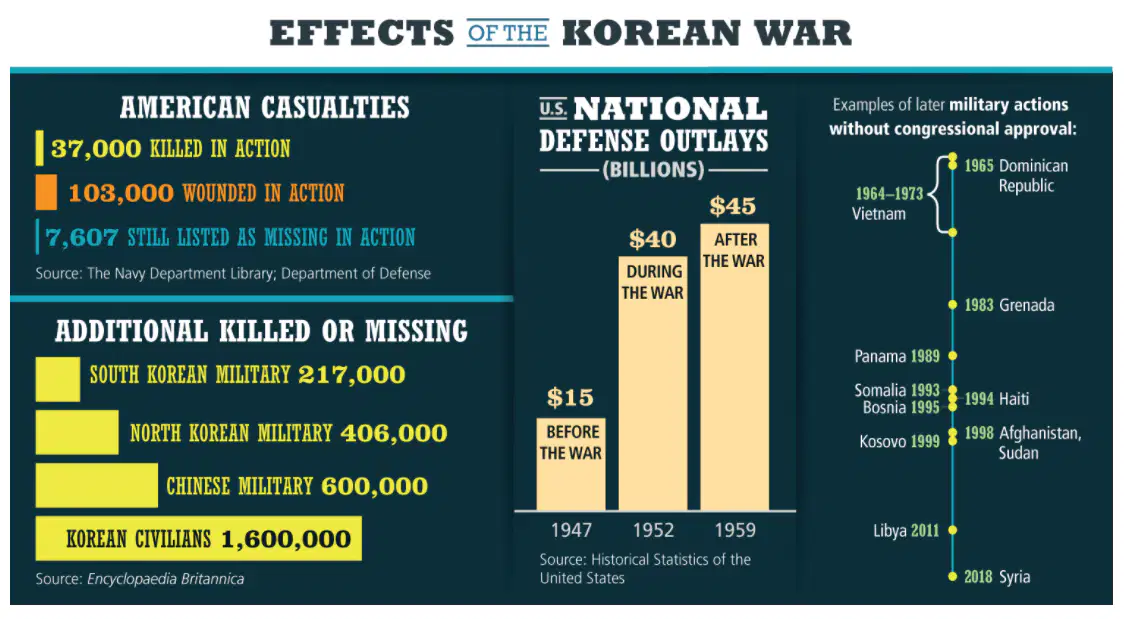
According to this information, what was a long-term effect of the Korean War on U.S. political decision making?
a)
The United States' defense budget continued to rise steadily.
b)
Later military actions were undertaken without congressional approval.
c)
More Americans were listed as missing in action than killed in action.
d)
American civilian casualties outweighed military casualties in later wars overseas.
8.
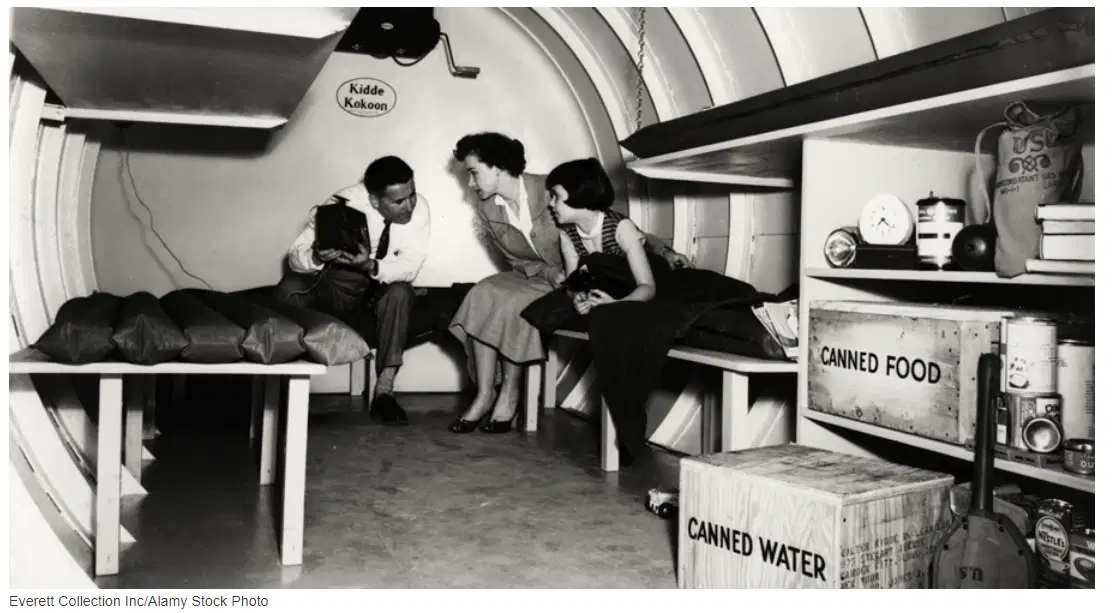
Americans built structures like the one pictured here because they were
a)
concerned about domestic terrorism in the 1950s.
b)
planning the launch of an American satellite into space.
c)
afraid of a potential nuclear attack during the Cold War.
d)
preparing for a Chinese attack during the Korean War.
9.

“The truth of the matter is that Europe’s requirements for the next 3 or 4 years of foreign food and other essential products—principally from America—are so much greater than her present ability to pay that she must have substantial additional help, or face economic, social, and political deterioration of a very grave character.“ The remedy lies in breaking the vicious circle and restoring the confidence of the European people in the economic future of their own countries and of Europe as a whole. The manufacturer and the farmer throughout wide areas must be able and willing to exchange their products for currencies the continuing value of which is not open to question." — George C. Marshall, Harvard University, June 5, 1947

The text above outlines the basis for the:

a)
Eisenhower Doctrine
b)
Cold War
c)
Berlin Airlift
d)
Marshall Plan
10.
As the postwar U.S. economy put technology to use in many new ways, workers’ ______ also improved, which meant that consumer goods were manufactured more quickly.
a)
education
b)
productivity
c)
union membership
d)
consumption
11.

“Our nation is moving toward two societies, one black, one white, separate and unequal. . . . Segregation and poverty have created the racial ghetto and a destructive environment totally unknown to most Americans.”—National Advisory Commission on Civil Disorders, Report, 1967

The Kerner Commission, which made this report, suggested that the majority of Americans were:

a)
living in a destructive environment.
b)
suffering from racial discrimination.
c)
unaware that urban poverty existed.
d)
critical of the creation of ghettos.
12.
What is the importance of the Supreme Court case referred to in the newspaper headline in this photo?
a)
In Sweatt v. Painter, the Supreme Court ruled that under the Constitution, Texas was permitted to establish separate all-black law schools.
b)
In Plessy v. Ferguson, the Supreme Court ruled that it was legal for states to have separate schools for African Americans.
c)
In Tinker v. Des Moines School District, the Supreme Court ruled that the right of free speech applies to students in all segregated schools.
d)
In Brown v. Board of Education, the Supreme Court ruled that separate schools for African Americans at all grade levels violated the Constitution.
13.
How did the Civil Rights Act of 1964 address minority rights?
a)
It allowed minority groups to organize public marches and demonstrations.
b)
It allowed the Equal Employment Opportunity Commission to desegregate schools.
c)
It allowed political organizations to lobby on behalf of minorities.
d)
It allowed the Justice Department to prosecute people who violated others' civil rights.
14.
“In the spring of 1964, in a speech at the University of Michigan, Johnson outlined his vision for America, calling it the Great Society. He said that during the past hundred years, Americans had spread across the continent, developed industrially, and created great wealth. But the work of America was not complete. . . . For Johnson, the Great Society demanded ‘an end to poverty and racial injustice’ and opportunity for every child.” Which of the following programs shows how President Johnson achieved one of the goals for the Great Society that he described in the quotation?
a)
strengthening the quota system with the Immigration and Nationality Act of 1965
b)
promoting Silent Spring to raise awareness about environmental problems
c)
providing federal funds to schools in poorer communities under the 1965 Elementary and Secondary Education Act
d)
reducing the costs paid by Americans age 65 and older for basic health insurance under Medicare
15.
The importance of television in the presidential election of 1960 suggested that
a)
voters wanted to learn as much as possible about the candidates.
b)
earlier candidates had not focused enough on campaigning.
c)
voters might be swayed by appearances rather than by issues.
d)
civil rights would become an important issue in the election.
16.
Below are four roles of the Peace Corps. Which is tied most directly with Kennedy’s larger goal of containing the spread of communism?
a)
to spread prosperity and democracy
b)
to encourage public service and volunteering
c)
to make connections between cultures
d)
to share technology for job creation
17.
How does this graphic relate to the U.S. decision to support the French in their struggle against Ho Chi Minh?
a)
The United States wanted retribution for losses to the communist forces in North Korea.
b)
The United States wanted to stop the spread of communism in Southeast Asia.
c)
The United States believed turning Vietnam from communism would lead to the fall of communism in North Korea and China.
d)
The United States feared that France's nuclear stockpile might fall into the hands of communist countries.
18.
“Ho Chi Minh’s military doctrine hinged on fighting only when victory was assured, which meant never fighting on his opponents’ terms. He compared his troops to a tiger, while the Americans were like an elephant. If the tiger stands still, the elephant will crush it. But if the tiger keeps moving and occasionally jumps on the elephant to take a bite out of it, the elephant will slowly bleed to death.” What did Ho Chi Minh believe this strategy would ultimately accomplish against the American military?
a)
He believed that if the North Vietnamese were patient enough, they could defeat the American forces in battle.
b)
He believed that if the North Vietnamese wore the American forces down enough, they would eventually leave.
c)
He believed that if the North Vietnamese could just avoid defeat long enough, the Chinese would eventually enter the war.
d)
He believed that if the war went on long enough, the South Vietnamese would grow tired of the conflict and surrender.
19.
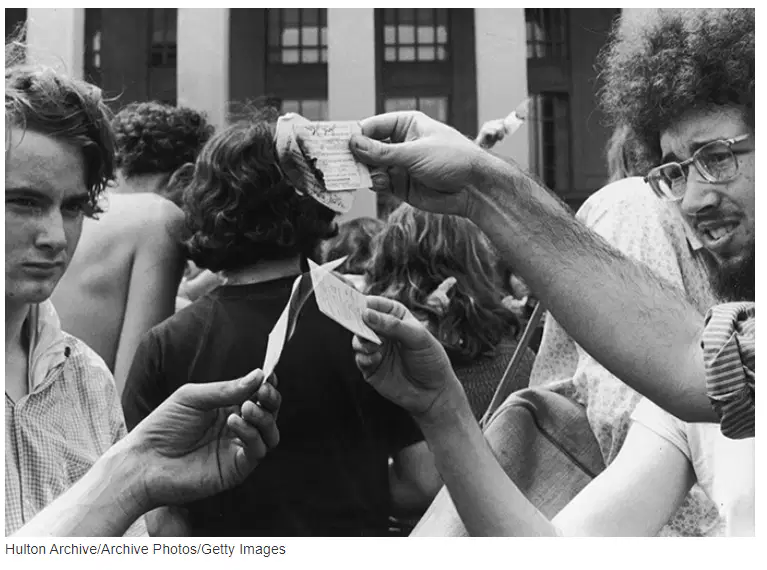
This image of students on the steps of the Pentagon in the late 1960s is associated with
a)
younger members of Nixon's so-called silent majority.
b)
disagreement with registering for the draft.
c)
support of Johnson's decision to reduce troop levels.
d)
conservative "hawks" who supported volunteering for the military.
20.
How did the Vietnam War affect American’s attitudes towards foreign policy in the years after the war?
a)
Most Americans during this time supported military intervention to keep countries from forming communist governments.
b)
Many came to believe it was important to give the president more control over military actions abroad.
c)
Many Americans became wary about sending troops abroad to avoid involvement in "another Vietnam."
d)
Most Americans, hawks and doves alike, became pacifists and joined forces to oppose all future wars.
21.
Which statement indicates the way that the Immigration and Nationality Act of 1965 affected Mexican immigrants in the United States?
a)
It required that all illegal immigrants register for temporary worker visas or risk deportation.
b)
It tightened immigration restrictions and dramatically reduced the number of immigrants coming into the United States.
c)
It eliminated national quotas for immigrants and led to a surge in immigration from Mexico in the 1960s and 1970s.
d)
It led to the deportation of thousands of Mexican immigrants who had come to the United States under the bracero program in the 1940s and 1950s.
22.
“From November, 1969 to June, 1971, a group called Indians of All Tribes, Inc., occupied Alcatraz Island. This group, made up of American Indians relocated to the Bay Area, was protesting against the United States government’s policies that affected them. They were protesting federal laws that took aboriginal land away from American Indians and that aimed to destroy American Indian cultures. The Alcatraz occupation is recognized today as one of the most important events in contemporary Native American history. It was the first intertribal protest action to focus the nation’s attention on the situation of native peoples in the United States. Because of the attention brought to the plight of the American Indian communities, as a result of the occupation, federal laws were created which demonstrated new respect for aboriginal land rights and for the freedom of American Indians to maintain their traditional cultures.” — “Alcatraz Occupation,” the National Park Service Based on this excerpt and from the text in the Topic, how did the American Indian civil rights movement differ most from the women’s rights movement and the African American civil rights movement?
a)
American Indians sought to draw attention to historical inequalities.
b)
American Indians asked for the return of land and respect for their culture.
c)
American Indians wanted equal access to education and other public services.
d)
American Indians focused on gaining increased representation in government.
23.
Which event is evidence of growing public support for people with disabilities during the 1960s?
a)
the establishment of the Special Olympics
b)
the publication of Ralph Nader's Unsafe at Any Speed
c)
public awareness of President Franklin Roosevelt's disability
d)
public debate over the passage of an Equal Rights Amendment
24.
What happened as a result of the Watergate scandal?
a)
President Nixon was impeached.
b)
Many Republicans became Democrats.
c)
Many Americans lost their trust in the government.
d)
Political corruption in Congress became more widespread.
25.
“In Nicaragua, the Somoza family had ruled the country with an iron grip since the mid-1930s, most of the time with the support of the United States. In 1978, a leftist group known as the Sandinistas began a rebellion against the country’s ruler, General Anastasio Somoza. His brutal response to the rebellion helped convince Carter to withdraw U.S. support. Without U.S. aid, General Somoza had to flee Nicaragua, and the Sandinistas came to power.” Which significant foreign policy development during President Carter’s time in office does this excerpt best illustrate?
a)
the ending of support for many oppressive dictatorships
b)
the replacement of military installations with humanitarian missions
c)
the installation of leaders selected by the United States in developing countries
d)
the increase in military spending to stop brutal communist regimes