
 Worksheets
DNA and Protein Synthesis Review
Total questions: 138
Worksheet time: 3hrs 56mins
What does DNA Replication mean? When does it occur?
DNA is made. During G1 phase
DNA makes new cells. During S phase
DNA copies itself. During S phase
DNA starts the cell cycle. During M phase

What is the result of the cell cycle?
Three cells
Four daughter cells
Two identical cells
One clone cell
Match the image to the correct answer

Prophase

Metaphase

Anaphase

Telophase

Cytokinesis
Label the parts of the Cell Cycle
G1
S phase
G2
Mitosis

During which phase of the cell cycle does the cell spend the most time?
Mitosis
Cytokinesis
Interphase
Mitosis is the division of the (a)
Cytokinesis is the division of the (a)
Match each phase with its correct description
Cell grows rapidly while carrying out normal functions.
G1 Phase
Cells must replicate their DNA before cell division to ensure that identical genetic information is passed to the next generation.
S Phase
FINISHES GROWING
Errors in DNA replication are checked- if something is wrong, cell needs to fix its errors before it divides!
G2 Phase
Put the Cell Cycle phases in order

Prophase

Metaphase

Anaphase

Telophase

Cytokinesis
Label the picture
Interphase
Prophase
Metaphase
Anaphase
Telophase
Cytokinesis
Put the Cell Cycle events in order
Cell grows
DNA replicates
Cell prepares for Mitosis
Cell divides
(a) is the uncontrolled growth of cells, often resulting in a tumor or mass of abnormal cells
Match the following pictures to their names:

Eukaryotic Cell

Prokaryotic Cell

Bacteriophage virus

Flu virus
Why aren't viruses considered living things?
They aren't made of cells
They don't have DNA or RNA
They make us sick
They are made of protein
Viruses can only reproduce with the help of a (a) cell. This is another reason that viruses are not considered (b) things.

When a virus takes over a cell, it can cause the cell to create many more copies of the virus until the cell bursts open and releases them. What part of the virus's lifecycle is this?
Lytic
Lysogenic

Why do viruses have projections on the outside?
To send signals to other viruses.
To maintain their structure.
To attach to the host cell.
To reproduce.
Which part of the virus contains/ holds genetic material?

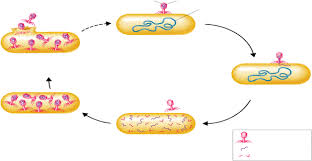

Which viral cycle kills its host cell by lysing (exploding)?
lytic
mitosis
lysogenic
S phase
Which virus life cycle allows the virus to combine DNA producing half viral DNA and half host cell DNA?
lytic
lysogenic
Viruses using the (a) cycle gives the host organism a quick onset of symptoms while viruses in the (b) cycle can not show symptoms for years.
Organize these options into the correct categories.
have Organelles
protein capsid
DNA/RNA
Have Proteins
Reproduce independently
need a host to reproduce
Evolve
maintain homeostasis
sole purpose is to replicate
Which of the following are a virus? (multiple answers)


Compare and contrast the functions of carbohydrates and lipids.
Compare and contrast Proteins and Nucleic Acids
Which nutrition label will provide more quick energy, but have the fewest amount of calories?
An advertisement for a health supplement for dogs claims to build lean muscle and strengthen tendons and ligaments, as well as provide energy. Which two biomolecules must the supplement contain to provide these benefits?
Carbohydrates
Lipids
Protein
Nucleic Acid
One of the main functions of the semi-permeable cell membrane is to maintain homeostasis for the cell. Semi-permeable means that only some molecules are allowed to cross the membrane and others are not.
Which biomolecule molecule enables large molecules to cross the membrane?
(a)
Both prokaryotes and eukaryotes have small, free-floating organelles. The cell makes these organelles from nucleic acids and amino acids found in food. Without these organelles, the cell could not make proteins.
These organelles are called (a)
Match the cell structure with its primary function.
Move the correct answers to the correct boxes.
(a) - controls cell activities
(b) - protein synthesis
(c) - controls what goes in and out of the cell
(d) - support
(e) - provides energy for the cell
Which type of movement across a cell’s plasma membrane requires energy supplied by ATP?
Passive Transport
Simple Diffusion
Active Transport
Osmosis
Passive transport is represented in three different forms. (a) is the movement of water across a semipermeable membrane. (b) , like when someone sprays perfume, is the movement of molecules down or under a concentration gradient. (c) is the movement of molecules down a gradient with the help of special protein channels.
Correctly label the image

No, because the excess water would accumulate and burst the cell.
Yes, because the paramecia would simply become bigger organisms.
Yes, because just like all living things, paramecia need water to survive.
No, because the excess water would create a balance between the inside and outside of the cell.
What are the 3 functions of the cell membrane?
Maintain Homeostasis
Protect the inside of the cell from the external environment
Allows specific things to enter or exit the cell (semi-permeable)
Keep all solutes out of the cell, only allows water in
Which statement best describes how a virus replicates?
A virus divides into two identical virus particles before infecting the host cell.
A virus enters a host cell and uses the materials from the host cell to produce new virus particles.
Multiple virus particles fuse and form a large particle that breaks apart, releasing new virus particles.
Multiple virus particles break down in component parts, which then reassemble into new copies of the virus.
Which part of the virus will be used to attach to a host cell receptor?
cell growth
G1
DNA Replicates
S
Interphase
G1, S, G2
M Phase
Cell Division
division of nucleus
Mitosis
Put the following phases into the correct order
Interphase
Prophase
Metaphase
Anaphase
Telophase
Which letter in the image represents metaphase?
Cancer is a disease of uncontrolled cell division. Cancer cells behave differently than normal cells, and function incorrectly during the cell cycle. Which of these best describes how cell division irregularities might lead to cancer?
Cancer cells become "stuck" in G1 of Interphase, which causes each cell to grow excessively large.
Cancer cells keep dividing and do not stop when overcrowded, leading to tumor formation.
Cancer cells remain too long in the DNA Replication part of Interphase, which creates excessive copies of new cells.
Cancer cells divide far less than normal cells, allowing each individual cell to increase in size.
Patients who have lymphoma, a cancer effecting blood cells,
are frequently prescribed a medication called Bleomycin.
This medication stops the growth of cancer cells in the body,
preventing them from dividing or growing.
What phase(s) of the cell cycle would likely be most heavily impacted by Bleomycin?
G1 and Prophase
Mitosis only
S
(DNA Replication)
G2 and Mitosis
What do all living things have in common?
have DNA
maintain homeostasis
able to reproduce
have identical proteins
Match the complementary nitrogen bases together
Adenine
Thymine
Guanine
Cytosine
Thymine
Adenine
Cytosine
Guanine
Label the nucleotide
Label the image
DNA molecules contain the genetic information that determines the characteristics of a living organism. How do DNA molecules express the genetic information they contain?
by breaking down proteins within the cell
by directing the process of protein synthesis
by regulating the storage of cellular proteins
by controlling the movement of protein molecules
In Texas Longhorn cattle, coat coloration is an inherited trait. What is the genetic basis of coat-color variation in Texas Longhorn cattle?
Differences in the nucleotide sequences of genes
Differences in the numbers of chromosomes in cells
Differences in the diets of individual cattle
Differences in the environmental conditions of different geographical areas
Label the diagram

AUG codes for the amino acid Methionine and AAA codes for Lysine in cucumbers. What do those two codons code for in birds?
Valine and Aspartic Acid
Serine and Glutamic Acid
Isoleucine and Histadine
Methionine and Lysine

Using the Codon chart attached, drag and drop the corresponding amino acid to its mRNA base
AAA : (a)
GUU : (b)
UAA : (c)
AGU : (d)

Which type of mutation is represented in the image?
a point mutation
an inversion mutation
a deletion mutation
an insertion mutation
Which type(s) of mutations will most likely change sequence of nitrogen bases in a codon?
Insertion
Substitution
Deletion
Translation
Label the diagram

Each cell in the human body, with the exception of gametes, contains the same number of chromosomes and the same genetic sequences. Which process determines cell differentiation or cell specialization?
Gene Expression
Mutation of the Genes
Different methods of cell division
the host chooses


What are the steps in order of protein synthesis.
Messenger RNA is produced using DNA as a template
mRNA attaches to the ribosome
a anti-codon on tRNA bonds to a specific codon on mRNA
Amino acids bond together to create a peptide chain
A protein is created
What is the correct order to make a protein?
Protein, DNA, RNA
RNA, DNA, Protein
DNA, RNA, Protein
Protein, RNA, DNA

What is the amino acid sequence for the following mRNA strand:
UGG-ACU-CGA-GUG
(a)
If the DNA sequence of a gene is TAC CCC GGA GAG, what mRNA sequence will be produced in transcription?
RNA Polymerase
AUG GGG CCU CUC
ATG GGG GGT GTG
AUG GGG CCU CUG
AUG CCG GCA CGG
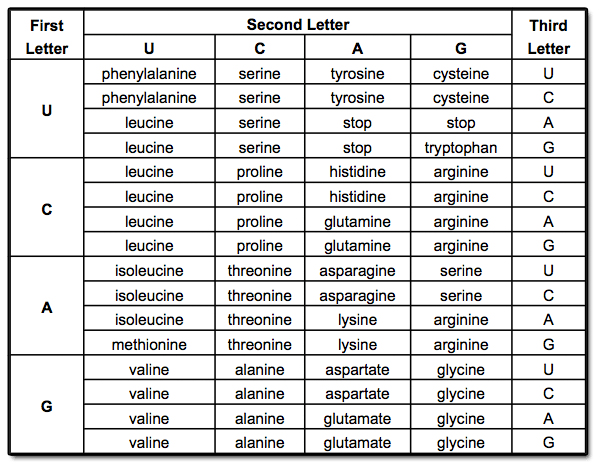
What amino acid would be added to the protein being formed during translation if the mRNA codon reads "AUG?"
Phenylalanine
Tyrosine
Leucine
Methionine
If the DNA sequence of a gene is GAC CAA TAT GTA, what mRNA sequence will be produced in transcription?
nucleus
AUG GGG CCU CUC
CUG GUU AUA CAU
GAC CAA UAU GUA
CUG CCG GCA CGG

What amino acid would be added to the protein being formed during translation if the mRNA codon reads "CCU?"
Isoleucine
Stop
Methionine
Proline
Circle the Mutation

What type of mutation is this?
Substitution
Deletion
Insertion
What is it called when a mutation has no effect on the amino acid sequence in the final polypeptide?
Substitution mutation
No mutation
Silent mutation
Replication mutation
What type of chromosomal mutation loses genes?
Duplication
Inversion
Deletion
Translocation
What is the first step in protein synthesis?
(a)
Transcribe the following sequence of DNA into RNA:
AAG CTT TGC
(a)
What would be the complementary DNA strand for the following nucleotide sequence?
TCG ATA CGA
(a)
A (a) mutation occurs at a single point in the DNA sequence.
Which of the following images is a INSERTION?


Which of the following images is a DELETION?
Which of the following images is a SUBSTITUTION?

Which of the following statements is a TRANSLOCATION?
Produces an extra copy of all or part of a chromosome.
Reverses the direction of parts of a chromosome.
Involves the loss of all or part of a chromosome.
Occurs when part of one chromosome breaks off and attaches to another.
During transcription, a sequence of (a) is copied onto a strand of (b) so that it can leave the (c) to find a (d) .

Determine the correct order of the amino acid sequence to be produced from the DNA template:
3' CCG TCT AAG GTG ACC CTT 5'
Valine - Threonine - Lysine - Serine - Proline - Glutamic Acid
Glycine - Valine - Lysine - Serine - Proline - Alanine
Proline - Serine - Lysine - Threonine - Valine - Stop
Glycine - Arginine - Phenylalanine - Histidine - Tryptophan - Glutamic Acid

Determine the correct amino acid sequence from the mRNA strand:
5' AUG CAG UCU GCA CUG AGC 3'
Met-His-Ser-Ala-Leu-Ser
Met-Arg-Ser-Ala-Leu-Ser
Met-His-Ser-Leu-Ala-Ser
Met-Gln-Ser-Ala-Leu-Ser
Which amino acid is coded for by the following mRNA codon CCU?

Determine the correct amino acid sequence from the mRNA strand:
5' UAU GCC GUA CGC GAA CAC 3'
Tyrosine - Glycine -Valine - Arginine -Glutamic Acid -Histidine
Tyrosine - Alanine -Leucine - Arginine -Glutamic Acid -Histidine
Tyrosine - Alanine -Valine - Arginine -Glutamic Acid -Histidine
Tyrosine - Alanine -Valine - Arginine -Glutamic Acid - Asparagine
Match the type of mutation with its definition:
when one nucleotide is switched for a different one in the DNA sequence
when one nucleotide is added into the DNA sequence
Insertion
when one nucleotide is removed from the DNA sequence
Deletion
Which type of mutation has occurred in this sequence of DNA?
Original DNA: 3' ATGCGCTAGATCGAT 5'
Mutated DNA: 3' ATGCCGCTAGATCGAT 5'
Which type of mutation has occurred in this sequence of DNA?
Original DNA: 3' ATGCGCTAGATCGAT 5'
Mutated DNA: 3' ATGCGCAAGATCGAT 5'

6C: The initial steps in gene expression are modeled above. Double-stranded DNA first unwinds into two strands. Which process and product are represented in Diagram 2?
Process: transcription; product: mRNA
Process: translation; product: protein
Process: replication; product: tRNA
Process: recombination; product: polymerase

6C Which of the following polypeptides is coded for by the mRNA sequence ′5 AUGGUUAAACGACAAUCC 3'?
Val, Lys, Phe, Gly, Ser
Met, Asp, Phe, Ala, Arg
Met, Val, Lys, Arg, Gln, Ser
Ile, Gln, Lys, Asp, Gly, Leu, Ser

What mutation has occurred here?
T-G-A-C-C-A
T-G-A-G-C-A
Substitution
Deletion
Insertion
Frameshift

DNA molecule segment is : TTACGCAAG
The mutated DNA segment is TTACGCAAC. This is an example of ___ mutation.
Substitution
Insertion
Inversion
Translocation

ATT-TGA-GCC- Original
ATT-GAG-CC - Mutated
The example above is an example of a
Insertion- Frameshift
Deletion- Substitution
Deletion -Frameshift
All of the above

DNA molecule segment is : TTA-CGC-AAG
The mutated DNA segment is TTC-GCA-AG. This is an example of ___ mutation.
Substitution
Deletion
Insertion
Inversion

Original DNA: CAT GAT CCA
New DNA: CAT TGA TCC A
What mutation occurred?
deletion
substitution
tranverse
insertion
Mutation: ATC GCAT
What mutation occurred?

What type of gene mutation has occurred here? Normal-
AGA-TTC-ATA-GCG
Mutant-
AGA-TTC-AAT-AGC-G
deletion frameshift
insertion frameshift
substitution
nonsense

Why are insertion and deletion mutations so harmful?
They change all of the codons from the mutation on down the line, which changes the amino acid sequence
They insert things that an organism doesn't need.
They often delete things that organisms need.
Insertion and deletions are not any more harmful than substitution mutations.


Which of the following is true regarding substitution mutations ...
a missense mutation. This could affect the 3D structure of the protein.
a silent mutation. The mutation causes no effect as the first mRNA codon still codes for the same amino acid even though the base has been substituted.
a nonsense mutation. The mutation causes the second mRNA codon to become a stop codon, which means it stops synthesis of the amino acid chain prematurely. This will likely result in a non-functional protein.
frameshift mutation. This causes all of the amino acids shown to change. This will cause a non-functional protein.
have no effect on the amino acids produced during protein synthesis.
silent mutation
causes a stop codon instead of a normal amino acid codon. This causes translation to be terminated prematurely, causing a shorter protein.
nonsense mutation
causes a codon to code for a different amino acid than the original one.
missence mutation
causes the “reading frame” of the codons to shift forwards or backwards. This can change the entire sequence of amino acids.
frameshift mutation
causes a change to one base and potentially one amino acid of the polypeptide chain
point mutation
Label each of the following chromosomal mutations
Identify which of the following are true and which are false
Match the following
C
cytosine
T
thymine
G
guanine
A
adenine
Label the Structure of a Nucleotide
Phosphate
Deoxyribose
Ribose
Nitrogen
Nitrogen Base
Why do A and T bond together and G and C?
Match the following
A-T forms
two hydrogen bonds
G-C forms
three hydrogen bonds
DNA structure
Double helix
Reorder the following enzymes from the order they occur in during DNA replication
Helicase
Topoisomerase
RNA Primase
DNA Polymerase
Ligase
Match the following
Helicase
Unwinds the DNA double helix
Topoisomerase
Prevents over-twisting of the DNA
DNA polymerase
Synthesizes new DNA strands
RNA Primase
Puts down the primer
Ligase
Joins Okazaki fragments (glue)
Match the following
DNA -> RNA
Transcription
RNA -> Polypeptides
Translation
Polypeptides -> DNA
None
Double Strand
Single Strand
Dexoyribose
Ribose
Thymine (T)
Uracil (U)
What are the 3 forms of RNA?

mRNA- (a) for (b) synthesis; travels from (c) to (d) .

tRNA- (a) (b) code to (c)
Transcription occurs in the (a) .
Reorder the steps of Transcription
RNA Polymerase binds to promoter
RNA nucleotides bind with complementary nucleotides
Keeps going until reaches terminator code
mRNA processing

Match the following
AUG-UAU-GCG-CCC-UAA
Met-Tyr-Ala-Pro
AUG-UUU-AAA-AAA-UAA
Met-Phe-Lys-Lys
AUG-UUU-UCA-CUU-UAA
Met-Phe-Ser-Leu
AUG-CAU-CAC-CGA-UAG
Met-His-His-Arg
AUG-UAG-GCU-AUU-UAG
Met
Translation occurs in the (a) at the (b) which forms a (c) .
There are no anticodons for the codons UAG, UAA, and UGA because...
What are DNA mutations?
What are point mutations?
Types of Point Mutations-
Substitution
affects only that one reading frame
Frameshift
addition or deletion of a single base
Substitution Example-
GCA VS. GTA
Frameshift Insertion Example-
TAC GCA TGG -> TAT CGC ATG G
Frameshift Deletion Example-
TAC GCA TGG -> TAG CAT GG
Frameshift Mutation... (two answers)
affects that reading frame and all after it
could possibly affect all amino acids
affects reading frame and all before it
Match the following Causes and affects of Mutations
Causes- Spontaneous Mutations
occur at random
Causes- Environmental causes of mutations
x ray, ultraviolet light
Effects- Mutations can be...
harmful, helpful, or no effect at all
Effects- Adds variety to...
species and opportunities for evolution

