wayground logo

Free Printable Worksheets

Font size

S
M
L
XL
Worksheets

Novi End of Year Mega Quiz

Total questions: 123

Worksheet time: 2hrs 6mins

Name
Class
Date
1.

Subatomic particles with a negative charge

a)

Electrons

b)

Neutrons

c)

Protons

d)

Quarks

2.

What is one way Neutrons are different from electrons?

a)

they both are negative

b)

neutrons have no charge, while electrons have a negative charge

c)

Both are in the nucleus( center of atom)

d)

Electrons are inside nucleus and neutrons are outside the nucleus.

3.

Match the Following

a)

Element

1.

A substance that cannot be broken down into simpler substances by physical or chemical means.

b)

Atom

2.

The smallest unit of an element that keeps the element’s chemical properties.

c)

Nucleus

3.

The dense center of an atom containing protons and neutrons.

d)

Proton

4.

Positively charged particles found in the nucleus of an atom.

e)

Neutron

5.

Particles with a neutral charge found in the nucleus of an atom.

4.
Value representing the number of protons in an element
a)
Atomic Mass
b)
Mass Number
c)
Valence Electrons
d)
Atomic Number
5.
Measure mainly of the nuclear particles: protons + neutrons
a)

Subatomic Particles

b)

Atomic Number

c)

Mass Number

d)

Gluons

6.
The smallest particle of an element that shows all the properties of that element.
a)
Subatomic Particles
b)
Atom
c)
Quarks
d)
Gluons
7.

Which TWO particles can be changed within an element without changing what the element is?

a)

Neutrons

b)

Electrons

c)

Protons

8.

Which part of the diagram represents the proton?

a)

a

b)

b

c)

c

d)

d

9.
Mg2+ and Cl- create...
a)
Mg2Cl
b)
MgCl2
c)
Mg2Cl2
d)
MgCl
10.
Ca2+ and N3- create...
a)
Ca2N3
b)
Ca3N2
c)
CaN3
d)
Ca2N
11.

The formula of calcium and phosphate is

a)

CaPO4

b)

Ca2(PO4)3

c)

Ca3PO4

d)

Ca3(PO4)2

12.

What is the formula for copper(I) and sulfate?

a)

CuSO3

b)

CuSO4

c)

Cu2SO3

d)

Cu2SO4

13.

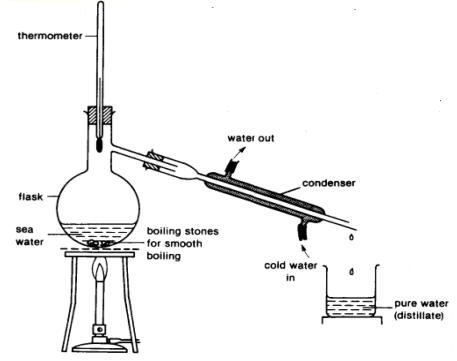
What is the name of this separation technique?

a)

Simple distillation

b)

Fractional distillation

c)

Boiling

d)

Evaporation

14.

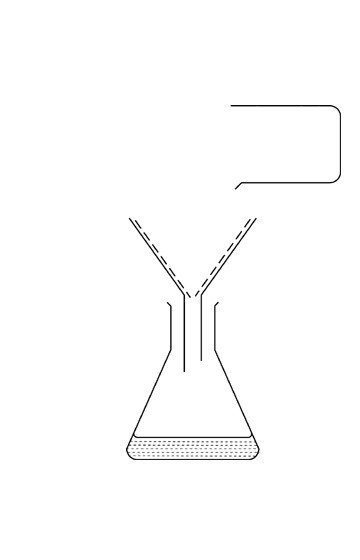
What is the name of this separation technique?

a)

distillation

b)

filtration

c)

evaporation

d)

chromatography

15.

Which separation technique is used to obtain salt from seawater?

a)

Simple distillation

b)

Filtration

c)

Chromatography

d)

Evaporation

16.

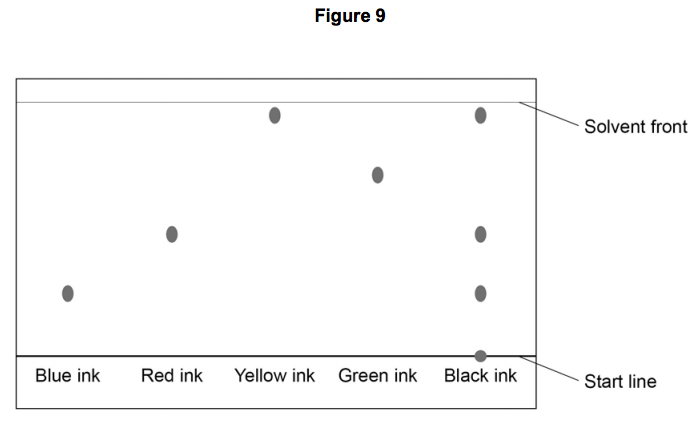
Which ink is a mixture?

a)

Blue

b)

Red

c)

Yellow

d)

Black

17.

Referring to the chromatogram, black ink contains

a)

Blue, red and yellow ink only

b)

Blue, red, yellow and green ink

c)

Blue and yellow ink

d)

Black ink only

18.

During filtration, the solid that is trapped in the filter paper is called ..A.. and the liquid that has passed through the filter paper is called ..B..

a)

A: residue B: filtrate

b)

A: residue B: filterate

c)

A: filtrate B: residue

d)

A: filterate B: residue

19.

What method would you use to separate a mixture of salt and water so that you can get keep the salt AND the water?

a)

sorting by hand

b)

distillation

c)

chromatography

20.

Dyes in a felt-tip pen may be separated by....

a)

Distillation

b)

Decanting

c)

Chromatography

d)

Centrifuge

21.
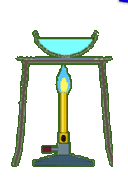
Which one of the following is the name for separation technique in the picture below
a)
distillation
b)
dissolving
c)
evaporation
d)
decanting
22.
Which one of the following is a disadvantage of evaporation?
a)
It always requires heat
b)
It cannot be used for insoluble solids
c)
All of the solute is recovered
d)
The solvent (liquid part) is not recovered
23.

No matter what you do, sand will not dissolve in water, because sand is _________.

a)

dissolved

b)

soluble

c)

insoluble

d)

aqueous

24.
Which technique is shown the diagram below
a)
seiving
b)
filtration
c)
decanting
d)
crystallization
25.
If you shake up the sand and water, the sand spreads through the water forming a cloudy ______.
a)
substance
b)
suspension
c)
sediment
d)
solution
26.

What is the formula for a magnesium ion?

a)

Mg+

b)

Mg2+

c)

Mg2-

d)

Mg-

27.

What is the name of this ion? SO42-

a)

sulfur tetroxide ion

b)

sulfonate

c)

sulfate

d)

sulfide

28.

Which is the correct formula for an ammonium ion?

a)

NH4

b)

NH4-

c)

NH42+

d)

NH4+

29.

Which of the following is the correct formula for a sodium ion?

a)

So+

b)

Na-

c)

Na+

d)

Na2+

30.

What is the formula for a nitrate ion?

a)

NO-

b)

NO2-

c)

NO3-

d)

NO4-

31.

What is the formula for lithium bromide?

a)

LiBr

b)

LiBr2

c)

Li2Br

d)

Li2Br2

32.

What is the formula for iron(II) oxide?

a)

FeO2

b)

FeO

c)

Fe2O

d)

Fe2O3

33.

What is the formula for iron(III) chloride?

a)

FeCl

b)

Fe3Cl

c)

FeCl2

d)

FeCl3

34.

What is the formula for aluminium hydroxide?

a)

AlOH

b)

AlOH3

c)

Al(OH)3

d)

(Al)3OH

35.

The formula for sodium oxide is

a)

NaO

b)

Na2O

c)

Na2O

d)

NaO2

36.

The formula for calcium oxide is

a)

CaO

b)

Ca2O2

c)

CaO2

d)

Ca(O)

37.

The formula for ammonium sulfate is

a)

(NH4)2S

b)

NHSO4

c)

NH42SO4

d)

(NH4)2SO4

38.

The formula for potassium chloride is

a)

KCl

b)

NaCl

c)

K2O

d)

K2CO3

39.

The sum of the charges in an ionic compound should equal

a)

zero 0

b)

eachother

c)

2

40.

If the calcium ion is Ca2+, and calcium nitride is Ca3N2, then what is the charge on the nitride ion?

a)

2-

b)

3-

c)

3+

d)

none of these

41.

The combination of Fe2+ ion and Cl- ion produce

a)

FeCl4

b)

FeCl

c)

FeCl2

d)

FeCl3

42.

Na +  and  S -2 form

a)

Na2S

b)

NaS2

c)

Na2S2

d)

NaS

43.

+  and  N-3 form

a)

KN

b)

KN3

c)

K3N3

d)

K3N

44.
The chemical formula for an ionic compound of potassium and oxygen is
a)
KO.
b)
K2O.
c)
K2O2.
d)
KO2.
45.
How do the following two elements bond together?
Al3+  O2-         
a)
AlO
b)
Al2O3
c)
Al3O6
d)
Al3O2
46.

Iron + copper oxide =

a)

Iron + copper oxide

b)

Iron oxide + copper oxide

c)

Iron oxide + copper

d)

Magic

47.

Which of the following is more reactive?

a)

Calcium

b)

Magnesium

c)

Zinc

d)

Magnesium

48.
a substance that is formed as the result of a chemical reaction
a)
Product 
b)
Reactant
c)
Starters
d)
Enders
49.

Will the following reaction take place?


Ni + NaCl ->

a)

NO

b)

YES

50.

Which one of the following combinations result in a displacement reaction?

a)

Iron with magnesium chloride

b)

magnesium with iron chloride

c)

Iron with Zinc Sulphate

d)

gold with silver nitrate

51.
A displacement reaction will occur when...
a)
a more reactive metal displaces a less reactive metal from its compound.
b)
A less reactive metal displaces a more reactive metal from its compound
c)
Displacement only occurs when two of the same metals are reacted 
d)
Displacement reactions will only occur in metals above iron in the reactivity series
52.

What will the products of this reaction be?

calcium + zinc nitrate --------->

a)

Calcium + zinc nitrate

b)

Zinc + calcium nitrate

c)

there will be no reaction

d)

Zinc + calcium chloride

53.
Which of the following will not undergo reaction?
a)
zinc metal  +  zinc oxide 
b)
iron metal  +  copper oxide
c)
zinc metal +  iron oxide
d)
magnesium  +  iron oxide
54.

True or false? Chemical reactions are easily reversible

a)

True

b)

False

55.

True or false: A change in state is a chemical reaction

a)

True - something melting would be an example of a chemical reaction

b)

False - a change in state is a physical change

56.

In a word equation, the starting chemicals are called...

a)

reactants

b)

products

c)

ingredients

57.

Sometimes, compounds can be broken down into simpler substances. What type of reaction is this?

a)

combustion

b)

oxidation

c)

decomposition

d)

displacement

58.

When energy is transferred from the substances to the surroundings during a chemical reaction, what type of reaction is this?

a)

endothermic

b)

exothermic

c)

decomposition

d)

combustion

59.

Which is NOT an example of something you could observe that would suggest a chemical reaction is taking place?

a)

melting

b)

fizzing

c)

smells

d)

temperature change

60.
According to the octet rule most elements need _______ valence electrons.
a)
2
b)
8
c)
6
d)
18
61.
Hydrogen needs _____ electrons in its valence shell to be stable.
a)
4
b)
6
c)
8
d)
2
62.
What is the correct formula for this molecule?
a)
NH
b)
N3H
c)
NH3
d)
NH4
63.
How many covalent bonds does carbon need to form in order to have a full octet?
a)
2
b)
3
c)
4
d)
5
64.

What is a double bond?

a)

a bond between two atoms

b)

one pair of electrons shared between two atoms

c)

two pairs of electrons shared between two atoms

d)

three pairs of electrons shared between two atoms

65.
Covalent compounds
a)
Share electrons
b)
transfer electrons
c)
contain a sea of electrons
d)
conduct electricity
66.

NH3 has how many lone pairs?

a)

0

b)

1

c)

2

d)

3

67.
How many valence electrons does nitrogen have?
a)
3
b)
2
c)
5
d)
1
68.

What is it called if there are three-pairs of electrons being shared?

a)

Triple bond

b)

Trigonal bond

c)

Tri-bond

d)

Three bonds

69.
What two types of atoms make a covalent bond?
a)
2 Nonmetals
b)
1 Nonmetal & 1 Metal
c)
2 Metals
d)
2 Noble Gases
70.
What is a diatomic element?
a)
a metal bonded with a nonmetal
b)
2 or more nonmetals bonded together
c)
2 or more metals bonded together
d)
2 atoms of the same element bonded together
71.
The number of bonds an element will form in a covalent compound will be equal to
a)
the number of valence electrons
b)
eight electrons
c)
the number of electrons needed to reach an octet
d)
the group number
72.

Which element below is not diatomic?

a)

hydrogen

b)

oxygen

c)

nitrogen

d)

sulfur

73.

How many valence electrons are in oxygen, O?

a)

2

b)

7

c)

6

d)

1

74.

Which of the following elements needs to bond 3 times?

a)

Oxygen, O

b)

Phosphorous, P

c)

Fluorine, F

d)

Silicon, Si

75.

Which of the following is a Diatomic Molecule?

a)

K2

b)

C2

c)

S2

d)

N2

76.

Which of these would be covalently bonded?

a)

Sodium, Na and potassium, K

b)

Magnesium, Mg and oxygen, O

c)

Fluorine, F and chlorine, Cl

d)

Helium, He and argon, Ar

77.

Many _____ exist as diatomic molecules.

a)

alkali metals

b)

semi-metals

c)

transition metals

d)

non-metals

78.

Which of these is not a covalent molecule?

a)

K2O

b)

CO2

c)

HCl

d)

CH4

79.
A decomposition reaction can be represented as _____________________.
a)
AB  → A + B
b)
A + B → AB
c)
AB + CD → AC + BD
d)
A + BC → B + AC
80.
A chemical change in which a single compound breaks down into two or more simpler products is called a ______________________.
a)
single-replacement reaction
b)
synthesis reaction
c)
double-replacement reaction
d)
decomposition reaction
81.
This chemical equation for mercury oxide is an example of what type of reaction?
2HgO  → 2Hg + O2
a)
decomposition reaction
b)
synthesis reaction
c)
combustion reaction
d)
Marvin the Martian reaction
82.
A chemical change in which two or more substances react to form a new substance is a ____________________________.
a)
decomposition reaction
b)
synthesis reaction
c)
double displacement reaction
d)
combustion reaction
83.
A synthesis reaction can be represented as ________________________.
a)
AB + CD → AC + BD
b)
AB → A + B
c)
A + B → AB
d)
A + BC → B + AC
84.
This chemical equation for magnesium oxide is an example of what type of reaction?
2Mg + O→ 2MgO
a)
decomposition reaction
b)
synthesis reaction
c)
single displacement reaction
d)
combustion reaction
85.
Which of the following is an example of synthesis?
a)
Na + Br--> NaBr
b)
KClO--> KCl + O2
c)
HgO + Cl2-->HgCl + O2
d)
Cl2 + NaBr --> NaCl + Br2
86.
What type of chemical reaction is this?
Al(OH)3 → Al2O3  + H2O
a)
Decomposition
b)
Combustion
c)
Synthesis
d)
Single Replacement 
87.
The number of atoms you begin with in a chemical reaction ...
a)
must be the same as the number of  atoms you end with
b)
must be an even number
c)
can be different to the number you finish with
d)
changes depending on how much energy is formed
88.
CxHy +O--> H2O + CO2
a)
Decomposition
b)
Double replacement
c)
Combustion
d)
Single Replacement
89.
Identify the reactant(s) and product(s) of the reaction.
a)
All three are reactants and none are products.
b)
Hydrogen and water are the reactants, and oxygen is the product.
c)
Water and oxygen are the reactants, and hydrogen is the product.
d)
Hydrogen and oxygen are the reactants, and water is the product.
90.
In the reaction methane + oxygen turns into carbon dioxide + water, the methane and oxygen are called _______________.
a)
reactants
b)
products
c)
neutrals
d)
energizers
91.

PCl5 + ___ H2O → ___ HCl + H3PO4

a)

4, 5

b)

1, 6

c)

3, 8

d)

2,2

92.
 Mg  +  ___ HCl  →   MgCl2  +   H2
a)
1
b)
2
c)
3
d)
4
93.
Balance this equation.
_SnO+_H2-->_Sn +_H2O
a)
1,1,2,1
b)
1,2,1,1
c)
1,2,1,2
d)
1,2,2,1
94.
Balance this equation
_Al +_HCl --> _H+_AlCl3
a)
2, 6, 3, 2
b)
it is already balanced
c)
4, 12, 3, 4
d)
2, 1, 4, 5
95.
Balance this equation.
_CH4 + _O--> _CO+ _H2O
a)
1,2,1,1
b)
2,1,2,1
c)
1,2,1,2
d)
0,2,0,2
96.
How many atoms are there TOTAL in:
H2SO4
a)
6
b)
5
c)
7
d)
3
97.
Balance this equation
_N+ _H--> _NH3
a)
1,2,3
b)
1,3,2
c)
1,1,2
d)
2,1,1
98.
Balance this equation:
P4+O2  -->  P2O3
a)
3 P4+ O--> 2 P2O3
b)
 P4+ O--> 2 P2O3
c)
 P4+ 3 O2 --> 2 P2O3
d)
 P4+ 2 O--> 3 P2O3
99.
Balance this equation,            
Al2O3 --> Al + O2 
a)
Cannot be balanced
b)
2Al2O3 --> 2Al+3O2 
c)
2Al2O3--> 4Al+3O2 
d)
3Al2O3--> 2Al+O2 
100.

PCl5 + ___ H2O → ___ HCl + H3PO4

a)

4, 5

b)

1, 6

c)

3, 8

d)

2,2

101.

Which factors affect the rate of a reaction?

a)

temperature

b)

concentration

c)

surface area

d)

pressure

e)

catalyst

102.

Why does a higher concentration increase the rate of reaction?

a)

it increases the amount of reactants

b)

it lowers the activation energy

c)

it increases the energy of particle collisions

d)

it increases the frequency of particle collisions

103.

Why does a higher temperature increase the rate of a reaction?

a)

it increases both the frequency and energy of particle collisions

b)

it only increases the frequency of particle collisions

c)

it only increases the energy of particle collisions

d)

it reduces the activation energy of the reaction

104.

Grinding a effervescent tablet into powder increases the rate of reaction due to increased

a)

concentration

b)

surface area

c)

temperature

d)

reactants

105.

Increasing the temperature gives particles more __________.

a)

Time

b)

Energy

c)

Space

d)

Frequency

106.

As the frequency of ______________ increases, the rate of reaction increases.

a)

Time

b)

Reactions

c)

Collisions

d)

Reactants

107.

Adding a catalyst ___________ the activation energy.

a)

Raises

b)

Lowers

c)

Doesn't affect

d)

Inreases

108.

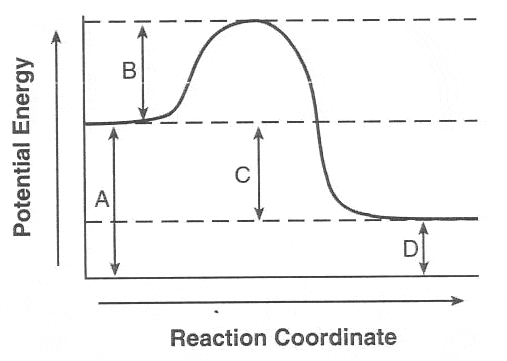
The minimum amount of energy needed for colliding particles to react is called

a)

Chemical Energy

b)

Kinetic Energy

c)

Activation Energy

d)

Potential Energy

109.

Substance that changes the rate of a chemical reaction without being consumed in the reaction

a)

bonding

b)

catalyst

c)

chemical reaction

d)

activation energy

110.
What method can NOT be used to collect gas?
a)
Using a gas syringe
b)
Collecting it in a measuring cylinder under water
c)
Measuring the change in mass
d)
Seeing how quickly the solution goes cloudy
111.

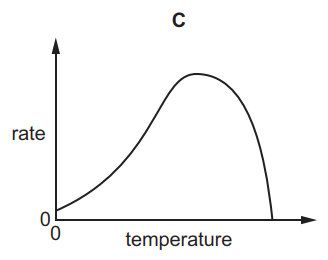
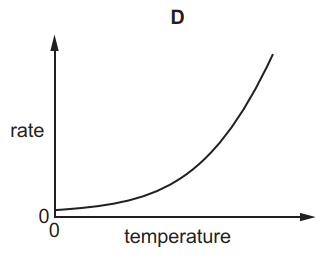
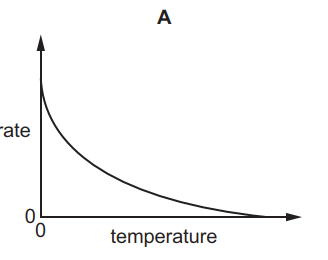
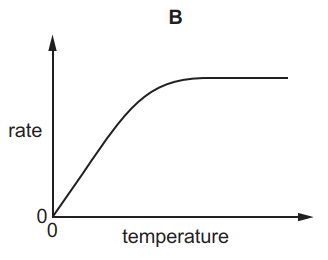
Which graph shows the effect of increasing temperature on the rate of reaction of calcium carbonate with dilute hydrochloric acid?
a)
b)
c)
d)
112.

P, Q, R and S are pieces of apparatus.

Which row describes the correct apparatus for the measurement made?

a)

A

b)

B

c)

C

d)

D

113.
What type of reaction is this?
a)
Endothermic
b)
Exothermic
114.
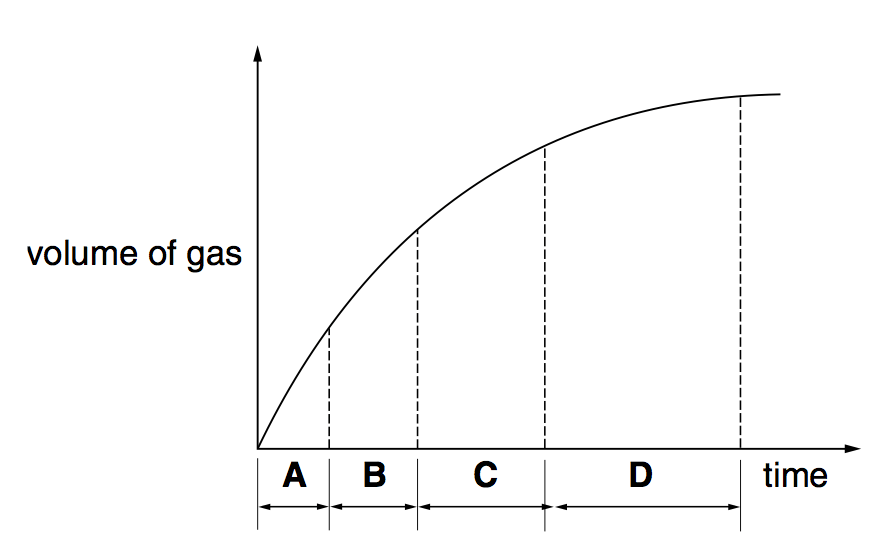
The graph shows how the total volume of a gas given off from a reaction changes with time. In which time interval is least gas given off? 
a)
A
b)
B
c)
C
d)
D
115.
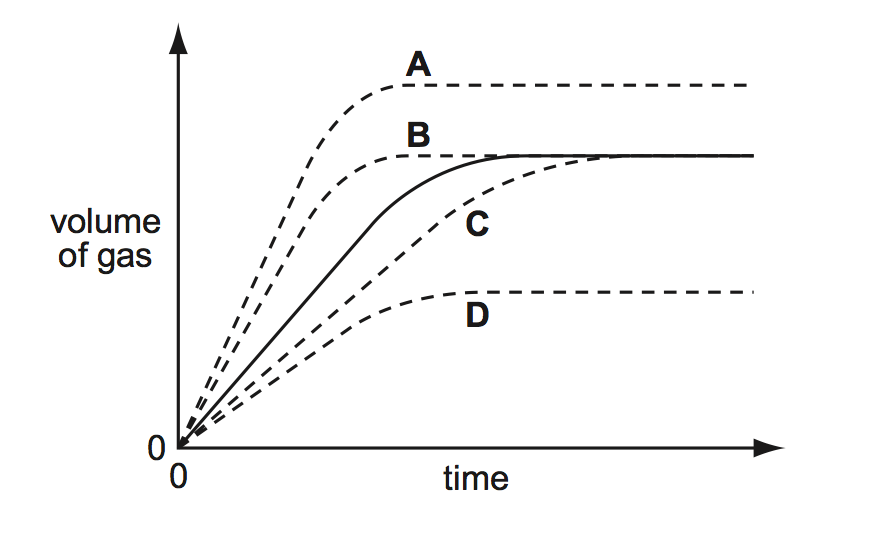
In an experiment, a 2 g lump of zinc and 2 g of powdered zinc are added separately to equal volumes of dilute sulphuric acid. The solid line on the graph shows the volume of gas given off when the 2 g lump is used. Which dotted line is obtained when the zinc is powdered? 
a)
A
b)
B
c)
C
d)
D
116.

Icing sugar has a greater ______ _____ than a solid cube of

sugar.

a)

Surface Area

b)

Catalyst

c)

Temperature

117.
A solution of hydrogen peroxide releases oxygen slowly at room temperature.
 hydrogen peroxide → water + oxygen
 The diagrams show the effect of adding blood to the solution. What could be the reason for the observed change? 
a)
Blood contains an enzyme. 
b)
Blood contains water. 
c)
The hydrogen peroxide becomes more concentrated. 
d)
The hydrogen peroxide is neutralised by blood. 
118.
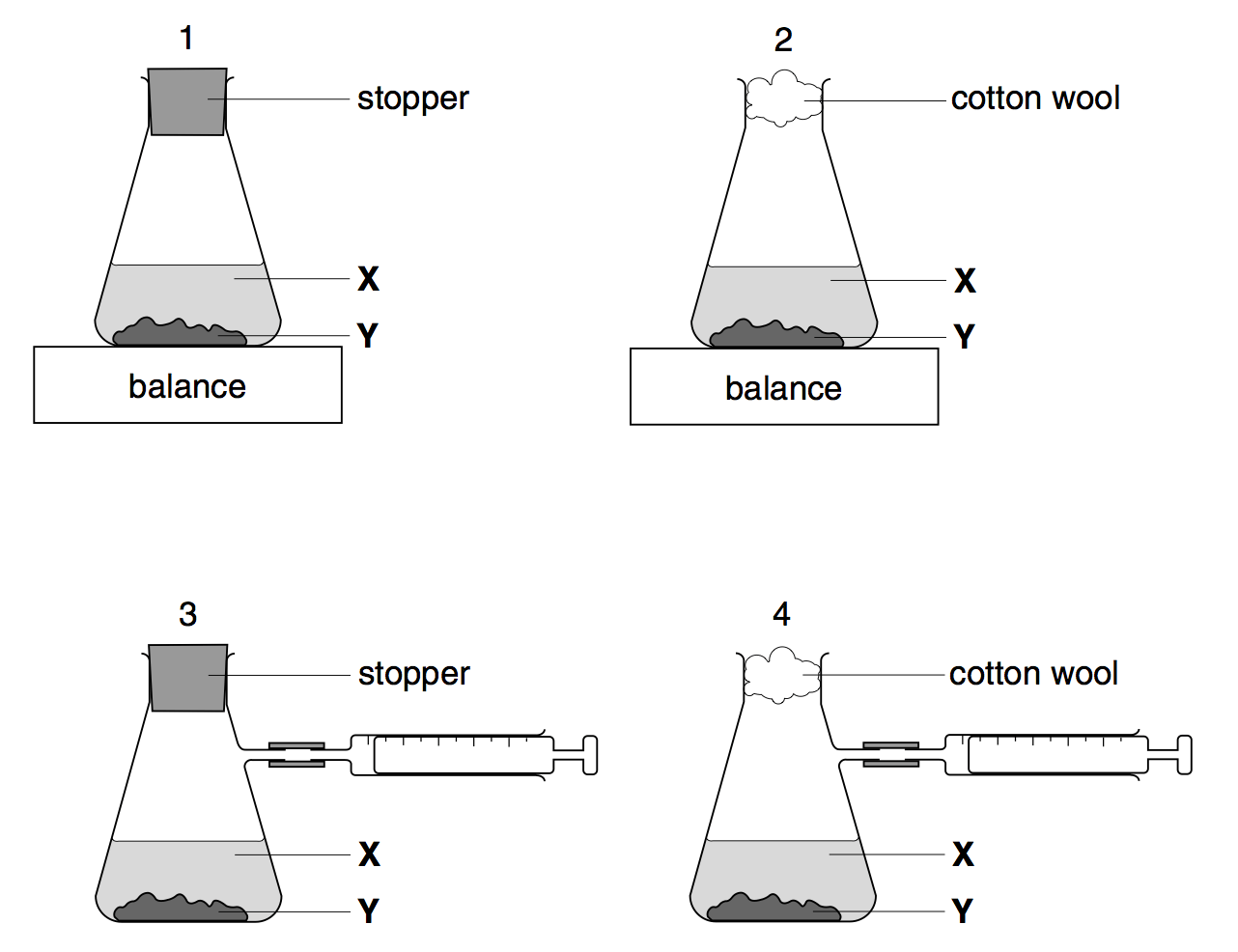
A liquid X reacts with solid Y to form a gas.
Which two diagrams show suitable methods for investigating the speed of the reaction? 
a)
1 and 3
b)
1 and 4
c)
2 and 3
d)
2 and 4
119.
In which experiment is the rate of reaction between hydrochloric acid and calcium carbonate slowest? 
a)
A
b)
B
c)
C
d)
D
120.
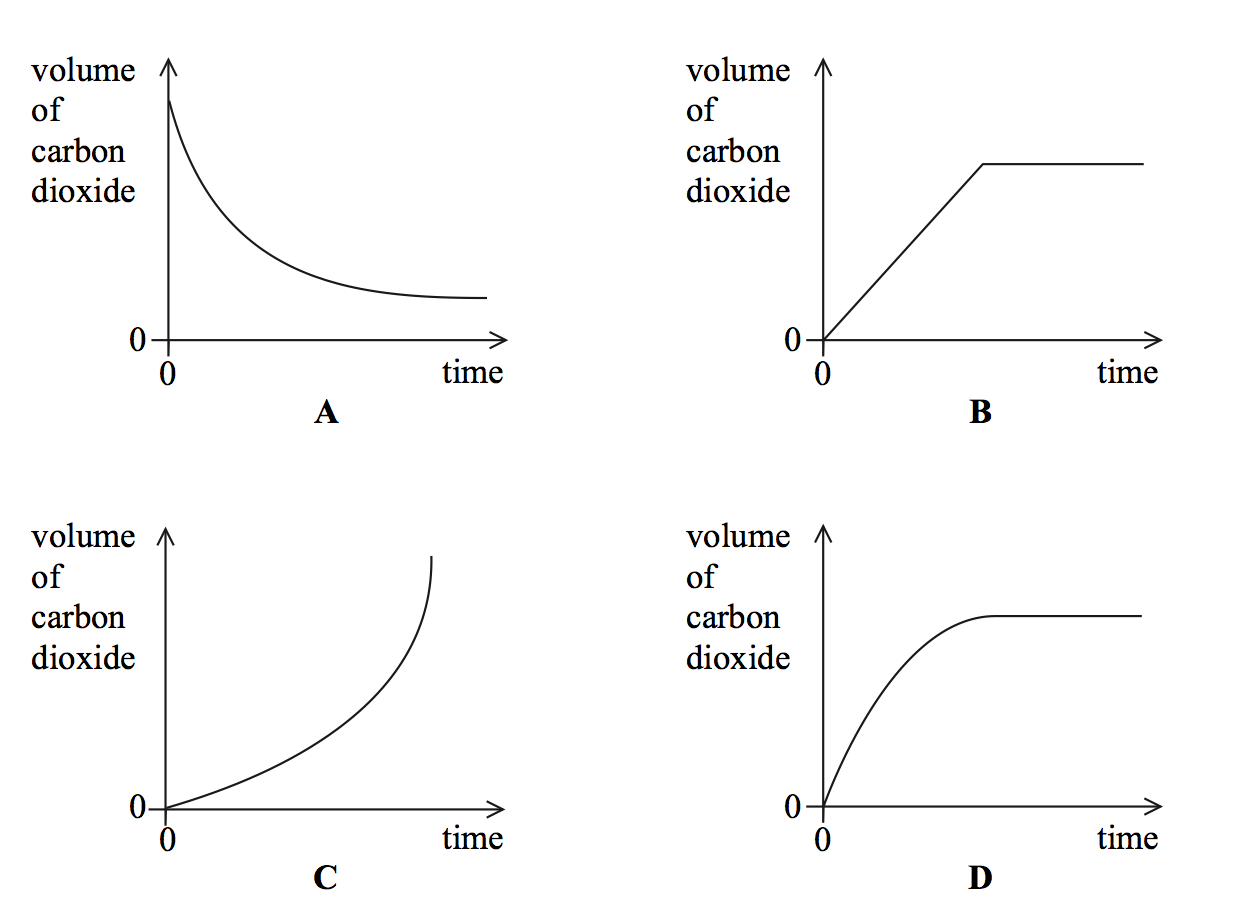
A student investigated the rate of reaction of calcium carbonate with dilute hydrochloric acid. Every minute, the student recorded the total volume of carbon dioxide produced, until some time after the reaction was complete.
Which graph shows the correct results? 
a)
A
b)
B
c)
C
d)
D
121.
Identify where the reaction has finished
a)
A
b)
B
c)
C
d)
D
122.
Order the letters from highest to lowest rate of reaction.
a)
A > B > C > D
b)
A > BC > D (B and C have the same rate)
c)
A > B > CD (C and D have the same rate)
d)
D > C > B > A
123.
Identify the part of the graph with the fastest rate of reaction.
a)
A
b)
B
c)
C
d)
D