Wayground logo

Free Printable Worksheets

Font size

S
M
L
XL
Worksheets

CNCPT_Basic_Electronics

Total questions: 65

Worksheet time: 1hrs 7mins

Name
Class
Date
1.

You are given a resistor whose stripes are colored from left to right as orange, orange, brown, silver. Find the resistance value.

a)

330 Ohms

b)

33KOhms

c)

3.3 Mega Ohms

2.

If the volatge is 20V and the current flowing through the circuit is 2 mA . What is the resistance?

a)

100 Ohms

b)

1 K Ohms

c)

10k Ohms

3.
Electronics is the science and technology concerned with regulating flow of:
a)
Heat
b)
Electricity
c)
Water
d)
Power
4.
Electricity is: 
a)
Flowing electrons
b)
Still electrons
c)
voltage x wattage
d)
amps x watts
5.
Choose the true statement below concerning DC currents:
a)
DC stands for Direct Computing and electrons flow in multiple pathways
b)
DC stands for direct current and electrons flow in multiple directions
c)
DC stands for direct current and the electrons do not flow
d)
DC stands for direct current and the electrons flow in only one direction
6.
The symbol for voltage is: 
a)
Vo
b)
V
c)
W
d)
Amp
7.
Current is measured in:
a)
Ohms
b)
Voltage
c)
Amperes
d)
Watts
8.
If you have three 1.5V batteries in series, what would be total voltage be? 
a)
3.4 V
b)
4.5 V
c)
1.5 V
d)
3 V
9.
A tool that measures voltage, current, resistance, and continuity is called a:
a)
voltmeter
b)
resistor
c)
multimeter
d)
screwdriver
10.

Current can only flow if there is a/an

a)

Open circuit

b)

Closed circuit

11.

What is the difference between a conductor and an insulator?

a)

An insulator allows electricity to flow through it easily and a conductor does not

b)

A conductor allows electricity to flow through it easily and an insulator does not.

c)

A conductor will not allows electricity to flow through it easily and an insulator does not.

d)

A conductor is magnetic and an insulator is not

12.

Identify the Symbol

a)

Breadboard

b)

LED

c)

Series circuit

d)

Diode

13.

Which leg of the LED is the positive side?

a)

The longer one

b)

The shorter one

c)

There is no positive side

d)

They are both positive, I'm positive of it.

14.

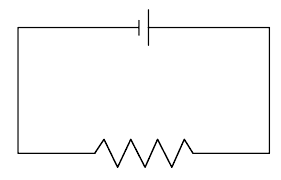
Identify the Circuit as

a)

Parallel circuit

b)

Combined circuit

c)

Series circuit

d)

Nothing connects them

15.

Which digit does the colour yellow represent on a resistor colour band?

a)

3

b)

2

c)

4

d)

7

16.

Which of these colours is NOT used in the resistor value color code?

a)

white

b)

black

c)

violet

d)

pink

17.
What is the number value for green in the color code chart?
a)
6
b)
4
c)
2
d)
5
18.
What does the 3rd band on a resistor represent?
a)
A number
b)
The Tolerance level
c)
The multiplier
d)
The electronic range
19.

A small component that lights up

when current flows through it.

a)

resistor

b)

capacitor

c)

circuit

d)

light-emitting diode

20.

To use an LED, you need to connect it in a circuit with a...

a)

resistor

b)

capacitor

c)

transistor

d)

inductor

21.

You use it to control the voltages and the currents in your circuit.

a)

capacitor

b)

LED

c)

switch

d)

resistor

22.
Name this electrical component
a)
Jump Wire
b)
Fixed Resistor
c)
Potentiometer
d)
Diode
23.
Name this electrical component
a)
Solderless Bread Board
b)
Fixed Resistor
c)
Potentiometer
d)
Diode
24.
a)
b)
c)
d)
25.

What is the color for the numerical value of 2 on a resistor?

a)

Brown

b)

Black

c)

Orange

d)

Red

26.
What are the color codes for a 470k ohm resistor?
a)
Yellow, Violet, Yellow
b)
Orange, Grey, Orange
c)
Yellow, Violet, Orange
d)
Orange, Grey, Yellow
27.
What is the tolerance for a Red, Brown, Brown, Silver resistor?
a)
1%
b)
20%
c)
5%
d)
10%
28.
What is the resistance for a Red, Brown, Black resistor?
a)
21 Ohms
b)
210 Ohms
c)
12 Ohms
d)
120 Ohms
29.
What is the tolerance for a Green, Red, Black, Gold resistor?
a)
1%
b)
20%
c)
5%
d)
10%
30.

Resistance is measured in:

a)

Volts

b)

Amps

c)

Ohms

d)

Watts

31.
What is the color code for a Orange, Black, Red resistor?
a)
3k Ohms
b)
200 Ohms
c)
300 Ohms
d)
2K Ohms
32.
What are the color codes for a 210 ohm resistor?
a)
brown, grey, red
b)
brown, black, yellow
c)
red, brown, brown
d)
brown, black, brown
33.

What is the resistance of this resistor?

a)

2200 ohm

b)

1000 ohm

c)

2.4K ohm

d)

100K ohm

34.

What is the name of this tool?

a)

Capacitor

b)

Multimeter

c)

Oscilloscope

d)

None of the above

35.

A bulb draws 0.5 amperes from a 120-volt supply. What is the resistance of the bulb?

a)

200 Ω

b)

240 Ω

c)

250 Ω

d)

300 Ω

36.

A bulb draws 0.4 amperes from a 90-volt supply. What is the resistance of the bulb?

a)

225 Ω

b)

250 Ω

c)

300 Ω

d)

360 Ω

37.

A current of 1.5 amperes is flowing through a resistor of 10 ohms. What is the voltage across the resistor?

a)

10 V

b)

15 V

c)

20 V

d)

25 V

38.

A current of 2.5 amperes is flowing through a resistor of 25 ohms. What is the voltage across the resistor?

a)

45 V

b)

50 V

c)

55 V

d)

60 V

39.
What size resistor would produce a 3 Amp current flow with a 12 Volt battery
a)
1 Ohm
b)
3 Ohms
c)
4 Ohms
d)
12 Ohms
40.
What word means how hard it is for electrons to flow through.
a)
Current
b)
Voltage
c)
Resistance
d)
Power
41.
This circuit has a 24 volt battery and the resistor is 8 ohms. How many amps are running through the circuit?
a)
3 Amps
b)
192 Amps
c)
2 Amps
d)
4 Amps
42.
If the Voltage stays the same and Resistance is increased, Current will 
a)
Increase
b)
Decrease
c)
Stay the same
d)
X
43.
If the Voltage is increased and the resistance stays the same, Current will
a)
Increase
b)
Decrease
c)
Stay the same
d)
X
44.

Voltage divided by Resistance

(V / R)

a)

Current

b)

Power

c)

Ohms

d)

Watts

45.
Current times Resistance equals
 (I X R)
a)
Power
b)
Voltage
c)
Amperage
d)
Ohm
46.
The mathematical relationship among Voltage, Current, and Resistance
a)
Faraday's Law
b)
Tesla's Law
c)
Edison's Law
d)
Ohm's Law
47.
Electricity that flows in a closed path is called a
a)
path
b)
current
c)
circuit
d)
light
48.
What is resistance measured in?
a)
Ω (Ohms)
b)
V (Volts)
c)
A (Amps)
d)
W (Watts)
49.
What is current measured in?
a)
Ω (Ohms)
b)
V (Volts)
c)
A (Amps)
d)
W (Watts)
50.
What is current measured in?
a)
Ω (Ohms)
b)
V (Volts)
c)
A (Amps)
d)
W (Watts)
51.
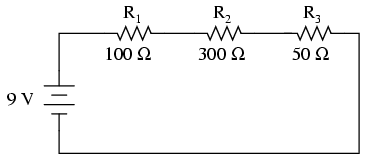
This is an example of a _______ circuit
a)
open
b)
series
c)
parallel
d)
square
52.
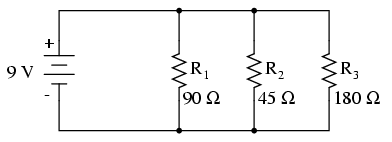
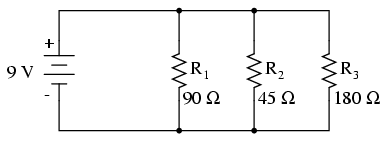
This is an example of a ______ circuit
a)
Series
b)
Parallel
c)
Open
d)
Dihexihedral
53.
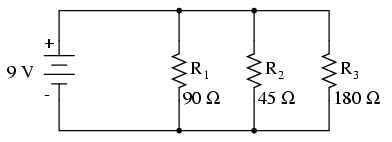
The total resistance in this circuit is 
a)
100 ohms
b)
450 ohms
c)
400 ohms
d)
30 ohms
54.
The current going through the 45 ohm resistor is 
a)
0.05 amps
b)
0.2 amps
c)
0.1 amps
d)
5 amps
55.
In a parallel circuit which of the following is the same value throughout the circuit?
a)
Voltage
b)
Current
c)
Resistance
d)
Charge
56.
As the resistance of a circuit increases, the current will...
a)
increase
b)
decrease
c)
stay the same
57.
The total resistance of this circuit is 
a)
25.7 ohms
b)
315 ohms
c)
324 ohms
d)
90 ohms
58.
The total current going through the battery of this circuit is
a)
0.35 amps
b)
0.0286 amps
c)
0 amps
d)
9 amps
59.
A series circuit has how many pathways for the electrons to flow?
a)
Two
b)
One
c)
Many
d)
Zero
60.
What is one problem with using a series circuit? 
a)
It has a lot of series. 
b)
If one light goes down, they all go down! 
c)
It doesn't work properly.
d)
There are no problems. 
61.
What is a benefit of using a parallel circuit?  
a)
It gets confusing.
b)
There are no problems.
c)
If one light goes out, it does not affect the others. 
d)
If one light goes out, they all go out. 
62.

Which ammeter measures the total current of the circuit?

a)

A1

b)

A2

c)

A3

d)

none

63.

If both resistors are 5Ω, are the values for the ammeter and voltmeter correct?

a)

yes

b)

no

64.

Ammeter devices should always be connected in...

a)

series

b)

parallel

c)

doesn't matter

65.

Voltmeter devices should always be connected in...

a)

series

b)

parallel

c)

doesn't matter

d)

none