
Font size
 Worksheets
HCI QUIZ
Total questions: 60
Worksheet time: 50mins
____ ____ ___ is a cross-disciplinary area (e.g., engineering, psychology, ergonomics, design) that deals with the theory, design, implementation, and evaluation of the ways that humans use and interact with computing devices.
(a)
This principle simply states that the interaction and interface should cater to the needs and capabilities of the target user of the system in design.
(a)
This term task refers to the job to be accomplished by the user through the use of the interactive system
(a)
Humans are certainly more efficient in carrying out tasks that require less memory burden, long or short-term
(a)
Consistency and familiarity also lead to higher acceptability and preference.
(a)
The term task refers to the job to beaccomplished by the user through the use of the interactive system.
Remind ___ and refresh ___ ___ ___.
(a)
"Prevent error ____ __ __."
While supporting a quick completion of the task is important, error-free operation is equally important. As such, the interaction and interface should be designed to avoid confusion and mental overload.
(a)
(a) refers to a trait that is reflective of various operations in our everyday life.
Is a set of rules or instructions that are given by an official organization telling you how to do something, especially something difficult
(a)
Visual Display Layout (General HCI design)
One of the main focuses in many design guidelines is the display (page) layout.
avoid cluttered displays
Minimal memory load on users.
optimize display density
Consistency of data-entry actions.
Place important items consistently
One of the main focuses in many design guidelines is the display (page) layout.
(a)
Fast and easy navigation means enabling the user to find the needed action (e.g., menu item) and information quickly.
(a)
Clever designs for taking user input (e.g., raw information or system commands) can improve the overall performance, in terms of both time and accuracy, for highly interactive systems.
(a)
Taking User Input
Consistency of data-entry actions.
Optimized display density
Align items on a page
Minimal memory load on users.
User with disability should be:
Functionable
understandable
Manual
robust
understandable
operable
Interacted
Minimalist
Operable
Minimum System
robust
Manual
perceivable
understandable
operable
robust
The (a) has led the web accessibility initiative and published the web content accessibility guideline. It explains how to make web content more accessible to people with disabilities. Web content generally refers to information in a web page or web application, including text, images, forms, sounds, and such.
Recently, with the spread of smartphones, the usability and user experience of mobile devices and applications has become even more important.
Fast status information (especially concerning network connection and services).
Create different sizes of your app icon for different devices
Efficient use of screen space (with condensed Information)
Verdana (bold, 8 point) is used only for title bars of tear-off/floating palettes.
Android design guidelines promote the use of list views and detailed views (multiple panels) to efficiently use the screen size of _____ _____.
(a)
Font for Windows XP (Vendor)
Franklin Gothic is used only for text over 14-point size.
Tahoma is used as the system’s default font.
Verdana (bold, 8 point) is used only for title bars of tear-off/floating palettes.
Trebuchet MS (bold, 10 point) is used only for the title bars of Windows
Any effort to design an effective interface for human-computer interaction (HCI) requires two basic elements: an understanding of:
(a) Computer factors (software/hardware) and
(b) human behavior.
Human Information Processing
Human Body Processing
As the main underlying theory for HCI, human factors can largely be divided into 2:
cognitive science
neurology
Physics
ergonomics
aerodynamic
Task/interaction modelling:
Understand and predict how humans might react mentally to various information-presentation and input-solicitation methods as a basis for interface selection.
True
False
Task/interaction modeling: Formulate the steps for how humans might interact to solve and carry out a given task/problem and derive the interaction model.
True
False
Prediction, assessment, and evaluation of interactive behavior:
Understand and predict how humans might react mentally to various information-presentation and input-solicitation methods as a basis for interface selection.
True
False
Sensation, which senses external information
(a)
(a) which interprets and extracts basic meanings of the external information.
(a) which stores momentary and short-term information or long-term knowledge
(a) which formulates and revises a “plan,” then decides what to do based on the various knowledge in the memory, and finally acts it out by commanding the motor system (for example. to click the mouse left button).
to some degree, predict how humans will react and perform in response to a particular human interface design.
We can consider two aspects of human performance:
one that is _______ and the other ______.
cognitive
memory
ergonomic
decision maker
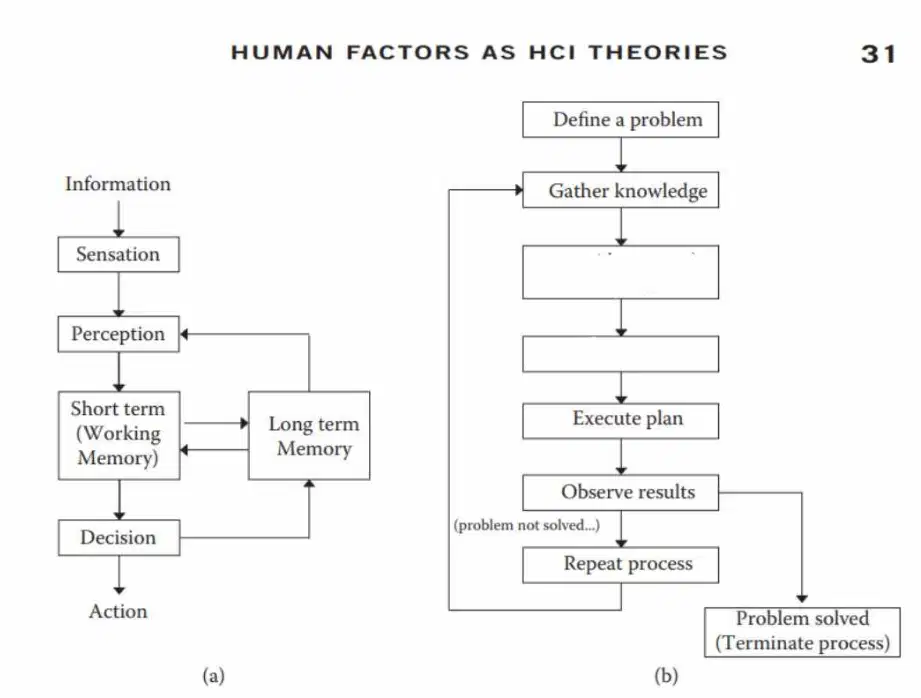
image shows a flowchart of the "decision maker/executor."
What are the missing procedures on the flowchart?
Consider possible actions --> create plan
create plan --> consider possible actions

image shows a flowchart of the overall human problem-solving model and process
What is the missing on the flowchart?
Short and long term memory
Working and short memory
long and short memory
What is GOMS
(a)
The original GOMS model was developed mainly for the desktop computing environment, with performance figures for mouse clicks, keyboard input, hand movement, and mental operators.
True
False
(a) modality is by far the most important information medium. Over 40% of the human brain is said to be involved with the processing of visual information.
Field of view (FOV):
This is the angle subtended by the visible area by the human user in the horizontal or vertical direction.
True
False
Viewing distance: This is the perpendicular distance to the surface of the display.
True
False
Display field of view: This is the angle subtended by the display area from a particular viewing distance
True
False
Pixel: A display system is typically composed of an array of small rectangular areas called pixels.
True
False
Display resolution: This is the number of inches in the horizontal and vertical directions for a fixed area.
True
False
Visual acuity: In effect, this is the resolution perceivable by the human eye from a fixed distance.
True
False
The human eye contains two types of cells that react to light intensities in different ways.
The cones, which are responsible for color and detail recognition, the rods are distributed mainly in the periphery of the retina and are responsible for motion detection and less detailed peripheral vision.
(a)
The amount of light energy emitted by the object.
color
brightness
contrast
aural
Human response to different wavelengths of light, namely those corresponding to red, green, blue, and their mixtures
color
brightness
contrast
aural
Relative difference in brightness or color between two visual objects.
color
brightness
contrast
aural
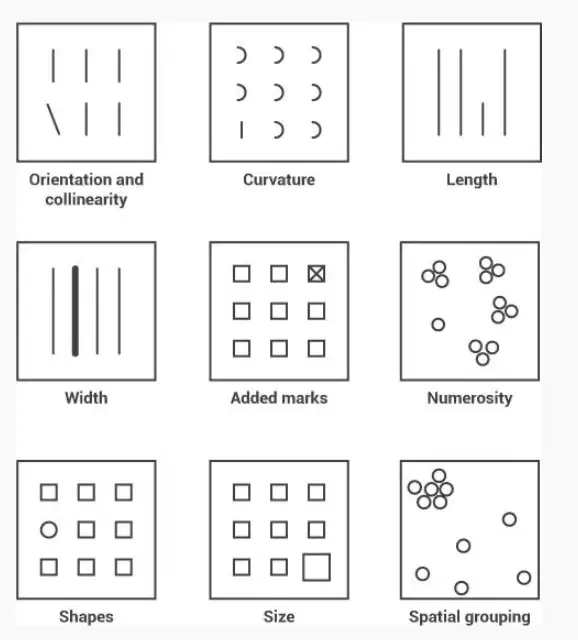
Pre-attentive features are composite, primitive, and intermediate visual elements that are automatically recognized before entering our consciousness, typically within 10 ms after entering the sensory system
True
False
Next to the visual, the A (a) modality (sound) is perhaps the most prevalent mode for information feedback. The actual form of sound feedback can be roughly divided into three types:
(a) simple beep-like sounds, (b) earcons, and (c) relatively longer “as is”
sound feedback that is replayed from recordings or synthesis.
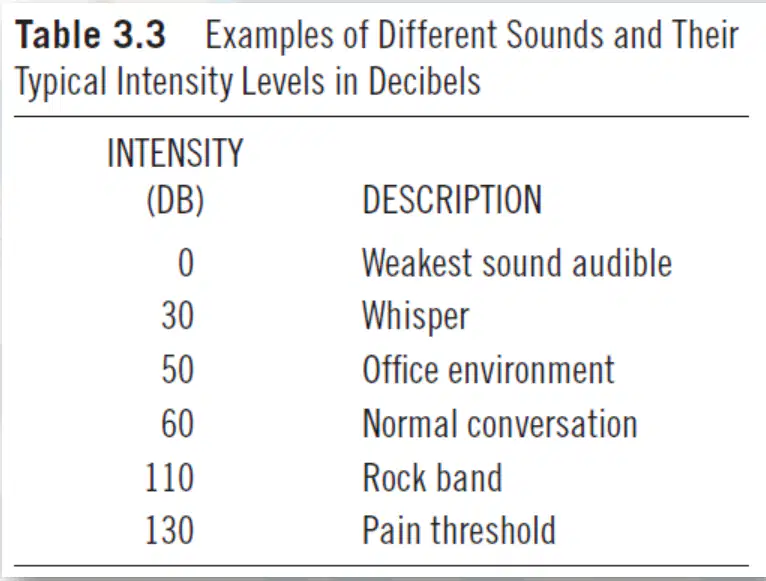
Intensity (amplitude) refers to the amount of sound energy and is synonymous with the more familiar term, volume.
True
False
(a) refers to the time differences among sound waves that emanate from the same source.
sound is effectively "omnidirectional". For this reason, sound is most often used to attract and direct a user’s attention. However, as already mentioned, it can also be a nuisance as a task interrupter (e.g., a momentary loss of context) by the startle effect.
True
False
Aural Modality as Input Method
So far, the aural modality has been explained only in the context of passive feedback.
As for using it actively as a means for input to interactive systems, two major methods are:
keyword recognition
natural language understanding.
the term H____ refers to the modality for sensing force and kinesthetic feedback through our joints and muscles, and the term T___ for sensing different types of touch (e.g., texture, light pressure/contact, pain, vibration, and even temperature) through our skin.
(a)
Human Body Ergonomics (Motor Capabilities)
(a) is a discipline focused on making products and interfaces comfortable and efficient.
Tactile resolution: The skin’s sensitivity to physical objects is different over the human body.
True
False
Vibration frequency:
Rapid movement such as vibration is mostly sensed by the Pacinian corpuscle,
which is known to have a signal-response range of 100–300 Hz.
True
False
Pressure threshold:
The lightest amount of pressure humans can sense is said to be about 1000 N/m2. For a fingertip,
this amounts to about 0.02 N for the fingertip area.
True
False
Multimodal Interaction (3answers)
complementary
redundant
alternative
Symmetrical
ergonomics
____ is a model of human movement that predicts the time required to rapidly move to a target area as a function of the distance to and the size of the target.
Fitts law
Fit's law
Fitts’s law
Motor Control
Perhaps the most prevalent form of input is made by the movements of our arms, hands,
and fingers for keyboard and mouse input.
True
False
What is Human-Computer Interaction (HCI)?
How can HCI contribute to the Aviation and IT industries?

