
 Worksheets
EPF Modules 1-7 Review
Total questions: 45
Worksheet time: 23mins
Which of the following does Economics primarily study?
how scarcity can be eliminated
how firms manipulate prices
how government influences resource allocation decisions
the problem of scarce resources relative to human wants
If you decide to study an extra hour tonight, what would be the economic outcome?
The marginal cost of studying an extra hour exceeds its marginal benefit.
The marginal benefit of studying an extra hour exceeds its marginal cost.
Studying harder will always improve your test scores.
You will most likely get a lower than expected grade on your last exam.

What is best illustrated by the negative slope of the production possibilities curve?
Some resources are always unemployed.
Opportunity costs are constant.
When resources are fully employed, an economy can produce more of one thing only by producing less of something else.
Businesses can sell more goods when their prices are low.
The factors of production include land, labor, capital and...
entrepreneurship
supply and demand
externalities
deficits
A basic requirement for survival-i.e, food, clothing, shelter
Durable Good
Consumer Good
Need
Want
Product that lasts 3 years when used regularly
Capital Good
Durable Good
FOMO
Insurable Good
Economic system that has some combination of traditional, command, and market economies.
Capitalism
Traditional Economy
Mixed Economy
Market Economy
______________ advantage refers to the ability of an individual or group to do something at a lower opportunity cost than another individual or group
Absolute
Competitive
Comparative
Product
Opportunity Cost
A country that has an absolute advantage in producing everything cannot benefit from trading with any other country.
True
False

What is Gross Domestic Product (GDP)?
the primary quantitative measure of economic activity for a nation
dollar value of all final G/S produced in a country in a 12 month period
the sum of consumption by households, investment by businesses, government spending, and net exports
all of these answers are correct
none of these answers are correct

What are the phases of the business cycle, in order as labeled in this image?
A=peak, B=contraction, C=trough, D=expansion
A=peak, B=trough, C=contraction, D=expansion
A=contraction, B=expansion, C=trough, D=peak
A=trough, B=expansion, C=peak, D=contraction

Which of the following actions by the FRS is most likely to increase the money supply?
selling government bonds in open market operations
decreasing the discount rate
increasing interest on reserves
increasing reserve requirements
Fiscal Policy is controlled by...
The Government
The Federal Reserve System
The states
The Department of Commerce
The two "tools" of Fiscal Policy are:
the power to tax
the power to spend
the power to borrow money
the power to print money

What makes up the largest area of government spending?
Food Stamps
Medicare
Social Security
Interest payments
Which of the following statements is true about externalities?
When externalities exist, resources are allocated efficiently
When positive externalities exist, efficiency is improved by taxing the product
From society's point of view, the output of goods for which a positive externality exists is too low
The price system overproduces goods with positive externalities

A tin-mining company is found guilty of polluting a river. Which one of the following government measures would an economist describe as an appropriate market-based solution?
Imposition of regulations and direct control on the company
A reduction of private property rights over the river
Increase tax on the tin produced
Nationalization of the tin-mining company

Apartment dwellers who buy fire alarms or fire extinguishers generate a
negative externality.
positive externality.
_____ are situations when there's an external costs or external benefits that accrue to other people or society as a whole.
Externalities
Internalities
Progressives
Which statement describes the law of demand?
As prices rise, quantity demanded decreases
As prices rise, demand decreases.
As prices fall, quantity demanded decreases.
As prices fall, demand decreases.
What causes a shift in the demand curve?
A decrease in price
An increase in price
A change in an area other than price
A change in price and availability
The market equilibrium price is the price at which
surpluses depress the number of goods supplied
shortages and surpluses will have no effect on the market
the government will not intervene in the market
the quantity demanded is the same as the quantity supplied
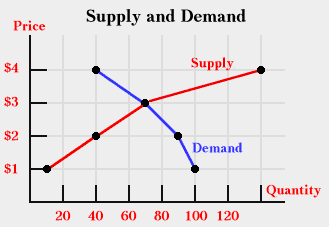
What is the Equilibrium Price?
1
2
3
4

When there is a shortage the price will usually?
rise
fall
remain the same
equilibrium
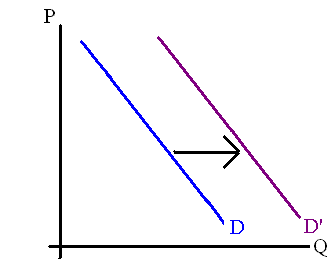
The diagram represents a
increase in demand
decrease in demand
change in quantity demand
none of the above

The diagram represents a(n)
increase in supply
decrease in supply
change in quantity supplied
none of the above
physical things you can buy and sell
goods
services
imports
exports
price
how much you pay for a good or service
services
actions or things people do and get paid for
imports
good and services that are purchased and brought into the country
exports
goods and services we sell to another country
economy
system for figuring out how to get people what they need
Goods and services brought in from other countries
supply
exports
imports
tariff
A tax on imports
tariff
import tax
supply
embargo
A limit to the number of imports that may enter a country
tariff
embargo
demand
quota
Government payments to exporters. This payment helps reduce an exporter’s cost of production.
Subsidies
Quotas
Tariffs
Standards
The characteristic of a society in which people rely on others for most of the goods and services they want.
Economic Interdependence
Economic Self-Sufficiency
The process by which people and economies around the world are becoming increasingly interconnected; the integration of national economies into the global economy.
Trade Barrier
Globalization
Macroeconomics
Microeconomics
A North American agreement formed to promote trade between Canada, the United States, and Mexico. Just renamed recently.
World Trade Organization
United Nations
World Bank
NAFTA-USMCA
An international organization based in Geneva that monitors and enforces rules governing global trade.
World Trade Organization
United Nations
World Bank
NAFTA-USMCA
The policy of erecting trade barriers to shield domestic markets from foreign competition.
Free Trade
Protectionism
Trade Barriers


