
 Worksheets
L2 ICT U1 Email Protocols Quiz
Total questions: 12
Worksheet time: 6mins
What does SMTP stand for in the context of sending emails?
Simple Mail Transfer Protocol
Secure Mail Transfer Protocol
Simple Message Transfer Protocol
Server Mail Transfer Protocol
What is the role of SMTP in the email system?
It encrypts email content for secure transmission.
It allows an email client to download an email from an email server.
It controls the passing of an email from the user's computer to the outgoing email server and between servers.
It filters spam emails from reaching the inbox.
What does POP3 stand for?
Post Office Protocol 3
Post Office Page 3
Protocol for Office Post 3
Post Operation Protocol 3
What is the main function of POP3 in receiving emails?
It encrypts incoming emails for security.
It allows an email client to download an email from an email server.
It controls the distribution of emails to various folders within the email client.
It manages the synchronization of emails across multiple devices.
What does IMAP stand for?
Internet Mail Access Protocol
Internal Message Access Protocol
Internet Message Access Protocol
Interactive Mail Application Protocol
Which of the following is a characteristic of POP3?
Emails are stored on a central server.
Fast download/upload speeds for large files.
Emails can be accessed from multiple devices.
Emails are accessible even when not connected to the internet, as they are stored locally.
What is a benefit of using IMAP over POP3?
Emails are stored locally on the user's computer.
Emails can be accessed without an internet connection.
Emails are stored on a central server and can be accessed on multiple devices.
Often slightly slower to download/upload files than POP3.
What is the store and forward model used for in internet messaging systems?
To store emails on the user's device for backup purposes.
To allow users to communicate with each other even when they are not both online at the same time.
To increase the speed of email delivery.
To encrypt emails for secure communication.
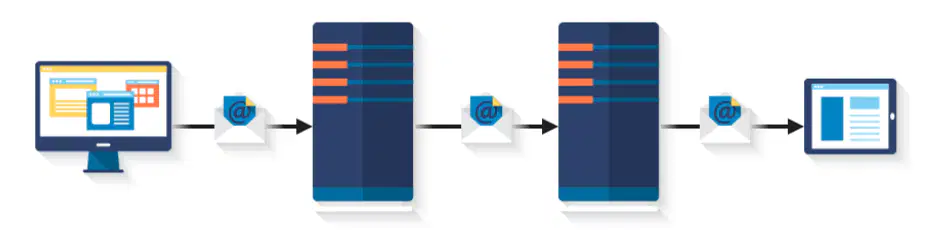
What is the Store & Forward Model in the context of email communication?
A real-time communication method that sends messages directly to the recipient without storing them.
A method of sending messages over a network where the message is sent to and stored on an intermediary device and only forwarded onto the recipient when they can be located.
A protocol that encrypts email messages for secure transmission.
A system that deletes email messages from the server once they are downloaded to the client.
Which of the following communication methods also use the store and forward model?
Video conferencing
Instant messaging and mobile phone SMS
Live streaming
Radio broadcasting
What happens to emails when using POP3?
They are stored on the server indefinitely.
They are synced across multiple devices.
They are downloaded locally and deleted from the server.
They are only accessible online.
How is IMAP different from POP3?
IMAP emails are not stored on a server.
IMAP allows accessing emails from any computer and syncs changes across all devices.
IMAP deletes emails from the server after downloading.
IMAP does not allow sending emails to people who are offline.

