
 Worksheets
Chapter 18 - Electrical Quantities - Part 1
Total questions: 30
Worksheet time: 30mins
This is the the work done by (a unit) charge passing through an electrical component; another name for the voltage between two points:
ohm
Direct Current (DC)
electromotive force (emf)
potential difference
Alternating Current (AC)

This is electric current that reverses its direction of flow in a regular pattern:
ohm
Direct Current (DC)
electromotive force (emf)
potential difference
Alternating Current (AC)
The tendency for materials to oppose the flow of electricity is known as __________ and is measured using ___________.
resistance, Ohms
current, AMPS
voltage, Volts
The rate of flow of electrons through a wire is known as __________ and is measured using __________.
resistance, Ohms
voltage, Volts
current, AMPS
30 C of charge flowed through a wire in 10 s.
What is the current in the wire?
(a)
Which of the following statements is/are true?
Charge is the fundamental quantity of electricity
There are two types of electric charge: positive and negative.
The SI unit for charge is Coulomb
All of the above

What is the voltage across each bulb?
(a)
Current is defined as...
work done per unit charge
rate of flow of charge
opposition to flow of charge
work done by energy source on external circuit

A wire has a certain electrical resistance.
The diameter and length of the wire may be changed.
Which pair of changes must cause the resistance of the wire to increase?
A
B
C
D

The diagram shows a piece of metal resistance wire. Which wire, made of the same metal, has a smaller resistance?
a wire of greater length with the same diameter
a wire of the same length with a smaller diameter
a wire of greater length with the same diameter
a wire of the same length with a larger diameter
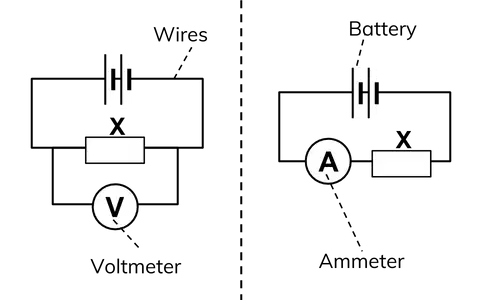
A student wishes to measure first the electromotive force (e.m.f.) of a battery, and then the potential difference (p.d.) across a resistor.
She has the resistor, the battery and some connecting wires. What else does she need?
a voltmeter only
an ammeter only
an ammeter and a voltmeter
a force meter (newton meter) and a voltmeter
A small heater has a rating of 15 V, 4 A. How much energy does it consume if it is turned on for two minutes?
7.5 J
120 J
450 J
7200 J
A small potential difference V is applied across a filament lamp. The current I in the lamp is measured. V is increased in stages and I is measured at each stage.
Which graph shows the results obtained?


A resistor of resistance R is connected to a battery of e.m.f. V.
There is a current I in the resistor.
Power P is dissipated by the resistor, and in time t the energy transferred is E. Which expression is correct?
P=VIR
E=IVt
E=PIt
P=V/R
Nguồn điện là
vật tích nhiều điện tích dương.
vật tích nhiều điện tích âm.
thiết bị tạo ra và duy trì dòng điện.
hệ thống 2 vật dẫn đặt gần nhau và cách điện với nhau.
Đâu là điểm khác nhau giữa pin và acquy?
Hoạt động dựa trên sự hình thành của hiệu điện thế điện hóa.
Dùng hết năng lượng thì nạp lại.
Gồm hai vật dẫn có bản chất khác nhau ngâm vào cùng dung dịch.
Đều là nguồn điện hóa học.
Dòng điện là gì?
Là dòng chất lỏng dịch chuyển có hướng.
Là dòng các nguyên tử dịch chuyển có hướng.
Là dòng các electron tự do dịch chuyển có hướng.
Là dòng các điện tích dịch chuyển có hướng.
Không có dòng điện chạy qua vật nào dưới đây?
Quạt điện đang quay liên tục.
Bóng đèn điện đang phát sáng.
Chiếc đồng hồ khi kim đồng hồ đang đứng yên.
Radio đang nói (phát ra âm thanh)
Các dụng cụ nào sau đây KHÔNG phải là nguồn điện?


Hiệu điện thế giữa hai điểm M,N là UMN=32V. Nhận xét nào sau đây đúng?
Điện thế tại điểm M là 32V
Điện thế tại điểm N là 0
Nếu điện thế tại M là 10V thì điện thế tại N là 42V
Nếu điện thế tại M là 0 thì điện thế tại N là -32V
Hiệu điện thế giữa hai điểm trong điện trường đặc trưng cho
khả năng sinh công của lực điện khi dịch điện tích giữa hai điểm.
khả năng tác dụng lực của điện trường.
khả năng phóng điện của điện trường.
khả năng cách điện của điện trường.
Hiệu điện thế giữa hai điểm M,N là UMN = 30V. Biết điện thế tại M là 40V. Điện thế tại N là
20 V
30 V
10 V
40 V
Chọn câu trả lời đúng
Để đo hiệu điện thế giữa hai đầu một dụng cụ điện, người ta dùng:
Vôn kế mắc song song với dụng cụ điện đó
Vôn kế mắc nối tiếp với dụng cụ điện đó
Ampe kế mắc song song với dụng cụ điện đó
Ampe kế mắc nối tiếp với dụng cụ điện đó
Phát biểu nào sau đây là sai về hiệu điện thế ?
Đặc trưng cho khả năng sinh công.
Có đơn vị là V.
Phụ thuộc vào mốc tính điện thế.
Là đại lượng vô hướng.

