
NEW
Font size
 Worksheets
SCIENCE5 3rd PT Review
Total questions: 25
Worksheet time: 8mins
Which of the following activities can be done using electromagnet?
lifting the refrigerator
keeping a room well lighted
Sweeping the floor
Sewing a dress
What happens when a part of an electromagnet is disconnected?
It loses its temporary magnet.
The electromagnet becomes a permanent magnet.
The electricity continues to flow through it.
There is an increase number of material attracted by the electromagnet.
Electromagnets are made of coils of wire with electricity passing through
them. How does an electromagnet work?
When an electric current flow through the wire wrapped around an iron core.
When an insulated wire is wrapped around an iron rod.
When no electricity is connected.
When the wire is wrapped around an iron core.
What should you do if you want to increase the strength of your
electromagnet?
choose a thinner nail
increase the number of batteries and more coil
lessen the number of turns of the wire
use a shorter nail
What would be the effect of adding more coil of wire in an electromagnet
setup?
The more coil the lesser magnet
The more coil the more battery.
The more coil the stronger energy of battery.
The more coil the stronger the electromagnet.
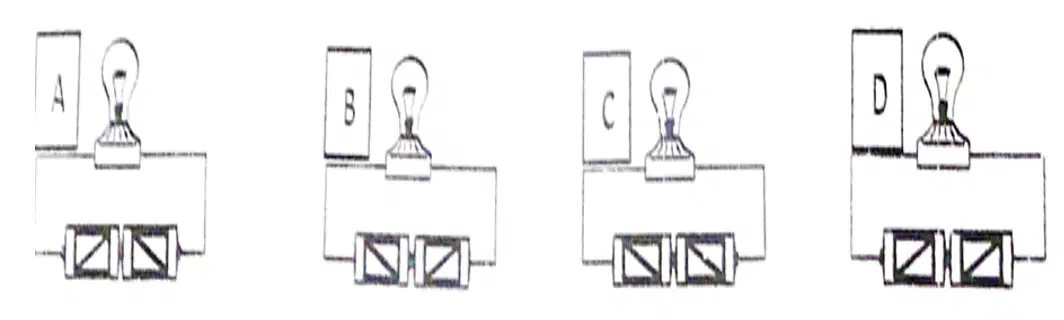
An electric circuit is a path for transmitting electric current. In which electric circuit will the bulb light?
A
B
C & D
A &B
Last year’s used Christmas light is not functioning because one of the bulbs is busted. Which of the following discusses the disadvantage shown in the used Christmas light?
In a parallel circuit, the electricity will flow in an alternative way.
In a parallel circuit, we can use the other bulbs even one is busted.
In a series circuit, the electricity will not flow to the wires when one of
the bulb is busted.
In a series circuit, same electricity will flow in the wires.
You have presented your project about series circuit on class and had a simple demonstration on it. You have removed one bulb and the other bulbs didn’t light. What might be the best explanation to this?
Bulbs are busted.
Energy can’t flow because the line is broken
No power supply.
Switch is broken
An electric circuit is a path for transmitting electric current. What is the effect of changing the number of bulbs in a circuit from 1 bulb to 3 bulb?
No changes take place.
The bulbs become brighter.
The bulbs become dimmer.
The bulbs stay at the same level of brightness.
An electric circuit is a path for transmitting electric current.
What is the negative effect of adding more batteries in a circuit?
Adding more batteries makes the light dimmer
Adding more batteries makes the wire longer
Adding more batteries will make the bulb busted
Adding more batteries will make the bulb light brighter.
An electric circuit is a path for transmitting electric current.
Which part of the electric circuit opens or closes the circuit?
electrical wire
load
power source
switch
A strong typhoon visited our country trees, small houses and electrical post
were destroyed, why should you avoid stepping on the broken wires?
Brown out may occur.
You may get electrocuted.
You may get hurt.
A and B are correct.
A strong typhoon visited our country trees, small houses and electrical post
were destroyed, why should you avoid stepping on the broken wires?
Brown out may occur.
You may get electrocuted.
You may get hurt.
A and B are correct.
A short circuit is simply a low resistance connection between the two conductors supplying electrical power to any circuit. Why is a short circuit dangerous?
Electricity does not cause fire.
It has a high voltage.
It has its own loop.
The sudden rush of current creates too much heat that can cause fire
A light-bulb produces light from electricity. Why does the bulb light?
Electricity flows in a complete circuit.
Electricity is changed into chemical energy.
Electricity is inside the bulb.
Electricity jumps from the dry cell to the bulb.
Electrical fires are caused by faulty electrical outlets or worn out sockets that
aren't properly grounded. Which of the following measures can prevent fire
caused by electricity?
Avoid walking under low dangling wires.
Have a regular inspection of electrical cords
Overload the outlet.
Touch a switch with dry hands.
A shadow is an area where direct light from a light source cannot reach due
to obstruction by an object When is a shadow formed?
when light is absorbed
when light is blocked
when light passed an object
when there is no light
What happens when light strikes a transparent surface, such as window glass
or plastic wrap?
The light can pass through or be transmitted
The light will be absorbed and heated
The light will bend
The light will bounce back
Reflection is the return of light or sound waves from a surface. When does
reflection happen?
When light bends as it moves through different materials
When light bounces off a shiny, smooth surface
When light curves in a circular path
The light will bounce back When light spreads out as it passes through a gap
Opaque material refers to common materials that are neither metallic
(strong reflections) nor transparent (refractive). What happens when opaque
materials absorb light?
The material bounces off the light.
The material scatters the light.
The material transmits light.
The light will bounce back When light spreads out as it passes through a gap
Translucent materials allow light to pass through but objects on the other
side cannot be clearly seen. What happens to light when it strikes
translucent materials?
Some lights are transmitted
The light is absorbed.
The light is blocked.
The light passes through.
When a pot of water is heated, water begins to rise. As the water rises, cold
water goes down. What is the transfer of heat from one place to another by
the movement of fluids?
conduction
convection
insulation
radiation
What is the difference between a conductor and an insulator?
A conductor allows heat to flow through it easily while an insulator does not.
A conductor is durable, while an insulator is not.
An insulator allows heat to flow through it easily while a conductor does not.
An insulator is durable, while a conductor is not.
An insulator is a material which does not easily allow heat and/or electricity to
pass through it. Why are cooking utensils made up of metal and the handles
are made of plastic?
Metal is a good conductor while plastic is a poor conductor of heat.
Metal is expensive while plastic is cheaper.
Metal is hard while plastic is soft
Metal is not brittle while plastic is brittle.
Electricity is the flow of electrical power or charge. Why is electrical wiring
usually covered with a layer of plastic?
to help electricity flow along the wire
to make it look more beautiful
to make it safe
to make it stronger

