
 Worksheets
Released Test Items 2023
Total questions: 15
Worksheet time: 8mins
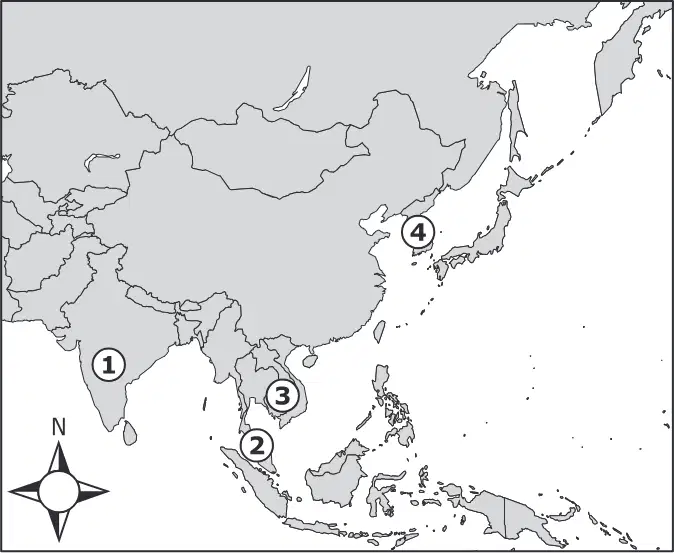
Look at the source and answer the question. Which number correctly locates the Korean Peninsula?
1
2
3
4
What was the role of the samurai in the rise of a military society in Japan?
merchants who provided foreign resources
judges who redistributed land to peasants
lawyers who served as government officials
warriors who followed a code of honor
In which two ways listed did Arab scholars contribute to the growth of knowledge in the Middle Ages?
by improving technology used for navigation
by creating the heliocentric theory of the universe
by developing the theory of gravity
by outlining the scientific method
by developing algebraic systems
Which factor contributed most to the development of Timbuktu as a center of learning?
the rise of West African trade routes
the reliance on griots
the expansion of ocean trade routes
the growth of African spiritual traditions
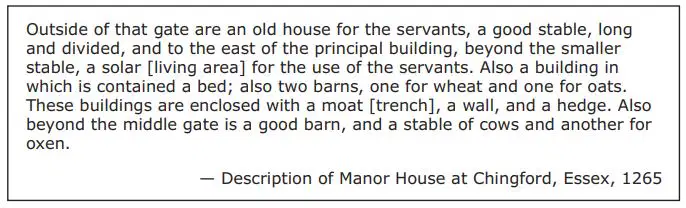
Read the source in the box and answer the question.
Which statement describes how manorialism influenced the development of the medieval economy?
Lords provided for the farmers and benefited from the profits of agriculture.
Military leaders needed local farmers to provide armies with agricultural goods.
Kings supported the growth of cities leading to a dependence on agricultural imports.
Church leaders competed with local lords to own land intended for agriculture.
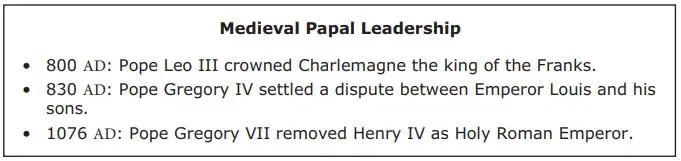
Study the information in the box about Medieval Papal Leadership and answer the question:
Based on this information, which statement explains the changing status of the Catholic Church in the Middle Ages?
Monarchs denied popes influence over state issues.
The noble class resisted the authority of the church.
Papal power depended on support from the Byzantine Empire.
The church increased power over political leaders.
How did the Black Death most affect societies in Asia and Europe?
significant decline in military conflicts
expansion of regional trade markets
advancement in agricultural technology
significant reduction of the population
Which two features of Florence contributed to its role in the Renaissance?
success as a center of trade
prominence in mapmaking
successful banking industry
influential class of clergy members
numerous printing presses
Which actions occurred in England during the reign of Henry VIII?
Pope refused to grant divorce
Anglican Church established
Protestants persecuted
Catholicism restored
Which phrase best describes the purpose of the Jesuits?
to spread the beliefs of the Catholic Church
to persecute those who did not believe in Christianity
to translate the Bible into several vernacular languages
to start a new type of Protestantism in overseas colonies

Read the source in the box and answer the question.
Which individual is associated with these achievements?
Nicolaus Copernicus
Sir Francis Bacon
Galileo Galilei
Sir Isaac Newton
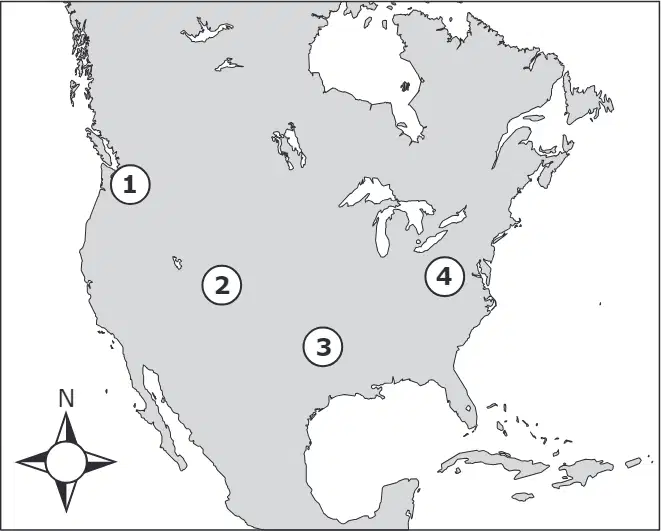
The map shows the locations of geographic features in North America. Which number on the map correctly identifies the location of the Rocky Mountains?
1
2
3
4

Based on the source in the box, which geographic feature most influenced the development of Aztec civilization?
deep ocean harbors
navigable lakes
coastal plains
narrow canyons
Which statement best compares the Maya and Aztec civilizations?
Both civilizations prospered by making slavery illegal.
The economies of both civilizations were dependent on farming.
Both civilizations used paper money as a form of currency.
The religions of both civilizations were monotheistic.
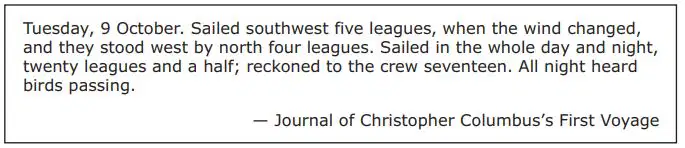
Read the source in the box and answer the question.
Which technology was necessary to make this voyage?
telescope
thermometer
compass
clock

