
 Worksheets
World War I to the Roaring Twenties SSUSH15 and SSUSH16
Total questions: 20
Worksheet time: 15mins
Select three factors that contributed to the United Stated entering WWI.
Strong economic ties with European countries involved in the war.
Fear of a German alliance with Mexico i.e. the Zimmerman Telegram
Desire to colonize Europe and Asia
Germany announcing unrestricted submarine warfare
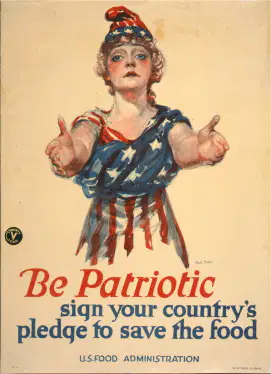
How could US citizens achieve the goal of voluntary rationing?
Rationing: allowing someone to have only a fixed amount of a certain commodity i.e. food, materials, etc.
By encouraging the hoarding of resources
By participating in "Meatless Mondays"
By purchasing "Liberty Bonds"
By planting "Victory Gardens"
The Great Migration was one of the largest movements of people in US history. Over 6 million Black Americans left the South for the North. What can we infer resulted in cities based on the change in population demographics?
Increase in racial tensions in urban centers of the Northeast.
Increase in overseas job competition
Decrease in farming communities in the Midwest
No change in population in any cities
Use the excerpt from a 1919 speech by Henry Cabot Lodge to answer the following question.
"I am as anxious as any human being can be to have the United States render every possible service to the civilization and the peace of mankind. But I am certain that we can do it best by not putting ourselves in leading strings, or subjecting our policies and our sovereignty to other nations. The independence of the United States is not only more precious to ourselves, but to the world, than any single possession."
— US Senator Henry Cabot Lodge, August 26, 1919
Based on this excerpt, Senator Lodge opposed what?
Having the US join the League of Nations
Promoting neo-liberalism
Supporting US hegemony
To prevent another World War, what did US President Woodrow Wilson promote the creation of?
European Union
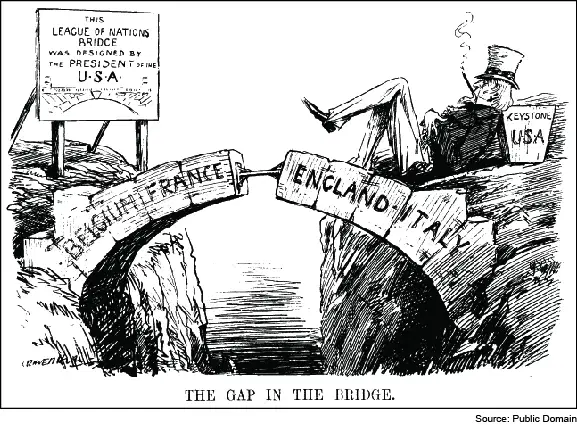
Based on the political cartoon, what can we infer that the artist is trying to say about the United States' lack of involvement in the League of Nations?
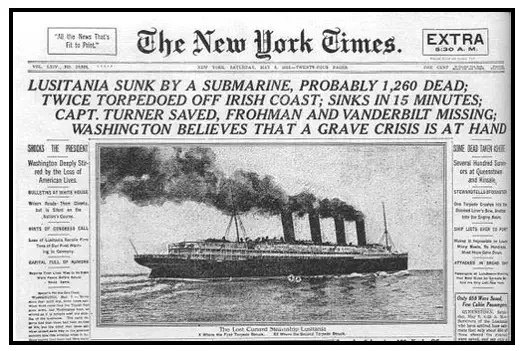
How did the sinking of the Lusitania affect American perception of Germany?
In January 1917 British officials decoded a telegram from the German Foreign Office to the German Minister to Mexico. President Woodrow Wilson saw the text of the Zimmerman telegram by the end of February.
"We intend to begin on the 1st of February unrestricted submarine warfare. We shall endeavor in spite of this to keep the United States of America neutral. In the event of this not succeeding, we make Mexico a proposal of alliance on the following basis: make war together, make peace together, generous financial support and an understanding on our part that Mexico is to reconquer the lost territory in Texas, New Mexico and Arizona."
What was the most significant effect of this telegram?
It pushed the United States to declare war on Germany and enter World War I.
The Socialist labor leader Eugene Debs was an outspoken critic of U.S. involvement in World War I. In a speech in Canton, Illinois in 1918, he called for resistance to the military draft. He was arrested and convicted of encouraging rebellion. This excerpt is from his testimony during his appeal to the Supreme Court:
"I admit being opposed to the present form of government. I admit being opposed to the present social system. . . .
I believe in the Constitution of the United States. Isn’t it strange that we Socialists stand almost alone today in defending the Constitution of the United States? The revolutionary fathers who had been oppressed under king rule understood that free speech and the right of free assemblage by the people were the fundamental principles of democratic government."
Which situation led to Debs’s arrest and conviction?
The US government enacting the Espionage Act of 1917 and the Sedition Act of 1918
Which constitutional issue was at the center of Schenck v. United States, a Supreme Court case that challenged the Espionage Act and Sedition Act?
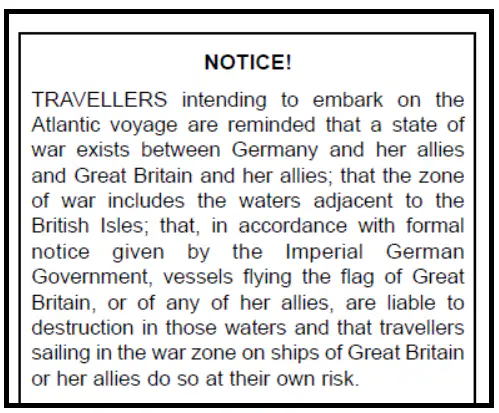
What country issued this advertisement/warning to travelers during WWI?
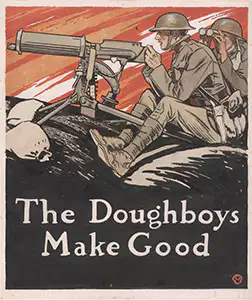
What change in military organization is shown in this propaganda poster?
The use of advanced weaponry prevented the need for the deployment of large numbers of US troops to the front.
The development of a modern army enabled the United States to help the Allies achieve victory in the trenches.
The success of US forces on the battlefield was reliant upon the use of foreign military technology.
The strength of the US military enabled the country to achieve its goal of expanding into Europe.

What event does this political cartoon highlight?
The Zimmerman Telegram
Which of the following is NOT a reason the United States entered World War I?
Unrestricted submarine warfare
The election of President Woodrow Wilson
US economic interests in Europe
The discovery of the Zimmerman Telegram
Read the following passage:
"In view of recent acts of the German authorities in violation of American rights on the high seas which [ended in the sinking of a] British steamship . . . on May 7, 1915, by which over 100 American citizens lost their lives, it is clearly wise and desirable that the government of the United States and the imperial German government should come to a clear and full understanding as to the grave situation which has resulted." The First Lusitania Note, Woodrow Wilson, 1915
What shift in US foreign policy is highlighted in this passage?
from imperialism to containment
from containment to isolationism
from isolationism to interventionism
from interventionism to imperialism
What was a key characteristic of the economic boom during the Roaring Twenties?
Rapid industrial decline
Significant increase in stock market investments
Decrease in consumer goods production
Stagnation in technological innovation
Which cultural movement, centered in Harlem, was known for its influence on African American literature, music, and art during the Roaring Twenties?
The Progressive Movement
The Enlightenment
The Harlem Renaissance
The Industrial Revolution
What amendment to the United States Constitution, passed during the Roaring Twenties, started the Prohibition era?
The 15th Amendment
The 19th Amendment
The 18th Amendment
The 21st Amendment
What amendment to the US Constitution gave women the right to vote?
What event ended the Roaring Twenties and led to the Great Depression?
The Labor Act of 1906

