
Font size
 Worksheets
Unit 3 Review
Total questions: 50
Worksheet time: 35mins
Which question led to the formation of the Federalist and Democratic-Republican parties?
How much authority should the national government have?
Should the United States establish a republican government?
Should the United States declare independence from Britain?
Is the collection of taxes by the national government legal?
What effect did the annexation of Texas have on slavery in the United States?
Texas served as a refuge for enslaved people traveling the Underground Railroad.
The addition of a slave state led to California entering the Union as a free state.
Texas chose to outlaw slavery to continue the policies of the Mexican government.
The forced migration of enslaved people into the United States was made legal.
How did the construction of the Transcontinental Railroad affect immigration to the United States?
Debt from its construction led Congress to increase limits on immigration.
Faster transit increased immigration from Mexico.
Railroad industry jobs increased immigration from China.
The ease of traveling led to increased immigration in the Northeast
What compromise was given to Alexander Hamilton in return for his offer to move the national capital to Washington, D.C.?
The country would stay out of European conflicts
The country's financial center would remain in New York City.
The president would be the head of the executive branch.
The federal government would assume the states' debts.
Which policies were associated with the Alien and Sedition Acts? Select two correct answers.
tighter restrictions on immigrants
imiting speech critical of the government
easier paths to citizenship
term limits for federal office
What effect did the Gold Rush have on California?
he increase in population strained California's agricultural resources.
The increase in wealth led to the elimination of poverty in California.
The population increase led to California being admitted as a state.
The need for labor increased support for slavery in California.
The cotton gin impacted agriculture by:
Leading to the end of slavery.
Increasing the demand for slave labor.
Decreasing cotton production.
Reducing the need for labor.
The 'Era of Good Feelings' under Monroe was characterized by:
A sense of national unity and pride.
Increased partisan conflicts.
The start of the Civil War.
The end of slavery.
John Adams’ Alien and Sedition Acts were significant because they:
Allowed unrestricted immigration.
Limited freedom of speech and press.
Ended conflicts with France.
Established the National Bank.
The California Gold Rush affected the U.S. by:
Weakening the U.S. economy.
Decreasing migration to the West.
Leading to economic growth and increased national population.
Reducing tensions between Native Americans and settlers.
The main cause of the Mexican-American War was:
The annexation of Texas by the U.S.
Disputes over the Oregon Territory.
British interference in American affairs.
The Monroe Doctrine.
What was a main reason for migration along the westward expansion trails?
Religious acceptance in the Eastern states.
The California Gold Rush.
Industrialization in the East.
The War of 1812.
Which statement best explains the impact of the Supreme Court's decision in Marbury v. Madison?
It established the Supreme Court's ability to declare a law unconstitutional.
It increased the powers of the President over the judicial system.
It led to the creation of new amendments to the Constitution.
It reduced the importance of the Constitution in American law.

The quote by Hamilton explains his economic policy of-
creating an agrarian bawsed economy
using tariffs to pay off war debts
supporting Britain during the French Revolution
staying away from the evils of political parties
Disagreements between __________ and _________ led to the formation of political parties
George Washington and Patrick Henry
Samuel Adams and George Mason
Benjamin Franklin and Thomas Paine
Alexander Hamilton and Thomas Jefferson
The Democratic Republicans, led by Thomas Jefferson, strongly believed that the-
British should be supported in the French Revolution
Constitution should be loosely interpreted
nation's future lay with an agricultural economy
government should be run by the educated and wealthy
A student claims “The Missouri Compromise had little effect on the balance of power between slave and free states.” Which evidence best refutes this claim?
It had no impact on Congressional representation.
It led to an immediate end to slavery in Missouri.
It abolished slavery in the northern states.
It temporarily maintained the balance by admitting Missouri as a slave state and Maine as a free state.
A student makes the claim “The Industrial Revolution had minimal impact on American society.” Which evidence best refutes this claim?
The Industrial Revolution had no impact on technology.
The Industrial Revolution led to significant urbanization and changes in labor and social classes.
The Industrial Revolution reduced the overall economic growth.
There were no significant inventions during the Industrial Revolution.
Immigration to the United States has been influenced by different push and pull factors. Which developments were pull factors?
Discovery of Gold in California
Famine in Ireland
Religious persecution
War in your homeland
Immigration to the United States has been influenced by different push and pull factors. Which developments were push factors?
Discovery of gold in California
Jobs created by the Industrial Revolution
Homestead Act becoming law
Famine in Ireland
What was the impact of the Monroe Doctrine on the relationship between the United States and European powers?
It immediately led to multiple conflicts between the U.S. and European nations.
The doctrine improved trade relations between the U.S. and Europe.
It established the U.S. as a significant diplomatic player, setting a boundary against European intervention in the Americas.
European countries largely ignored the Monroe Doctrine, continuing their colonization efforts in the Americas.
What was the primary motive for settlers traveling the Oregon Trail?
The promise of owning land
Destruction in the East caused by the Civil War
A chance to work on the transcontinental railroad
Fewer jobs in the East due to the Industrial Revolution
What was one of the warnings that Washington gave to the American people in his Farewell Address?
differences in beliefs based on location
division caused by party politics
geographical expansion of the country
the increasing influence of the federal government

Andrew Jackson's election victory in 1828 depended on support from
the rich and well-born.
Native Americans.
the common people.
states' rights supporters.

Jacksonian Democracy
an informal group of trusted advisers who sometimes met in the White House kitchen
The practice of giving government jobs to political backers
The period of expanding democracy that gave voting rights to all white males
The Court ruled that the national bank was constitutional

The Trail of Tears refers to
Jackson’s angry negotiations with the Five Civilized Tribes.
the movement of Seminole Indians from the West to Florida.
government workers who lost their jobs due to Jackson’s spoils system.
the removal of Cherokee Indians from Georgia to Indian Territory in Oklahoma.
The Trail of Tears refers to
Jackson’s angry negotiations with the Five Civilized Tribes.
the movement of Seminole Indians from the West to Florida.
government workers who lost their jobs due to Jackson’s spoils system.
the removal of Cherokee Indians from Georgia to Indian Territory in Oklahoma.
The Trail of Tears refers to
Jackson’s angry negotiations with the Five Civilized Tribes.
the movement of Seminole Indians from the West to Florida.
government workers who lost their jobs due to Jackson’s spoils system.
the removal of Cherokee Indians from Georgia to Indian Territory in Oklahoma.


How did tariffs affect imported goods?
Tariffs lowered the prices of imported goods.
Tariffs made imported goods illegal to buy.
Tariffs set weight restrictions for imported goods.
Tariffs raised the cost of imported goods.
In the late 19th century, how did the growth of industry affect American society?
The percentage of Americans living in urban areas increased.
Population centers shifted from the Northeast to the South.
Restrictions on immigration created a more homogeneous culture.
The United States experienced the disappearance of the traditional family farm.
In the late 19th century, inventions such as the mechanized reaper and the steel plow made farming more efficient. What impact did the introduction of farm machinery have on American farms in the 19th century?
More workers were needed to run the new machines.
Large farms increased their output and supplied food to eastern cities.
Wages for unskilled farm workers increased.
The high cost of the machines made farming unprofitable.
What was the main purpose of the Transcontinental Railroad?
To make China more powerful.
To help with transportation, communication, and to connect the continent.
To make Native Americans move off their land.
To give immigrants a job, to feel important, and needed in America.
A machine invented by John Deere that could plow through thick soil so people could now farm in the Midwest
Steel Plow
McCromick Reaper
Turbine
Phonograph


What piece of legislation distributed free land in the Great Plains and primarily attracted farmers?
The Homestead Act
The Interstate Commerce Act
The Dawes Act
The American Indian Citizenship Act
Assimilation is the process of adapting or adjusting to the culture of another group or nation.
True
False
Which trail was established to escape religious persecution?
the OregonTrail
the Mormon Trail
the Santa Fe Trail
the Trail of Tears

An artificial waterway constructed to allow the passage of boats or ships inland is called a ...
stream
river
irrigation
canal
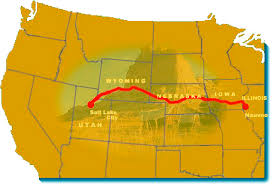

Which of the following trails was not a trail that pioneers could take west?
Oregon Trail
California Trail
Mormon Trail
Pacific Trail
What was George Washington's advice on Foreign Policy?
The Nation should remain neutral and avoid permanent alliances
The Nation should end slavery
The Nation should expand from East to West
The Nation should colonize Latin America

