
 Worksheets
Y13 REVISION
Total questions: 20
Worksheet time: 2hrs 40mins
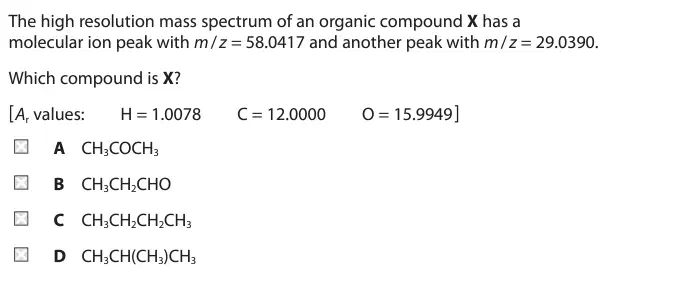
The high resolution mass spectrum of an organic compound X has a molecular ion peak with m/z=58.0417 and another peak with m/z= 29.0390.
Which compound is X?
A
B
C
D
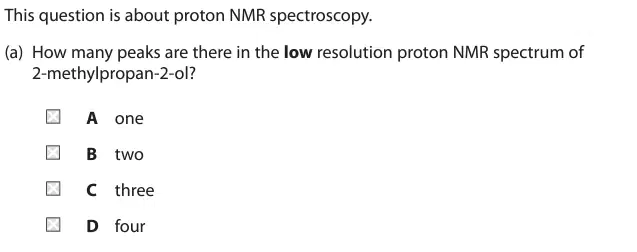
How many peaks are there in the low resolution proton NMR spectrum of 2-methylpropan-2-ol
A
B
C
D
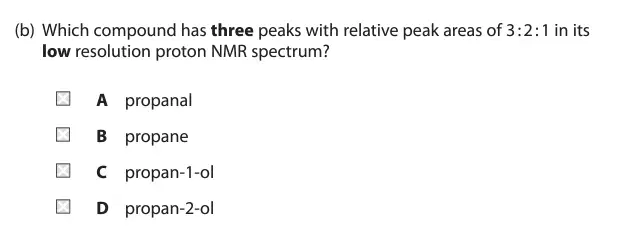
Which compound has three peaks with relative peak areas of 3:2:1 in its low resolution proton NMR spectrum
A
B
C
D
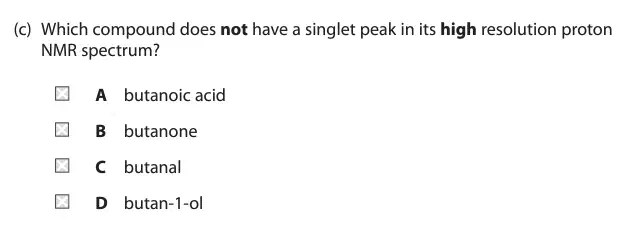
Which compound does not have a singlet peak in its high resolution proton NMR spectrum
A
B
C
D
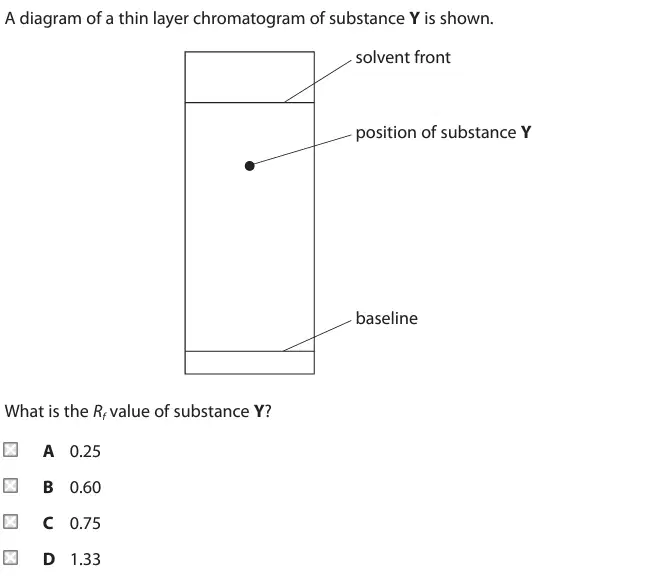
A diagram of a thin layer chromatography of substance Y is shown.
A
B
C
D
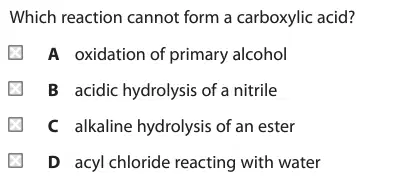
Which reaction cannot form a carboxylic acid?
A
B
C
D
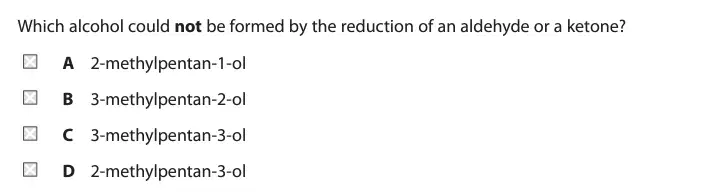
Which alcohol could not be formed by the reduction of an aldehyde or a ketone?
A
B
C
D
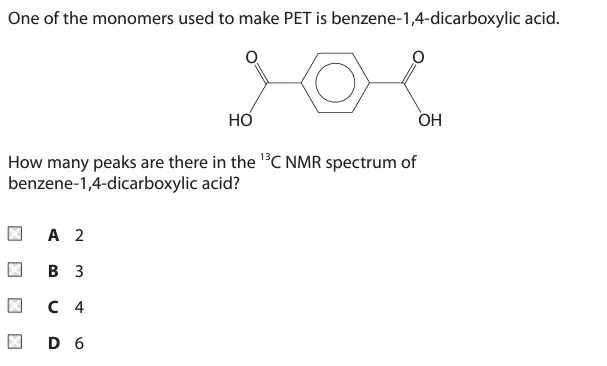
How many peaks are there in the 13C NMR spectrum of benzene-1,4-dicarboxylic acid?
A
B
C
D
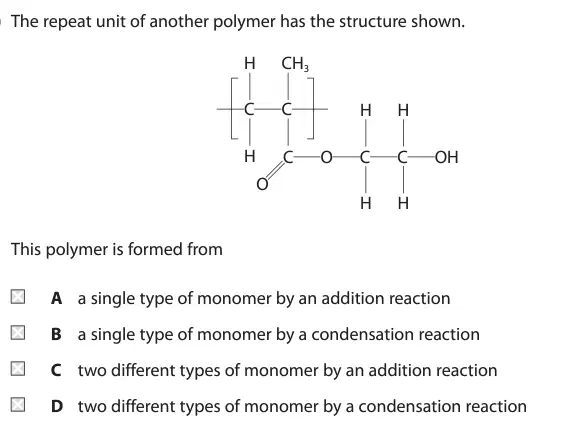
This polymer is formed from
A
B
C
D
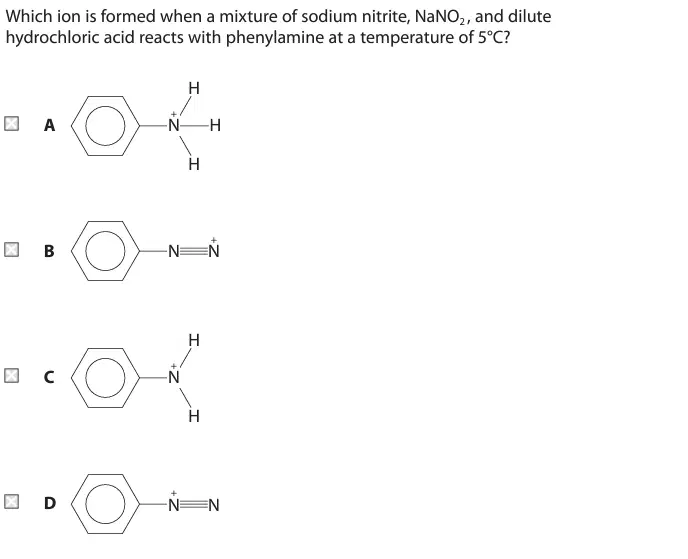
Refer to the image
A
B
C
D
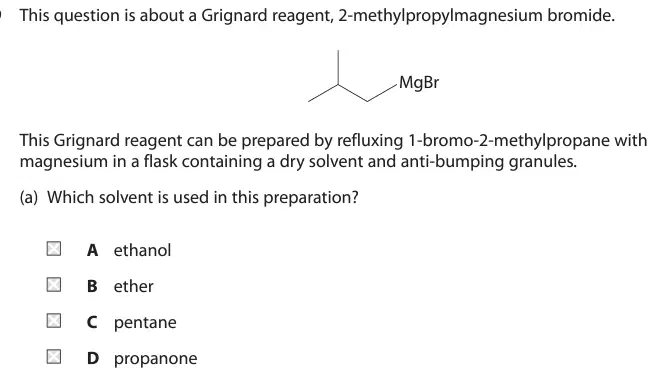
Which solvent is used in this preparation?
A
B
C
D
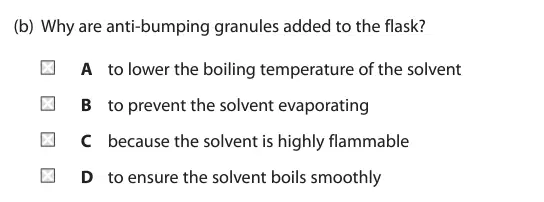
Why are anti-bumping granules added to the flask?
A
B
C
D
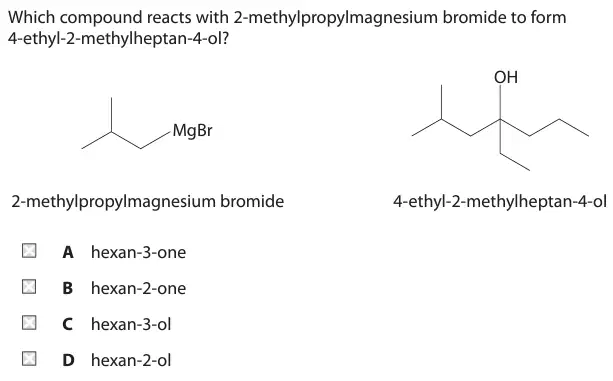
Refer to the image
A
B
C
D
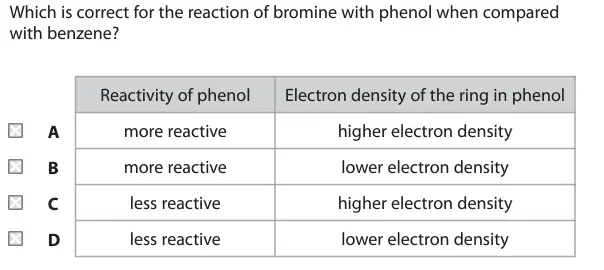
Which is correct for the reaction of bromine with phenol when compared with benzene?
A
B
C
D
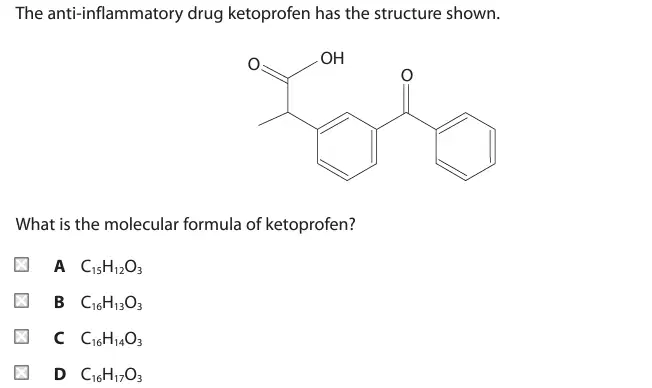
What is the molecular formula of ketoprofen?
A
B
C
D
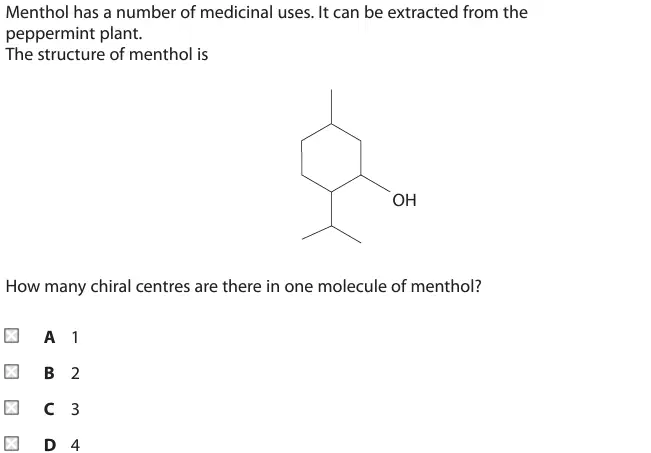
How many chiral centres are there in one molecule of methanol
A
B
C
D
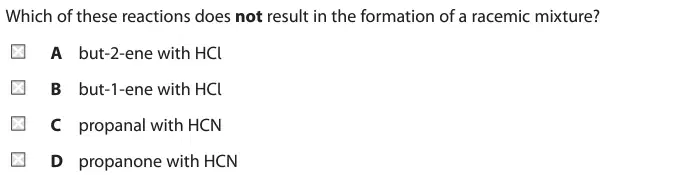
Which of these reactions does not result in the formation of a racemic mixture?
A
B
C
D
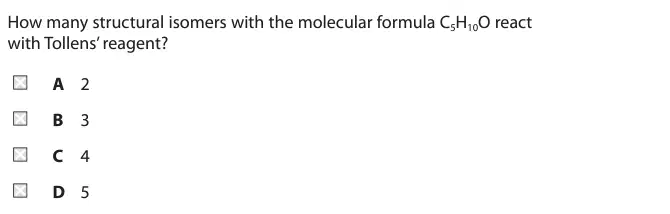
How many structural isomers with the molecular formula C5H10O react with Tollen's Reagent?
A
B
C
D
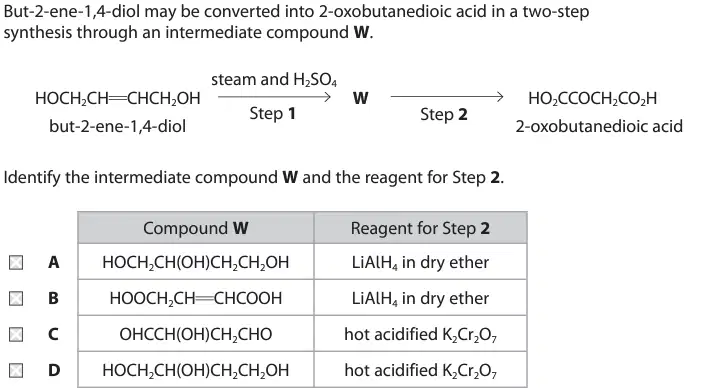
Identify the intermediate compound W and the reagent for step 2.
A
B
C
D
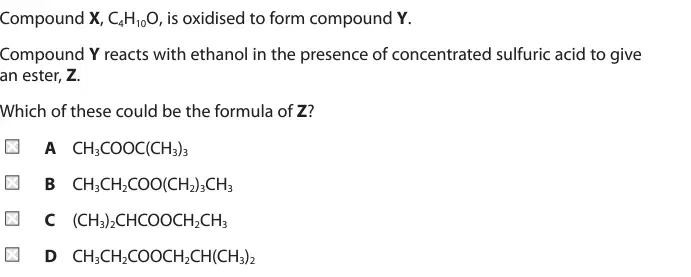
Which of these could be the formula of Z?
A
B
C
D

