
 Worksheets
Adaptations of Organisms
Total questions: 51
Worksheet time: 41mins
A feature that allows an organism to survive its environment is called what?
Evolution
Adaptation
Trait
Survivability factor
Click all the boxes that are adaptations.
Bear hibernating
Gills in fish
Water in a pond
The wings of a bird
The temperature of the earth
Which of the following examples are of behavioral adaptations?
Migration
Claws
Teeth
Eyes
Which of the following are examples of structural adaptations?
Hibernation
Migration
Eyes
Mating calls
What is the best definition of animal adaptation?
Changes to an animal's diet.
Characteristics that help animals survive.
Characteristics of an animal's habitat.
Skills learned in order to hunt.
True or false: All animals have adaptations that help them survive in their habitat.
True
False
Partially true: Not all animals have adaptations
Partially true: adaptations are not for surviving
Animals who travel to warmer habitats in the winter to escape the cold are using which behavioral adaptation?
Mimicry
Camouflage
Hibernation
Migration
When animals go into a deep sleep during the winter, they are using which behavioral adaptation?
Hibernation
Mimicry
Migration
Camouflage
Fill in the blank: A ______________ adaptation is the way an animal looks in order to help them survive.
simple
behavioral
physical
extreme
Some animals are able to copy other animals in order to look more dangerous to get away from predators. What is this called?
Hibernation
Camouflage
Mimicry
Migration
I am a polar bear who lives in the arctic. My fur is a beautiful white, just like the snow I live in. What adaptation is this adaptation called?
camouflage
mimicry
migration
hibernation

What physical adaptation helps some organisms breathe under water?
a. lungs
b. gills
c. fins
d. heart

The chart tells us about four animals. Which animal has needs and body parts for a place that is mostly water?
Camel
Rattlesnake
Beaver
Kangaroo Rat
Why do plants adapt to their environments?
in order to give the surrounding animals and people enough food to survive
in order to get the water and sunlight they need to survive in a harsh environment
in order to block sunlight from the floors of the ocean and the rainforest
in order to grow very tall and to become as bright and colorful as they can
What adaptation helps penguins and seals stay warm?
long eyelashes
long necks
a thick layer of fat
long fur
What is a habitat?
all of one kind of animal or plant in the same area
all the animals living in the ocean
living and nonliving things that interact in the same space
the space where a plant or animal lives


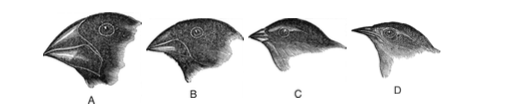
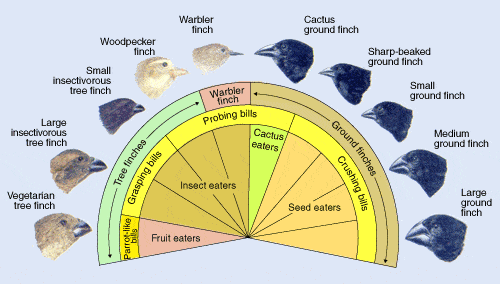
The four different types of beaks shown are most likely the result of
The tundra is a vast plain with frigid temperatures and plenty of snow. Which of the following adaptations does not help the polar bear survive in the tundra.
Layers of fat for insulation
webbed toes for swimming
white fur for camouflage
total herbivorous diet
Plants have different signals for attracting pollinators. It is not uncommonm for the same plant to have more than one signal. Which of the following would not be a way in which plants attract pollinators?
Presence of barbs
specific texture or pattern
strong scents
bright colors
Which organism would be least likely to survive a migration?
A deer with an extra horn
A bird flying with a flock
A monarch butterfly with a damaged wing
A bison that joins a herd

Based on the picture above, what structures allow Galanthus flowers to better survive drought conditions compared to the Bluebell flower
Galanthus flowers have longer stems that allow them to capture more sunlight.
Galanthus flowers have fewer leaves causing food production to be efficient.
Galanthus flowers have long roots to reach ground water.
Galanthus flowers have bulb roots that store large amounts of food.

A desert is biome that can have extremely harsh living conditions. Which adaptations do animals need to survive in this type of environments.
I, III, and IV
I, II, and IV
II, III, and IV
I, II, III, and IV

Flightless Mormon crickets often move in large groups but no always. Which of these inferences about Mormon crickets is most likely accurate?
Mormon crickets with a group survive only two days.
Mormon crickets away from a group successfully reproduce
Mormon crickets away from a group return to it for protection
Mormon crickets within a group are less likely to be eaten by predators

Which type of seed dispersal would most likely be used by the organism shown in the diagram above?
Animal dispersal
Wind dispersal
Water dispersal
Which part of the plant above is a variance that stores food for the plant?
Bulb
Leaves
Stem
Flower
A female Atlantic green turtle is born with the need to travel to Ascension Island in the South Atlantic Ocean to lay eggs in the sand. This behavior is best described as --
Hibernation
Instinct
Classification
Amphibian

Dogs pant when they are hot.


It is an example of an innate adaptation
hibernating
building a nest
hunting
The black bear’s primary diet is fruit, nuts, honey, and berries. However, they also like to eat fish and small mammals. Their long, sharp claws make it possible to climb trees in order to reach some of their food sources. Black bears also have an extremely good sense of smell. Their long nose allows them to smell up to 20 miles away. This is 100 times better than humans can smell. The black bear’s tongue is sticky allowing them to easily eat ants, berries, and nuts. Black bears also have extremely strong legs, allowing them to move rocks and other obstacles out of their way to get to their food. SELECT ONE EXAMPLE OF THE PHYSICAL ADAPTATIONS LISTED ABOVE.
Eating nuts
Sticky tongue
Eating fish and small mammals
Moving rocks

