
NEW
Font size
 Worksheets
Interest Groups Open Notebook Quiz
Total questions: 25
Worksheet time: 13mins
What is the primary purpose of interest groups?
To nominate candidates for political office
To gather and exert political pressure to achieve policy goals
To provide entertainment to the public
To conduct scientific research
Which of the following is NOT a characteristic of interest groups?
They consist of people with shared characteristics
They wish to achieve a singular policy goal or a series of connected policy goals
They nominate candidates for political office
They gather to exert political pressure
What type of lobbying involves personal contact with policymakers?
Direct lobbying
Grassroots lobbying
Coalition lobbying
Going Public
Which strategy involves interest groups working with other interest groups to achieve their goals?
Direct lobbying
Grassroots lobbying
Coalition lobbying
Litigation
What is the term for the legal strategy used by interest groups that involves filing lawsuits or amicus curiae briefs?
Direct lobbying
Grassroots lobbying
Coalition lobbying
Litigation
What does the 'Going Public' strategy of interest groups involve?
Personal contact with policymakers
Sending cues through group members
Working with other interest groups
Using media to gain attention
What did the Federal Election Campaign Act (1974) create to administer campaign finance laws for federal elections?
The Presidential Election Campaign Fund
The Federal Election Commission (FEC)
Matching funds
Full public financing for major party candidates
What are matching funds according to the Federal Election Campaign Act?
Contributions of any amount are matched for candidates who meet conditions.
Contributions of up to $250 are matched for candidates who meet conditions, such as limiting spending.
Contributions of up to $250 are matched for all candidates.
Contributions of up to $500 are matched for candidates who meet conditions.
What is "Soft Money" in the context of political contributions?
Money donated to a candidate's personal expenses
Political contributions earmarked for party-building expenses or generic party advertising
Funds allocated for government infrastructure projects
Money used for individual voter campaigns
What did the Buckley v. Valeo decision rule regarding spending money on one's own political campaign?
It is considered a form of bribery and is illegal
It is a form of "Speech" and cannot be limited
It must be limited to a certain amount per campaign
It can only be done if matched by public funds
What was one of the outcomes of the McCain-Feingold Act of 2002?
It allowed unlimited soft money contributions
It decreased the amount of individual contributions
It banned soft money and increased the amount of individual contributions
It deregulated the use of "issue ads"
What are Political Action Committees (PACs)?
Independent groups that can donate unlimited funds to any political candidate
Groups created by law in 1974 to allow corporations, labor unions, and other interest groups to donate money to campaigns
Organizations that are not registered with any regulatory body
Committees that directly seek election of particular candidates without restrictions
What can SuperPACs do as a result of the Citizens United vs FEC decision?
SuperPACs can only spend money on elections if they communicate with campaigns or candidates.
SuperPACs can spend unlimited amounts of money on elections but must disclose all donors.
SuperPACs can spend unlimited amounts of money on elections provided they do not communicate with campaigns or candidates.
SuperPACs are not allowed to spend any money on elections.
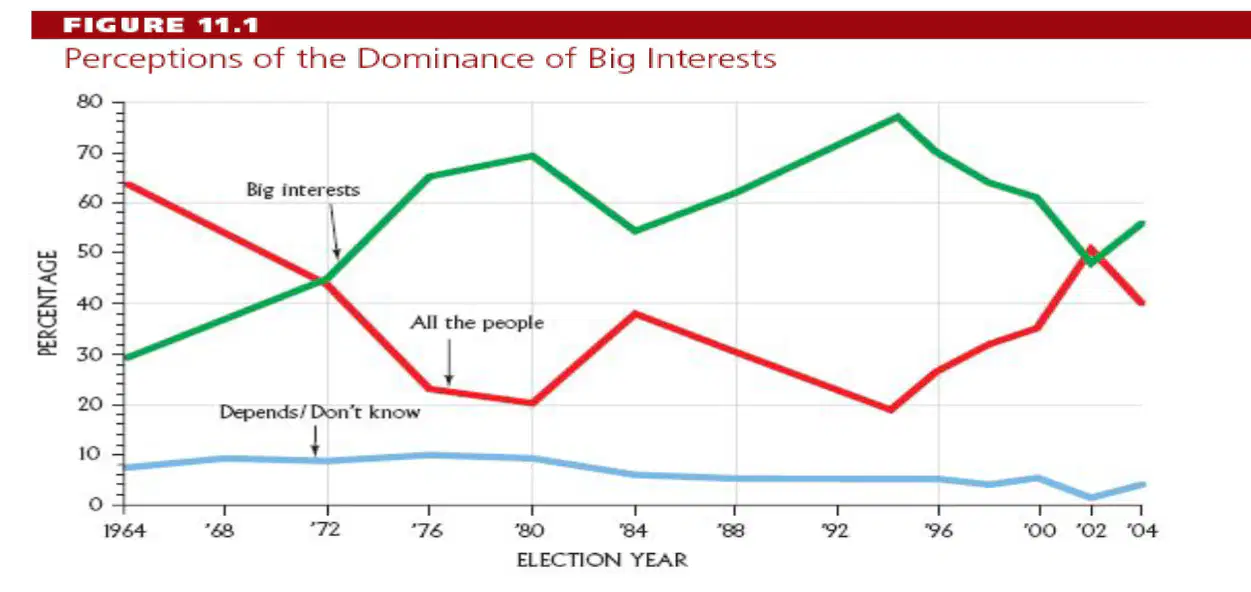
According to Figure 11.1, in which election year did the perception that "Big interests" dominate reach its highest point?
1968
1980
1992
2004
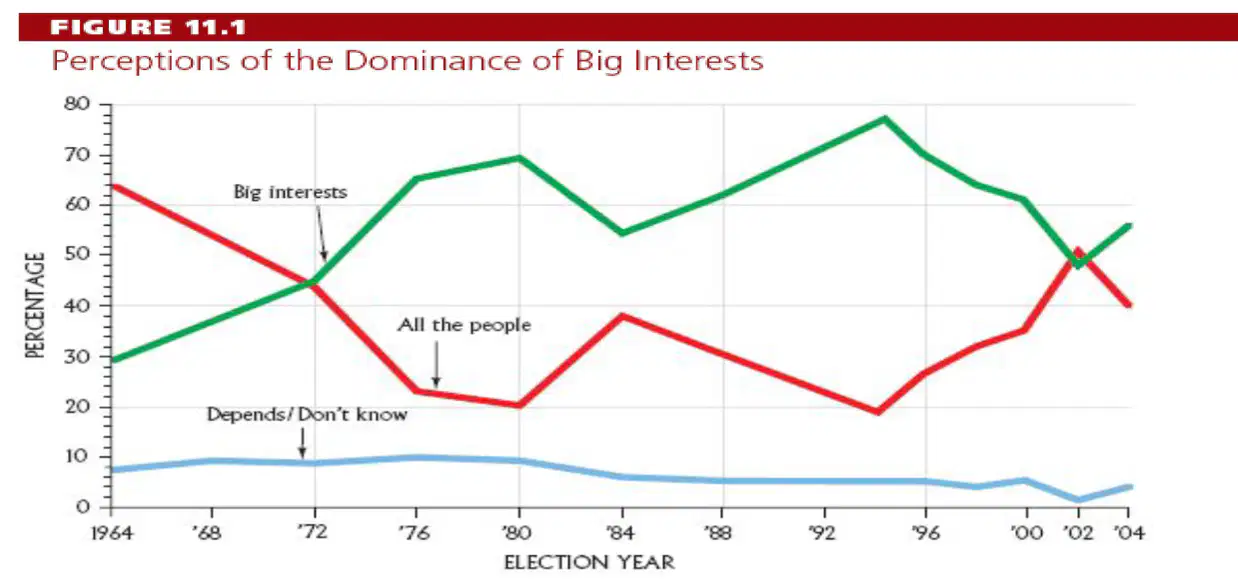
Based on Figure 11.1, which statement best describes the trend in the perception of "All the people" having dominance from 1964 to 2004?
It shows a consistent increase over the years.
It fluctuates over the years with no clear trend.
It shows a decrease over the years.
It remains relatively stable over the years.
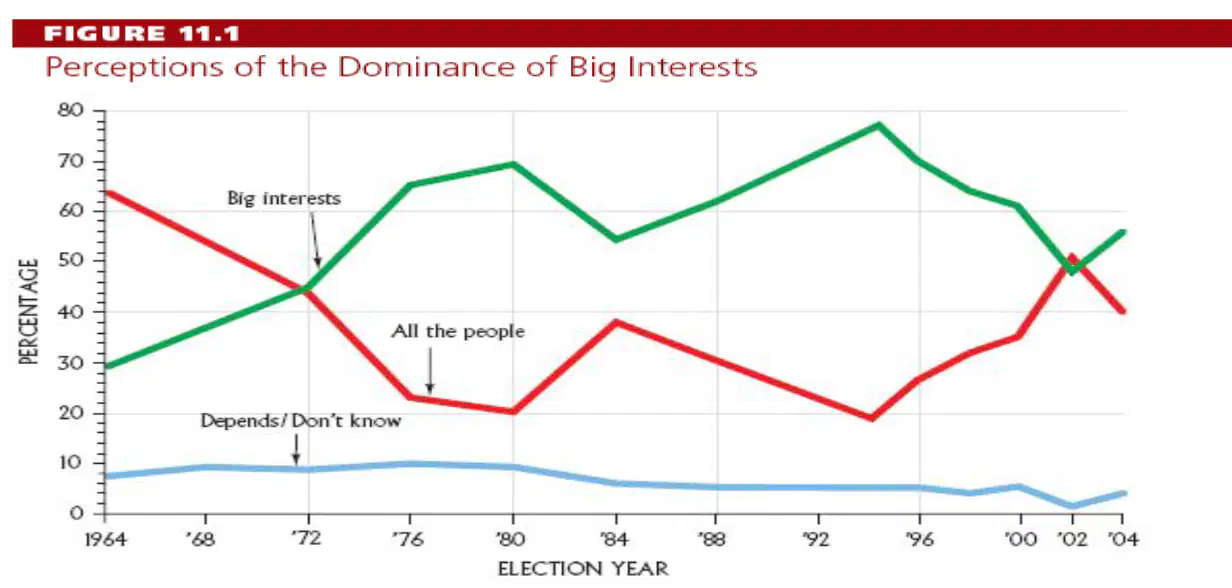
Referring to Figure 11.1, in which election year was the perception that "All the people" dominate approximately equal to the perception that "Big interests" dominate?
1964
1976
1984
2000
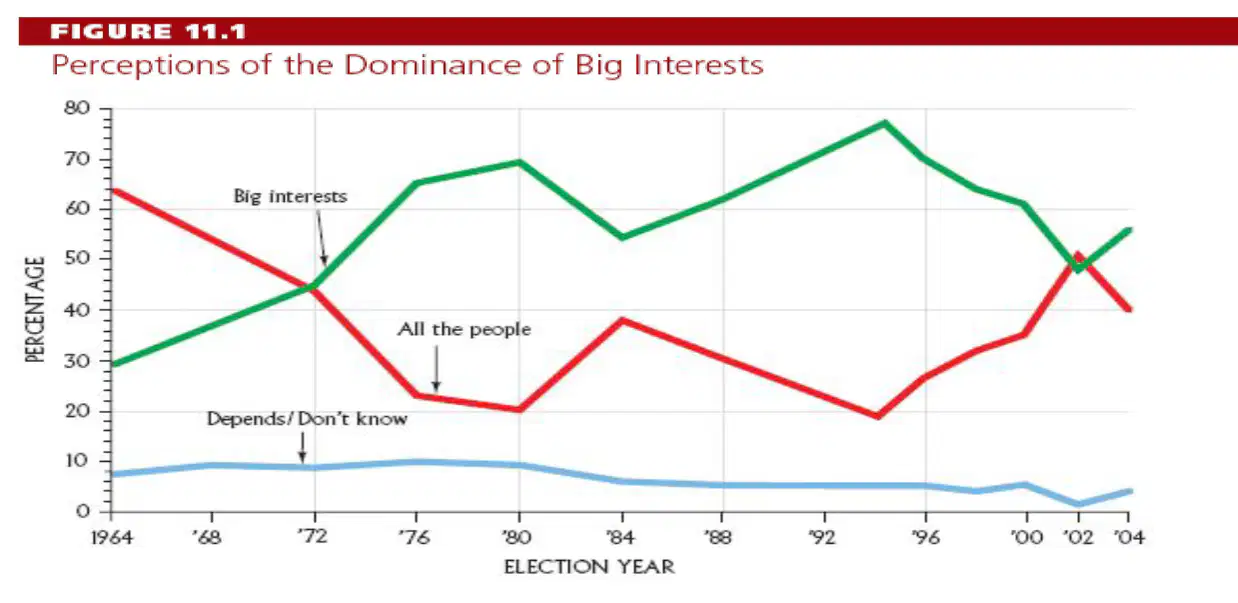
What does the "Depends/Don't know" line in Figure 11.1 indicate about the public's perception over the years?
It indicates a growing uncertainty or lack of opinion over time.
It indicates a decreasing uncertainty or lack of opinion over time.
It indicates a high level of uncertainty or lack of opinion throughout the years.
It indicates a low and stable level of uncertainty or lack of opinion throughout the years.
Which of the following are parts of Iron Triangles/Subgovernments?
Political parties, executive offices, media
Interest groups, congressional committees, bureaucracies
Corporations, non-profits, international organizations
Voters, local governments, courts
Issue networks are described as having which of the following characteristics?
Narrow focus on a single issue or industry
Composed of fewer interest groups and bureaucracies
Broader coalition and focus on more than a single issue or industry
Always aligned with Iron Triangles/Subgovernments
What is a collective good in the context of interest groups?
A resource that only members of the group can use
Benefits that cannot be withheld from group members
A strategy to recruit more members
A type of membership fee
What is the "Free-Rider Problem" in interest groups?
When group members have to pay additional fees
When the group becomes too large to manage
When potential group members benefit from the actual group members' work without effort or personal cost
When smaller groups merge into larger ones
Which type of groups are said to work more effectively according to the content?
Larger, more diverse groups
Smaller, more focused groups
Multinational corporations
Public interest groups
Which of the following is a form of non-conventional participation?
Voting
Civil Disobedience
Lobbying
Coalition Building
What do financial resources usually translate into for interest groups?
Public endorsements
Access
Policy changes
Increased membership
Single-issue groups are known to:
Prefer multi-faceted issues
Work well with multiple parties
Play on emotional issues
Attract a wide range of members

