
 Worksheets
Ecosystems, Living & Nonliving (STAAR released items)
Total questions: 22
Worksheet time: 33mins
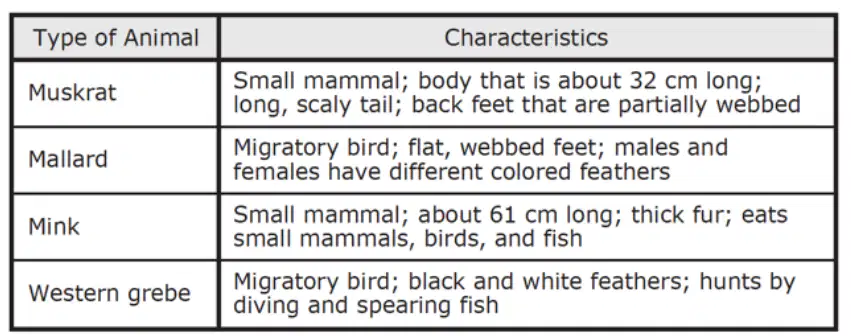
The table lists the characteristics of four types of animals. What feature do the ecosystems in which these animals live most likely have in common?
dry, rocky mountains
forests of pine trees
tall, spiny cacti
lakes and rivers
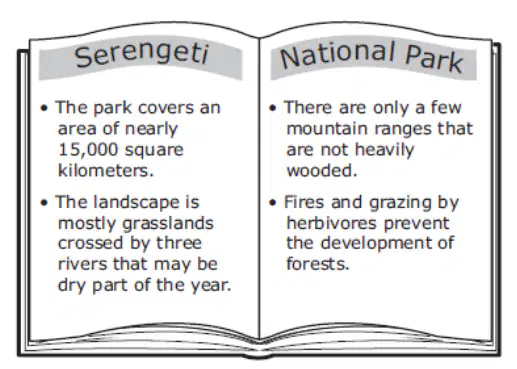
A student studying East Africa reads these facts about the Serengeti National Park in Tanzania. The student thinks that parts of Texas are probably similar to the Serengeti. Based on the following descriptions, which of these Texas animals would be least likely to live in the Serengeti's grasslands?


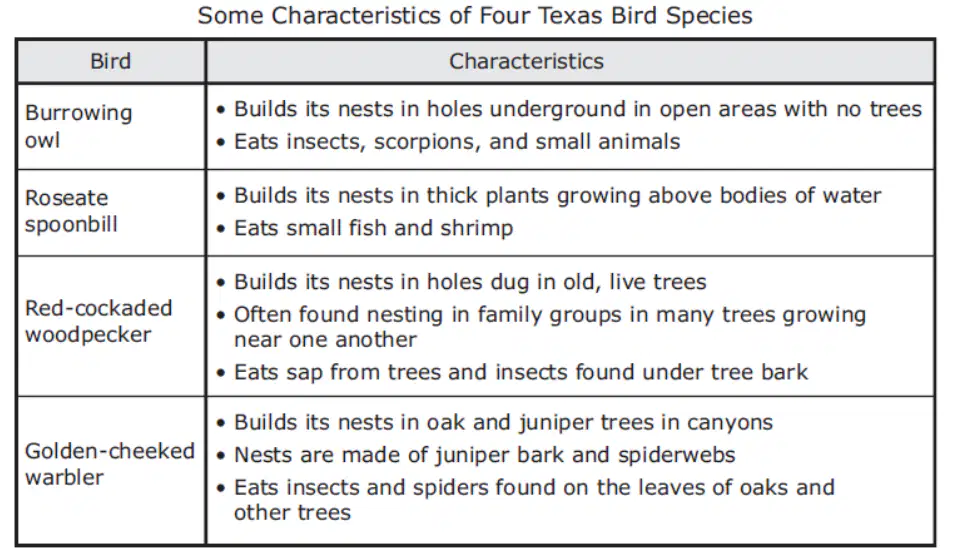
In parts of the East Texas Piney Woods ecosystem, there are forests with many tall pine trees. These thick forests have few other types of tall trees besides pine trees. The other plants growing in the ecosystem are usually small shrubs, grasses, and other short trees. A student wants to know what type of birds live in the Piney Woods region. The student reads the table shown below about four different birds. Based on the table, which bird is most likely to live in Texas's Piney Woods region?
burrowing owl
roseate spoonbill
red-cockaded woodpecker
golden-cheeked warbler
An African savanna is a grassland with shrubs and a few small trees. It has warm temperatures all year long, a dry winter season, and a rainy summer season. Which group of animals is most likely supported by an African savanna?


A tropical rainforest is a place with many trees and vines. It has warm temperatures all year long and plenty of rain. Which group has at least three animals most likely supported by a tropical rainforest?
The arctic tundra is a place with small plants, such as moss and lichens, and has few, if any, trees. It has snowy winters and cool summers. Which group of animals is most likely supported by an arctic tundra?
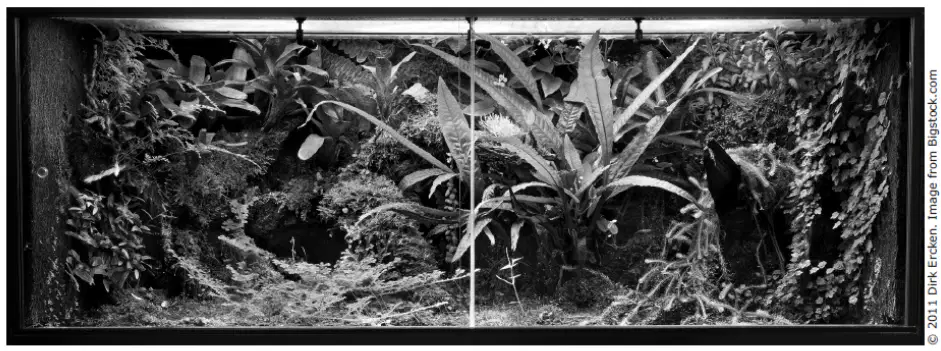
A teacher is setting up this terrarium in a science classroom. Which of these organisms is best suited for the terrarium?
Blue Jay
Lobster
Snail
Water Lily
Which of these describes one or more LIVING ORGANISM that depends on another LIVING ORGANISM to survive?
Bacteria living in the mouth of a horse
Ivy plants growing up a fence to obtain more sunlight
Mold living on a hard, rocky surface
An angelfish releasing carbon dioxide into pond water
Aquatic plants have adaptations that help them live in water. For example, the structures needed for making food are located on the tops of floating plant leave. This adaptation helps the plants -
absorb sunlight
stay anchored
avoid predators
capture fish
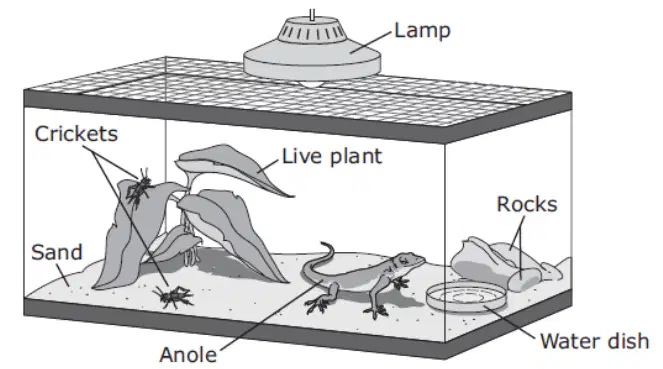
Green anole lizards are bright-green reptiles native to the southeastern United States and the Caribbean islands. They can be kept in terrariums to study their behavior and how they interact with their environment. Which observation describes this anole lizard interacting with the LIVING elements in its environment?
The anole rested on one of the rocks and lifted its head toward the light
The anole climbed the plant and then ate a cricket off one of the leaves
The anole drank some water and then ran across the sand
The anole jumped from the rock and scattered sand with its tail
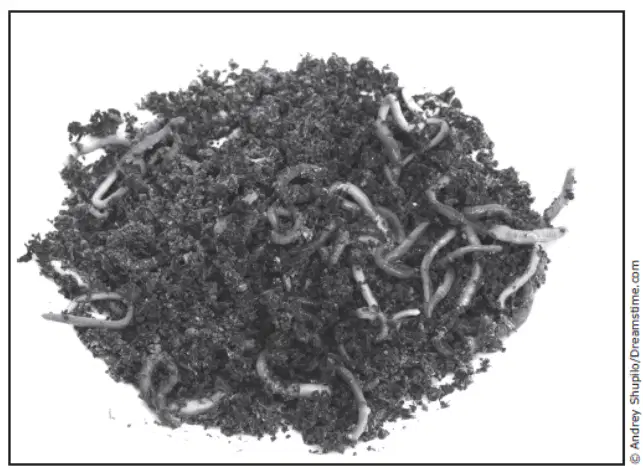
Many gardeners use red worms to turn vegetable and fruit scraps into topsoil for plants. The gardeners built a worm farm in a large container lined with old newspapers and filled with moist garden soil. The worms eat about half their body weight daily and produce waste that can be used as fertilizer. The container for a worm farm needs to have a lid, but the lid must be left partially open because worms require which of the following in order to survive?
Oxygen
Sunlight
Carbon dioxide
All of these
A student observing birds in a park records some ways that birds interact with LIVING and NONLIVING parts of their environment. ALL of the following observations are ways that a bird interacts with NONLIVING parts of its environment EXCEPT -
reacting to morning sunlight by singing
drinking and taking a bath in a puddle of water
responding to cold temperatures by fluffing its feathers
feeding insects to its chicks
Tropical climates have warm temperatures and abundant sunlight all year. What must be available for plants in these climates to make their own food throughout the year?
Bacteria
Birds
Shade
Water
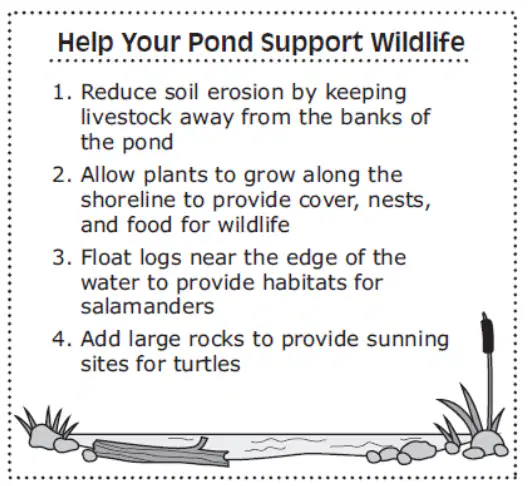
A farmer is reading a nature guide to learn how to make changes to a pond so that it will attract and support wildlife. The guide gives the suggestions listed in the picture. Which suggestion involves interactions between TWO GROUPS of LIVING organisms?
suggestion 1
suggestion 2
suggestion 3
suggestion 4
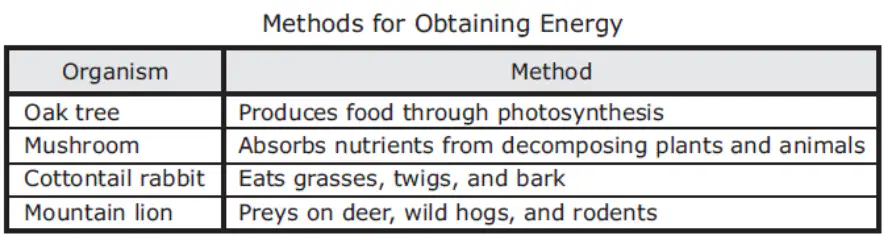
The table below lists ways that four organisms obtain (get) energy. Which organism obtains (gets) energy WITHOUT depending on another organism (living thing)?
Oak tree
Mushroom
Cottontail rabbit
Mountain lion
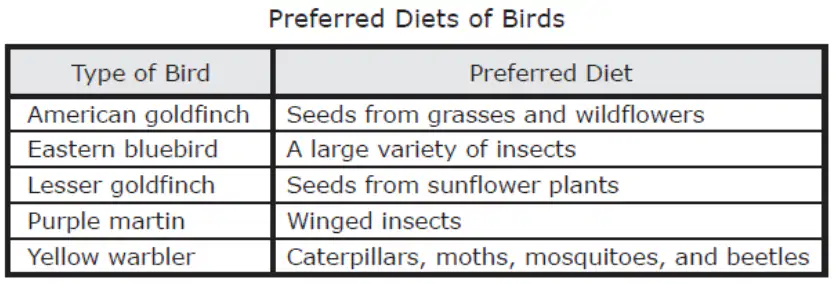
The table lists the preferred diet of several types of birds. Based on this information, which two types of birds DO NOT COMPETE for food resources?
Purple martin and yellow warbler
Eastern bluebird and purple martin
Lesser goldfinch and eastern bluebird
American goldfinch and lesser goldfinch
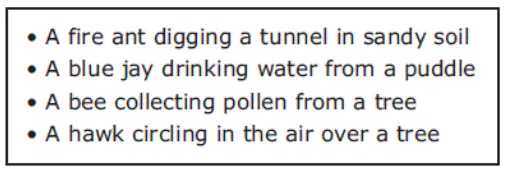
A student observes some activities while walking in a park. Which of these living organisms was interacting with another LIVING ORGANISM in the environment?
Fire ant
Blue Jay
Bee
Hawk
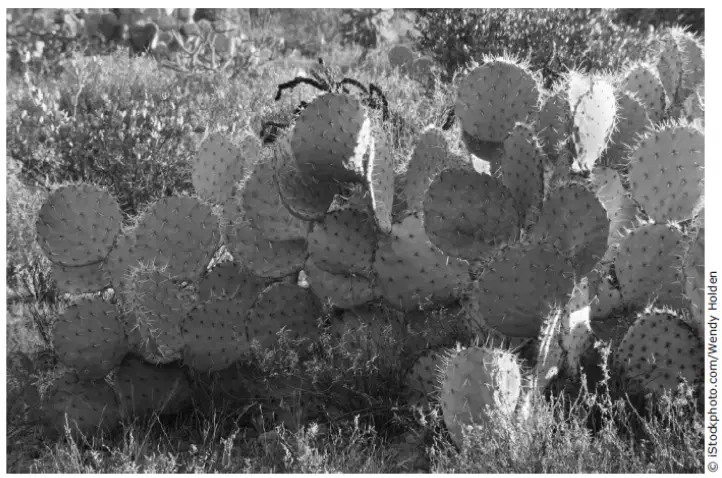
A prickly pear cactus is shown. The roots of the prickly pear cactus spread out in a wide underground network. How does this type of root system benefit (help) a prickly pear cactus?
By producing fruit and storing water
By capturing sunlight and getting rid of waste materials
By absorbing water and supporting the plant in loose, sandy soil
By releasing nutrients into the sandy soil and taking in oxygen
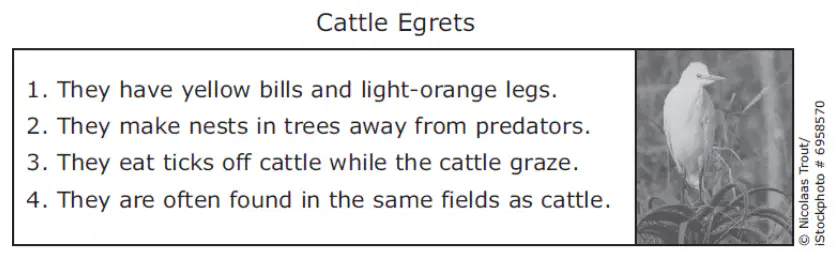
Some facts about birds called egrets are listed in the chart. Which of these facts best describes how these birds DEPEND ON OTHER ANIMALS to survive?
Fact 1
Fact 2
Fact 3
Fact 4
Some beetles break down the remains of dead animals. Some mushrooms break down the remains of dead trees. How do these actions most benefit (help) plants?
By returning nutrients to the soil
By releasing oxygen into the air
By making space for new animals
By decreasing (lowering) the population of herbivores (plant eaters)
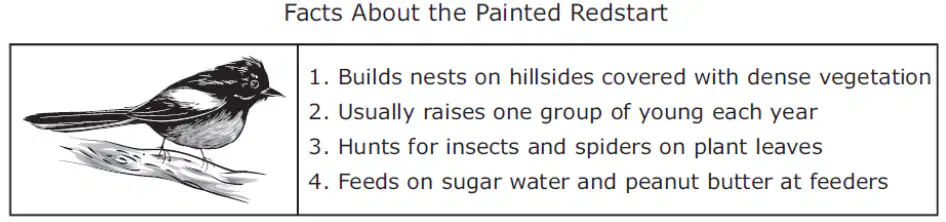
Some facts about a bird called the painted redstart are listed in the box. Which fact best describes one way this bird CHANGES ITS ENVIRONMENT to meet its needs?
fact 1
fact 2
fact 3
fact 4
In fall and winter many trees lose their leaves in response to (BECAUSE OF) cooler temperatures and -
a decrease in average wind speed
fewer hours of daylight
an increase in humidity
more direct sunlight

