
 Worksheets
Cold War Unit Quiz
Total questions: 16
Worksheet time: 12mins

How did the media (television) impact the Vietnam War?
Negative press coverage contributed to the public disillusionment with the war.
The positive press coverage encouraged enlistment in the military.
The impact of the media in Vietnam was rather minimal.
The media showed that the majority of Americans supported the war effort.

The launch of Sputnik I intensified Cold War tensions and caused the —
United States to increase spending on technology, education and weapons to compete with the Soviet Union
Soviet Union to move missiles and warships to Cuba in order to threaten the United States
United States to send troops and aid to East Berlin to free it from Soviet control
Soviet Union to threaten Europe with nuclear attack if Soviet airspace were violated

What individual/group contributed to the Red Scare and accused American citizens of being communists?
Martin Luther King & Black Panthers
Jane Addams & Settlement Houses
Joseph McCarthy & HUAC
Cesar Chavez & United Farmworkers Union
During the Cuban Missile Crisis, what did JFK do when he heard that the Soviet Union was constructing a missile site in Cuba.
JFK gave into the Soviet demands.
JFK bombed the Soviet Union with an atomic bomb.
JFK ordered a naval blockade of Cuba.
JFK invaded Cuba from Guantanamo Bay.
Which of the following is most characteristic of the Cold War?
The growth of nuclear arsenals in the United States and the Soviet Union
The expansion of national borders by imperialistic European countries
The implementation of isolationist foreign policies in Great Britain and China
The rapid industrialization of many Southeast Asian countries
Match the following
Truman Doctrine
Truman
Cold War
Soviet Union
Marshall Plan
European Recovery
Berlin Airlift
Aid during Soviet blockade
NATO
North Atlantic Treaty Organization
Which U.S. President escalated the Vietnam War by ordering the first large-scale deployment of American troops?
John F. Kennedy
Lyndon B. Johnson
Richard Nixon
Gerald Ford
What was the primary goal of the Nixon administration's policy of Vietnamization?
To increase the number of U.S. troops in Vietnam
To hand over the responsibility of war to South Vietnamese forces
To introduce democratic elections in Vietnam
To negotiate a peace treaty with North Vietnam
Which U.S. President signed the Paris Peace Accords, leading to the end of U.S. involvement in the Vietnam War?
Lyndon B. Johnson
Richard Nixon
Gerald Ford
Jimmy Carter
Reorder the following
Franklin D. Roosevelt
Harry S. Truman
John F. Kennedy
Lyndon B. Johnson
Richard M. Nixon
"The consequence of the (a) failure wasn't an acceptance of Castro and his control of Cuba, but, rather a renewed determination to bring him down by stealth."
--Robert Dallek

Chairman of the Chinese Communist Party Mao Zedong Shakes Hands with U.S. President Richard Nixon, February 29, 1971
What was one of President Nixon’s goals for the meeting shown in this photograph?
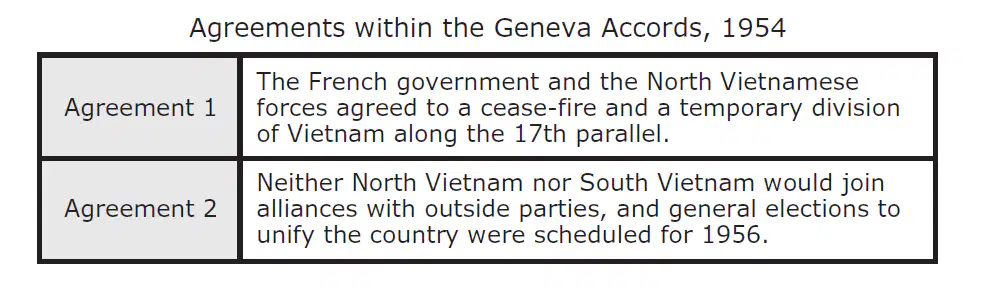
Why was the United States concerned about Agreement 2?
Officials believed the election would lead to a civil war and revolution.
Leaders feared communist officials would win the election and take over the country.
The administration opposed the creation of regional alliances.
Congress members feared foreign policy decisions would lead to criticism at home.

What was the purpose of the Berlin Airlift?
To provide supplies to Berlin citizens without provoking the Soviet Union
To provoke the Soviet Union by providing supplies to Berlin citizens
To provide supplies to US soldiers stationed in Berlin without provoking the Soviet Union
To provoke the Soviet Union by providing supplies to Us soldiers stationed in Berlin
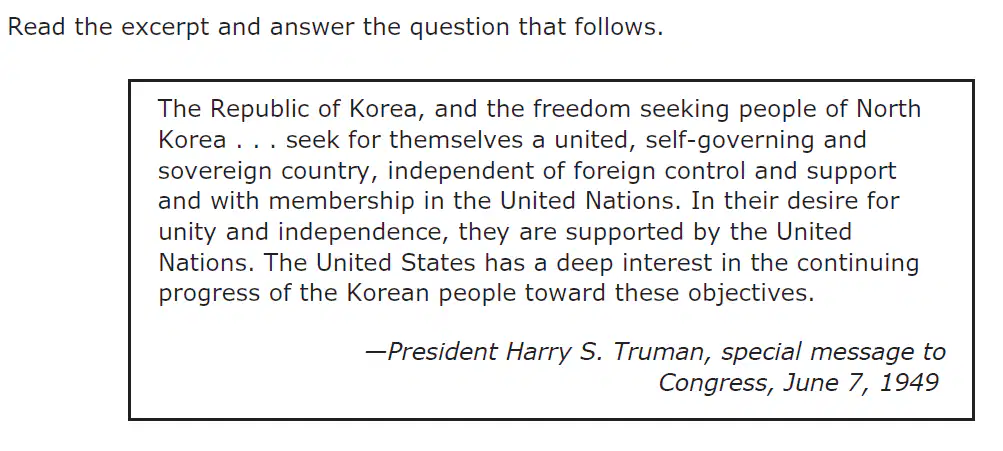
What was the primary goal of the foreign policy described in this excerpt?
Prevent the spread of communist influence in Asia
Expand military presence in the region
President Truman introduced the (a) in 1947. Its main purpose was to prevent the spread of (b) . His successor, Dwight D. Eisenhower, promoted the (c) , which was the idea that if one country became (d) , then other countries would follow. To counteract this problem, the United States used the foreign policy known as (e) . This meant that the United States would send money and/or troops to any country fighting communist forces.

