
 Worksheets
Year 9 Easter Term Quiz
Total questions: 81
Worksheet time: 51mins
Instructions carried out one after another in order is a...
List
Sequence
Collection
Series
While the program is running, if the program makes a choice if it should run some code or not, it is called a...
variable
sequence
selection
mistake
When a program repeats, looping over the same sequence, it is called...
iteration
a variable
an instruction
Instructions carried out one after another in order is a...
List
Sequence
Collection
Series
Which is the definition of "sequence"?
A set of instructions in a specific order
Where instructions repeat
Code where decisions are made
Which is the definition of "selection"?
A set of instructions in a specific order
Where instructions repeat
Code where decisions are made
Which is the definition of "iteration"?
A set of instructions in a specific order
Where instructions repeat
Code where decisions are made
Why is iteration important?
It determines the order in which instructions are carried out
It allows code to be simplified by removing duplicated steps
It allows multiple paths through a program
Which of the following contains an INCORRECT sequence when getting dressed to go out?
Put on socks, put on shoes, put on coat
Put on coat, put on shoes, put on socks
Put on socks, put on coat, put on shoes
Why is selection important?
Selection allows us to include more than one path through a solution
Selection allows us to repeat steps in a solution
Selection allows us make our solution more efficient

What does iteration involve?
Rejecting
Reclining
Repeating
Recycling

Instructions being followed one after the other. What is it?
Selection
Iteration
Sequence
Variable

Only allowing one bit of code to run when something happens.
Example:
• Only run this bit of code “When” or “If” this bit has run
• WHEN you press on the keyboard, on the arrows, DO move.
Selection
Sequence
Iteration
Variable




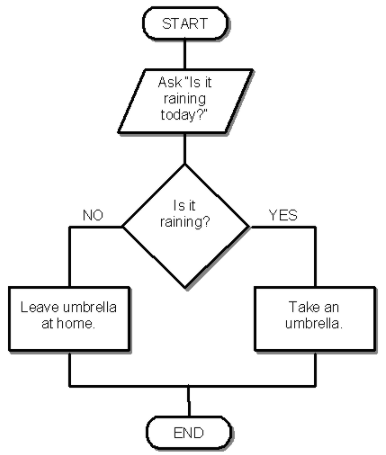
Yes
<

What is decomposition?
Adding detail to make a problem more complex
Breaking down a complex problem or system into smaller, more manageable parts
When you ignore the unnecessary detail in a problem
Why do we decompose a complex problem?
To make it easier to solve
To make it more difficult to solve
To change the problem we have
Which of these is an example of decomposition?
Watching a mechanic repair a car
Finding out how a car works by looking in detail at the different parts that make up the car
Looking at different car models for similarities between them
How often do we decompose problems?
We never decompose them, computers do this for us
Occasionally, but we don't really need to
Every day, often without thinking about it
Which of these is NOT an example of decomposition?
Thinking about how the problem could be divided into smaller parts
Adding more parts to the problem so it becomes more complex
Working out who could help you solve a part of the problem
What is pattern recognition?
Breaking down a complex problem into smaller problems
Looking for similarities among and within problems
Building models from patterns
Why do we need to look for patterns in problems?
Patterns make it easier for us to solve complex problems
We don't need to look for patterns
Patterns make it more difficult complex problems
Which of the following is not done by abstraction?
Identifies essential details
Disregards non-essential information
Breaks the problem down into smaller tasks
Which of the following is not done by decomposition?
Allows multiple people to work on the problem together
Disregards non-essential information
Breaks the problem down into smaller tasks
You could use abstraction to replace specific objects with simple shapes
True
False
Abstraction and Decomposition are examples of...
Computational Thinking
Algorithmic Thinking
Computer Science
Logical Reasoning
In programming, what is iteration?
The repetition of steps within a program
The order in which instructions are carried out
A decision point in a program
Testing a program to make sure it works
FOR loops are
loops which run an unknown number of times
loops which run for a specific number of times
the same as if statements
not part of programming
Which type of loop iterates until instructed otherwise?
FOR loop
WHILE loop
A condition is
a statement that is either True or False
a string
an integer
a list


Hello world!
Hello world!
Hello world!
Hello world!
Hello world!
......(repeated continuously)

Hello world!
Hello world!
Hello world!
Hello world!
Hello world!
(repeated continuously)
break
Instructions carried out one after another in order is a...
List
Sequence
Collection
Series
Which is the definition of "selection"?
A set of instructions in a specific order
Where instructions repeat
Code where decisions are made


How many times will a 'FOR' Loop repeat? (2 answers)
A fixed number of times
Unlimited times
A certain number the user wants
1 000 000 times
What is the proper name for repetition?
rounders
iteration
Circular
cookie

Which line shows a comment?
1
2
3
4

Which line shows selection?
6
9
12
13

What lines show iteration?
1 to 4
6 to 11
9 to 10
12 to 13

How many variables are part of this subroutine?
2
3
4
5
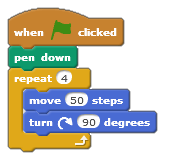
What shape will this code draw?
Circle
Square
Triangle
Rectangle

How many INPUTS are shown on the image?
1
2
5
6

How many OUTPUTS are shown on the image?
1
2
5
6
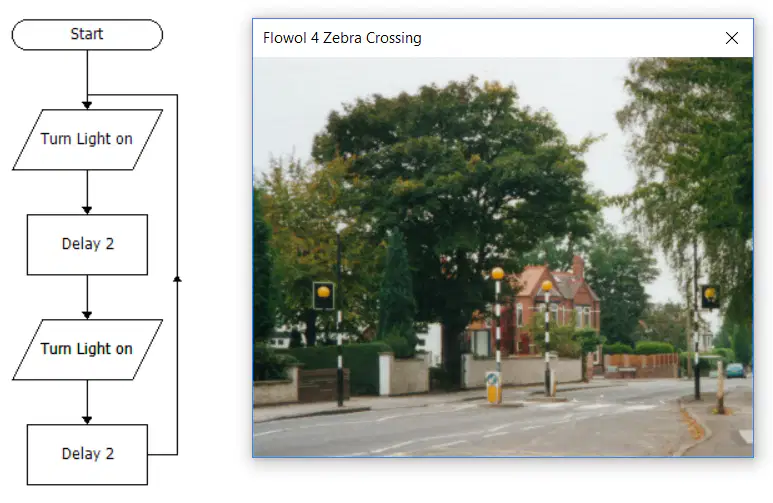
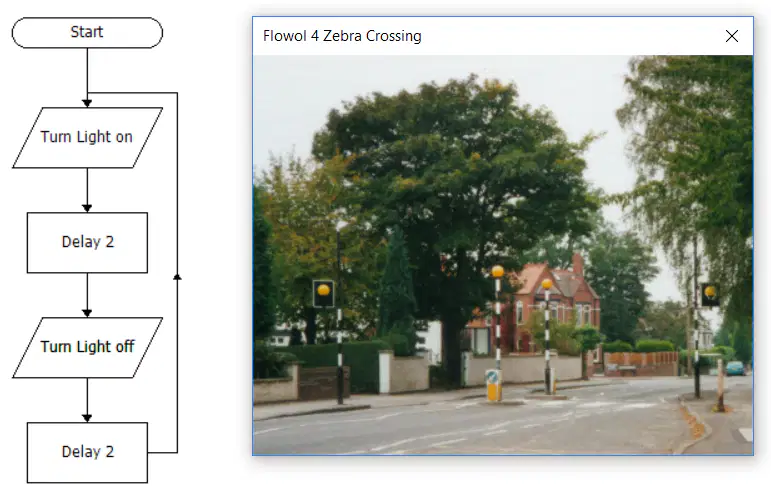
Terminator symbol
Process symbol
Input/Output symbol
Decision symbol
Terminator symbol
Process symbol
Input/Output symbol
Decision symbol
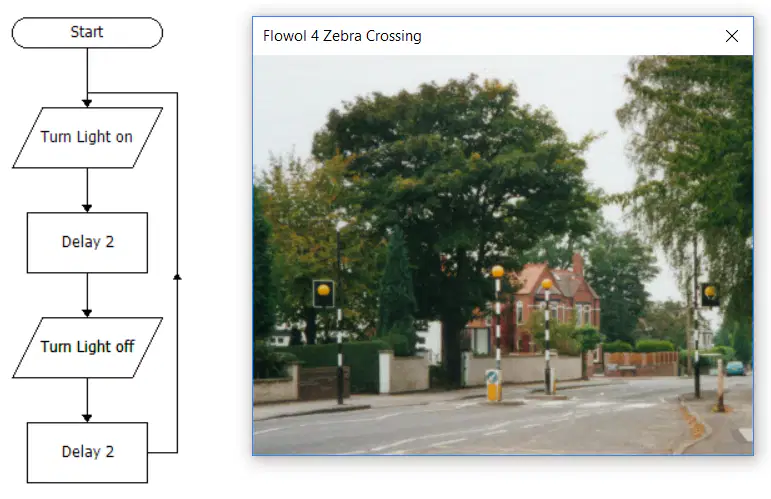
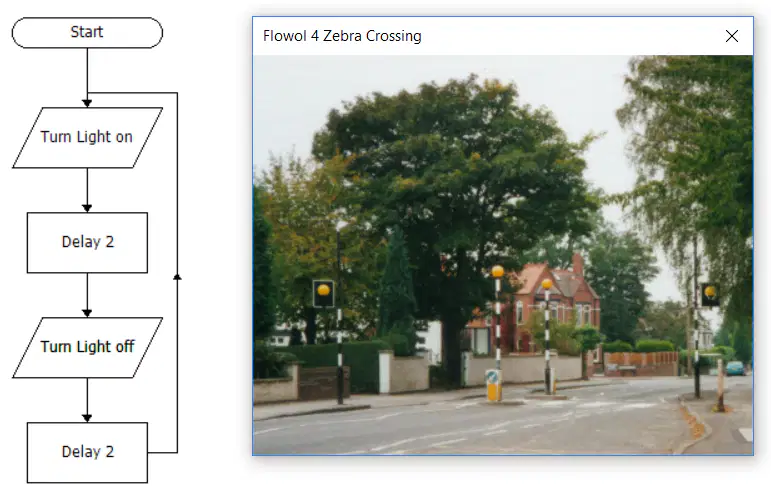
Look at the flowchart shown. The flowchart shows the control system for a zebra crossing. In order for the lights to flash continuously what is implemented on the flowchart?
A decision
A termination
A loop
An input
Match the definition to the keyword:
Iteration
Repeating steps, or instructions
Sequencing
Specific order of instructions
Selection
a decision or a questions
Algorithm
A step-by-step instructions
Click on on of the input devices:
Click on on of the output devices:
Click on on of the input AND output devices:
What is meant by 'proprietary' software?
Software owned by an organisation, you may need to buy a license for.
software distributed with its source code, making it available for use, modification, and distribution with its original rights
What is meant by 'open source' software?
Software owned by an organisation, you may need to buy a license for
Software distributed with its source code, making it available for use, modification, and distribution with its original rights
Which of the following is not 'proprietary' software?
Windows 10
MAC OSX
Linux
McAfee
Which of the following is an advantage of 'open source' software?
You can edit the source code to customise it
You need to be an expert to edit code
Source code not made available
License restricts the copying / modifying / distribution of the software
Which of the following is a disadvantage of 'proprietary' software?
You can edit the source code to customise it
It may have bugs, since updates are not readily available
Less likely to have 'bugs' as updates are regular to fix them
May have features within the software you don't need, source code can't be changed.
Which of the following is a disadvantage of 'open source' software?
You can edit the source code to customise it
It may have bugs, since updates are not readily available to fix issues.
Less likely to have 'bugs' as updates are regular to fix them
May have features within the software you don't need, source code can't be changed.
Which of the following is an advantage of 'proprietary' software?
You can edit the source code to customise it
It may have bugs, since updates are not readily available to fix issues.
Less likely to have 'bugs' as updates are regular to fix them
May have features within the software you don't need, source code can't be changed.
Which of the following is a disadvantage of 'proprietary' software?
You can edit the source code to customise it
It may have bugs, since updates are not readily available to fix issues.
Less likely to have 'bugs' as updates are regular to fix them
May have features within the software you don't need, source code can't be changed.

