
Font size
 Worksheets
Ecol - Ch 6 Evolutionary Ecology
Total questions: 17
Worksheet time: 20mins
(a) are regions on the DNA strand that carry the code for a trait. (b) are the possible variations of a trait. For example, (c) #1 may be the (d) for the for fur color. The alleles for fur color may be (e) .
Unless siblings are identical twins, two parents will never produce identical children. How is there so much genetic variation among the offspring of two parents?
1) (a) = parents' pairs of chromosomes are randomly sorted into egg & sperm (b)
2) (c) = DNA swaps occur among a parent's chromosomes during (d) before egg & sperm form
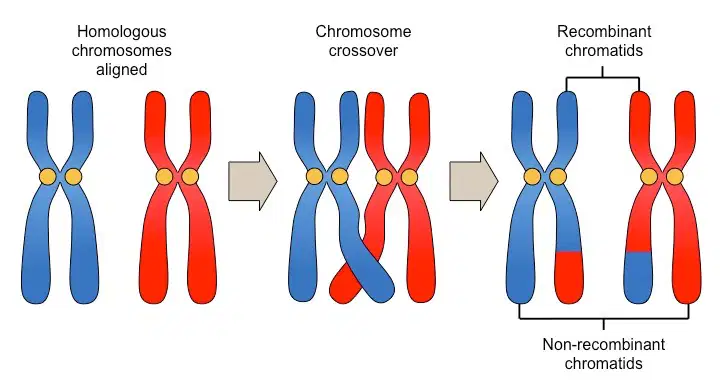
The diagram shows new offspring genetic variation created during which event of meiosis
random assortment of new chromosomes into 4 new cells
recombination of sections of DNA during DNA replication
don't pick me
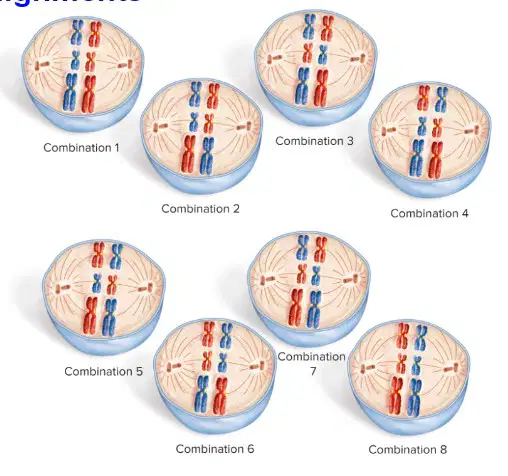
The diagram shows new offspring genetic variation created during ....
random assortment of new chromosomes into 4 new cells
recombination of sections of DNA during DNA replication
don't pick me
This organism's diploid adult cells have ___ pairs of homologous chromosomes that can sort into ___ different arrangements before the cell splits to make haploid gametes (egg or sperm).
FYI: A human cell can sort into
223 or over 8,388,608 possible arrangements to form egg or sperm.
3 / 8
6 / 16
12 / 8
Genetic drift occurs when the allele variation in a gene pool decreases.
Match the forms or examples.
bottleneck effect
pop. drops
gene pool shrinks
founder effect
newly isolated pop. has small gene pool
water hyacinth transplanted to other countries
founder effect
elephant seal pop. drops from hundred thousands to 20
bottleneck effect
Selection is when certain phenotypes (traits) survive and are passed on, while other phenotypes decrease survival.
Match the types
Stabilizing selection
middle phenotypes increase
Directional selection
phenotype shifts to one extreme or other
Disruptive selection
middle decreases and both ends increase
3 types of selection (change in phenotypes w/in population)

middle phenotypes increase

phenotype shifts one side to other

extremes both increase
middle decreases

(a) occurs at the (b) level.
It can be artificial when humans are responsible for (c) agricultural plants domesticated animals. It can also be caused by (d) , such as limiting hunting of the white deer enclosed at the Seneca Army Depot.
Microevolution occurs when the peppered moth population shifts between the white and black phenotype. During the industrial revolution, when soot builds up on the tree trunks, there is selective pressure toward which phenotype?

black moths

white moths
don't pick me
Microevolution occurs when the peppered moth population shifts between the white and black phenotype.
When air pollution control technology became prevalent, selective pressure changed to which phenotype?
black moths
white moths
don't pick me
(a) is at levels beyond one population, such as the entire species or genus. The development of a new species is (b) . (c) show how evolutionarily close different species are to a shared (d)
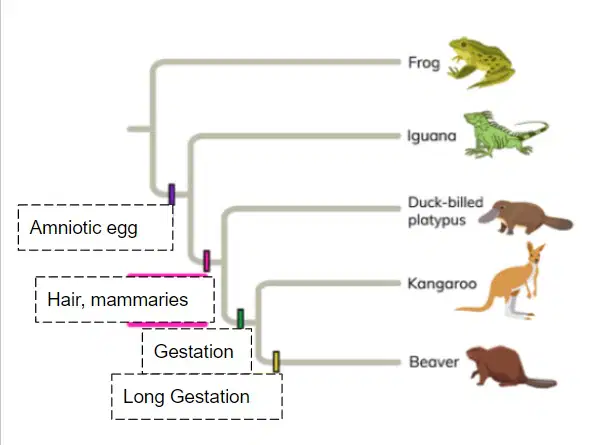
Refer to the phylogenetic tree. Remember that organisms further up the branches have all the traits below them.
(click image to enlarge)
has not evolved an amniotic egg
frog
has amniotic eggs
iguana, platypus, kangaroo, beaver
evolved gestating young inside the body
kangaroo
beaver
share common ancestor w/ hair
platypus
kangaroo
beaver
Who is most closely related evolutionarity?
frog and platypus
platypus and beaver
kangaroo and beaver
2 types of speciation:
(a) speciation = evolution due to (b) isolation, it's the most common reason new species arise.
(c) speciation = evolution (d) due to geographic isolation.
Most new species arise when their small gene pool becomes closed off -- this is allopatric speciation. Match the examples.

all the weird organism in Australia
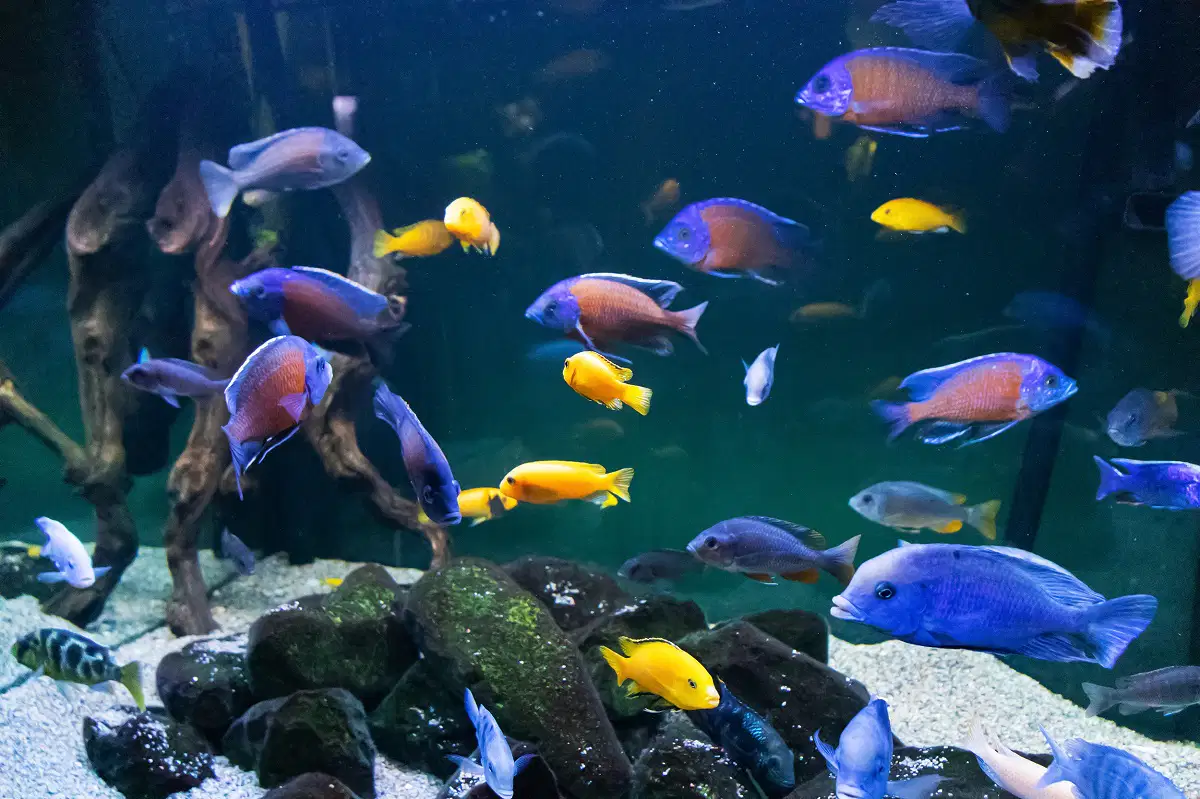
200 cichlid species in Lake Tanganyika
geographic isolation leads to
allopatric speciation
no geographic isolation
sympatric speciation
allopatric speciation
Darwin's finches in the Galapagos
(a) is modifying the traits by manipulating the (b) code.
(c) is when more than the normal pairs (2) homologous chromosomes exists and this can lead to (d) speciation.
Common wheat has been genetically engineered to be polyploidy with (e) chromosomes.

