
 Worksheets
Law Studies EOC Review P1
Total questions: 152
Worksheet time: 3hrs 32mins
According to John Locke, which agreement did individuals enter into to form their own society?
Constitution
Social Contract
Mayflower Compact
English Bill of Rights
According to John Locke, which agreement did individuals enter into to form their own society?
Constitution
Social Contract
Mayflower Compact
English Bill of Rights
The statement below is from the Magna Carta:
No freeman shall be taken or imprisoned or disposed or exiled or any way destroyed, nor will we go upon him nor send upon him, except by the lawful judgment of his peers or by the law of the land.
What right was guaranteed in this excerpt?
trial by jury
no taxation without representation
freedom of the press
freedom of religion
Which thinker introduced the idea of a separation of powers for effective government?
John Locke
Baron de Montesquieu
Thomas Paine
Thomas Jefferson
How was Locke's social contract theory related to his belief in natural law?
He argued subjects had the right to rebel against a ruler who acted against natural law.
He argued that whatever the king did was good according to natural law.
He argued that natural law required the colonists to be given their independence.
He argued that God had especially chosen kings to rule over their subjects as part of nature.
Which describes an impact of Magna Carta on the American colonists in the 1770s?
They believed they could not be taxed without their consent.
They believed they could not be governed by a far-away island.
They thought they had the right to overthrow a king who did not protect their rights.
They favored a separation of the powers of government into different branches.
What most attracted the Founding Fathers to Montesquieu's explanation of the separation of powers?
Their separation could help prevent the central government from becoming tyrannical and oppressive.
Their separation could protect the rights of the nobility from the actions of the king.
Their separation could preserve the privileges of the monarch and nobles from popular attack.
Their separation raised judicial power to a level of equality with legislative and executive power.
Which right was established by the Magna Carta in 1215?
the right to vote in elections
the right to choose the monarch
the right to freedom of speech
the right to a trial by jury
Which document confirmed the rights of English subjects after the overthrow of James II in the Glorious Revolution?
Magna Carta
Mayflower Compact
English Bill of Rights
Montesquieu's Spirit of the Laws
Which of the following were most similar?
the Mayflower Compact and John Locke's social contract theory
the English Bill of Rights and Thomas Paine's Common Sense
Magna Carta and Montesquieu's separation of powers
the Mayflower Compact and Montesquieu's separation of powers

The diagram indicates that the colonists based some of their political views on historic documents.
Which phrase completes the diagram?
Natural law
Separation of powers
Divine Right of Kings
Guarantee of certain individual rights
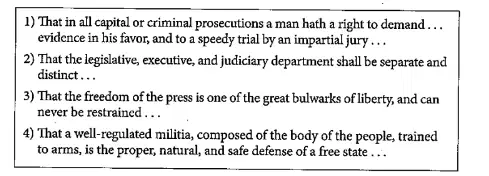
The picture contains statements from the 1776 Virginia Declaration of Rights.
Which statement guarantees a right first granted by the Magna Carta?
1
2
3
4
Which colonial leader introduced the ideas of John Locke's "social contract" theory into the Declaration of Independence?
John Hancock
Thomas Paine
James Madison
Thomas Jefferson
Which work publicized the concept of "natural rights," later found in the Declaration of Independence?
Magna Carta
the English Bill of Rights
the Mayflower Compact
John Locke's Two Treatises of Government
According to the Declaration of Independence, what was an "unalienable right" that all governments should protect?
the right to social equality
the right to personal liberty
the right to religious equality
the right to elect government officials
The passage below comes from the Declaration of Independence (1776)
"He has kept among us, in times of peace, Standing Armies without the Consent of our legislatures..."
Which section of the Declaration contained this passage?
its list of colonial grievances
its justification of the conduct of the colonists
its theory of government based on a social contract
its announcement of American Independence from Britain
Which statement best describes the role of the government according to the Declaration of Independence?
"The main purpose of government is to expand and glorify the state."
"The main purpose of government is to protect unalienable rights of individuals."
"The main purpose of government is to protect the rights and privileges of His Majesty, the King."
"The main purpose of government is to promote the general welfare of the community by taking steps toward social equality."

The diagram in the picture summarizes ideas from the Declaration of Independence.
Which statement completes the diagram?
Because governments derive their just powers from the consent of the governed, they are incapable of acting against the people.
Whenever any form of government becomes destructive of these ends, it is the right of the people to take peaceful measures to alter those policies.
Whenever any form of government becomes destructive of these ends, it is the right of the people to alter or abolish it, and to institute new government.
Because governments derive their powers from the consent of the governed, it is the obligation of the people to obey their government whatever it commans.
Based on the Declaration of Independence, which is a natural right?
the right to vote
the right to bear arms
the right to pursue happiness
the right to equal protection of the laws
Why did the Preamble to the Constitution begin with the phrase, "We the People"?
to indicate that the national government had limited powers
to indicate that the states had been associated in a confederation
to indicate that federal power was separated among three branches
to indicate that the American people were the ultimate source of its authority
Which identifies one of the goals of government listed in the Preamble?
to guarantee employment to all citizens
to establish independence from Great Britain
to expand the nation's frontiers westward
to protect the rights and freedoms of all citizens
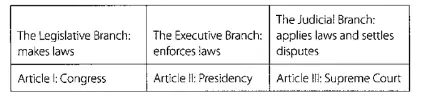
The chart in the picture shows the organization of the United States, based on the Constitution.
Which constitutional principle is illustrated by the chart?
federalism
separation of powers
checks and balances
popular sovereignty
When the President nominates an individual to serve as Secretary of State, the Senate must confirm the appointment. Which constitutional principle does this illustrate?
limited government
popular sovereignty
separation of powers
checks and balances
Which example illustrates the principle of checks and balances?
The Supreme Court interprets a federal law.
The President vetoes legislation proposed by Congress.
The President confers with the members of the Cabinet.
A case between citizens from different states is tried in a federal court.
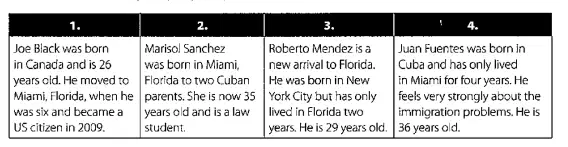
The four individuals in the chart are thinking of running for the office of U.S. Senator from Florida.
Which of these candidates is qualified to become a U.S. Senator?
Joe Black
Juan Fuentes
Roberto Mendez
Marisol Sanchez
What is an "enumerated power" of Congress?
the power to tax imports
the power to declare war
the power to issue hunting licenses
the power to operate public school districts
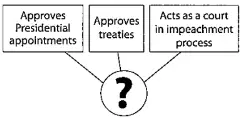
The diagram shows details about the U.S. government.
Which branch of government completes the diagram?
The Senate
The Cabinet
The Supreme Court
The House of Representatives
Why do most of the bills introduced in Congress never become law?
They are defeated in floor votes.
They never get out of committee.
They are vetoed by the President.
They are overruled by the U.S. Supreme Court.
What happens when the House and Senate pass different versions of the same bill?
The House bill is changed to conform to the Senate bill.
The Senate bill is changed to conform to the House bill.
A conference committee is appointed to resolve the differences.
A standing committee from one house is chosen to resolve the differences.
Which action is an example of an "implied" power?
Congress votes to raise income taxes.
Congress holds an investigation on women in the military.
Congress declares war on a country for sponsoring terrorism.
Congress decides to close post offices in rural areas on Saturdays.
A bill is passed by both the House and the Senate. The bill is then submitted to the President. Which is not an option for the President?
let the bill die in committee
sign the bill and it becomes law
veto the bill and inform Congress of the reasons for the veto
not sign the bill and after 10 days, if Congress is not in session, the bill dies

The diagram shows some of the steps involved in passing a federal law.
What is the next step in the lawmaking process?
The President signs the bill.
The bill is sent to the Senate.
The bill is sent to a conference committee.
The bill is debated on the floor of the House.
Which individual could qualify as a candidate for President of the United States?
Max is 67 years old; he has lived in Ontario, Canada for all of his life; he was born in Detroit.
Martha is 45 years old; she has lived in Chicago for the last 18 years; she was born in Tampa.
Samuel is 27 years old; he has lived in New York City for the past 3 years; he was born in Israel of American parents.
Karen is 42 years old; she has lived in Boston for the last 26 years; she was born in Ireland of Irish parents.
Which statement accurately describes the Electoral College?
Each state has the same number of electoral votes.
The winner of the popular vote automatically wins the Electoral College.
The electors for the Electoral College are chosen before the general election.
In all but two states, the candidate receiving the largest popular vote in a state wins all of that state's electoral votes.
The 25th Amendment sets out the order of succession to the Presidency. If the President dies, the Vice President is next in line. Which official follows next?
Secretary of State
Secretary of Defense
Speaker of the House
President pro tempore of the Senate
When the President of the U.S. hosts the President of France at a dinner at the White House, what role is the President performing?
Chief Diplomat
Chief Legislator
Chief Executive
Commander in Chief
Which role does the President perform when speaking at a political rally in support of a candidate running for Congress?
Party Leader
Head of State
Chief Diplomat
Chief Executive
During the 1976 Presidential campaign, Jimmy Carter promised to pardon draft evaders from the Vietnam War to help heal the wounds of the war. Shortly after he was elected, President Carter pardoned about 100,000 draft dodgers. How was he able to pardon so many at once?
He was exercising his implied powers as PResident.
He was exercising his customary powers as President.
He was exercising his emergency powers as President.
He was exercising his expressed powers as President.
How does an Executive Order differ from a law?
Executive Orders are not subject to judicial review.
Executive Orders are not limited by the Constitution.
Executive Orders do not need to be approved by Congress.
Executive Orders are limited to military and foreign affairs.
Article III of the Constitution established the U.S. Supreme Court. Why does this article refer to this court as "supreme"?
It hears more cases than any other court.
It has authority over all other courts in the U.S.
Its officers are appointed by the President of the U.S.
It has authority over both the executive and legislative branches.
An oil barge belonging to the State of Alabama has a massive oil leak in the Gulf of Mexico. The leaked oil damages the beautiful beaches of Destin, Panama City, and Ft. Walton. The oil also endangers the shrimp and crab industry of Florida. The State of Florida sues the State of Alabama. Which court has jurisdiction over the case?
U.S. Supreme Court
Florida Supreme Court
U.S. Court of Appeals for the Eleventh Circuit
U.S. District Circuit Court for the Northern District of Florida
How does an appellate court differ from a trial court?
An appellate court usually has a jury.
An appellate court decides issues of fact.
An appellate court examines more witnesses.
An appellate court reviews another court's decision.
How do the Justices of the Supreme Court communicate their decisions?
News agencies televise the Justices' voting as it happens.
The Justices cast a secret ballot and issue each decision without comment.
As soon as oral argument ends, the Justices vote and announce their decision.
Once a decision is reached, one Justice writes a majority opinion while others may write dissenting opinions.
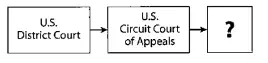
The diagram provides details about the U.S. court system.
Which court completes the diagram?
U.S. Supreme Court
Florida District Court
Court of Veterans Appeals
Florida Supreme Court
Connie Hargrave's tree fell in the last storm and damaged the car of her neighbor, Andy Collin. Connie did not have insurance that covered this type of accident and has not paid Andy for the damage. Andy decides to sue Connie in court. Which type of lawsuit will this be?
civil
military
criminal
constitutional
Why were Hammurabi's Code, the Twelve Tables, and the Code of Justinian significant?
They established official religions.
They established new economic systems.
They established democratic governments.
They established written laws for the entire community.
How did the U.S. Supreme Court decision in Marbury v. Madison affect the role of the judicial branch in the American system of government?
It expanded the role of the judicial branch by establishing judicial review.
It established the right of the Supreme Court to expand its original jurisdiction.
It upheld the right of the Supreme Court to approve all lower court appointments.
It determined that the U.S. Supreme Court could offer advisory opinions to either the President or the Atoorney-General.
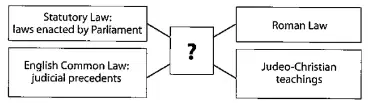
The diagram shows details about the law.
Which phrase completes the diagram?
The Code of Justinian
Sources of American Law
The Enforcement of Contractual Agreements
Blackstone's Commentaries on the Laws of England
Jack lives in Miami. He has a contract dispute with a hotel owner in Tampa for less than $15,000. In which court should Jack seek help?
U.S. District Court
Florida Circuit Court
Florida County Court
Florida District Court of Appeal
What does the U.S. Constitution have in common with the Twelve Tables of ancient Rome?
Both established harsh punishments for crimes.
Both described detailed procedures for court proceedings.
Both emphasized that citizens were protected by rule of law.
Both were more concerned with property rights than with individual freedom.
What is a benefit of rule of law?
Bureaucratic government procedures are reduced.
Government decisions are based on the will of the majority.
Government officials can act in their own instincts in emergencies.
Citizens are protected from arbitrary and oppressive uses of government power.
What is one of the five freedoms protected by the first amendment?
Freedom of speech
Freedom from self-incrimination
Freedom from unreasonable searches and seizure
Freedom from cruel and unnatural punishments
What is the first step in amending the U.S. Constitution?
Three-fourths of the state legislatures propose the amendment
Two-thirds of each house of Congress propose the amendment
Conventions in three-fourths of the states propose the amendment
The President, after consulting the U.S Supreme Court, proposes the amendment
Juanita was accused of shoplifting in a neighborhood department store. She went to trial and the jury found her to be "not guilty." However, the storeowner found video footage after the trial, proving that Juanita did shoplift. The owner takes this evidence to the district attorney. How will the district attorney respond?
With this evidence, Juanita will probably be convicted on her second trial.
Juanita cannot be convicted because she was not advised of her right to legal counsel.
Juanita cannot be tried again because this would violate the ban on "double jeopardy."
After seeing this evidence, Juanita may admit her wrongdoing and plead guilty to a lesser charge.
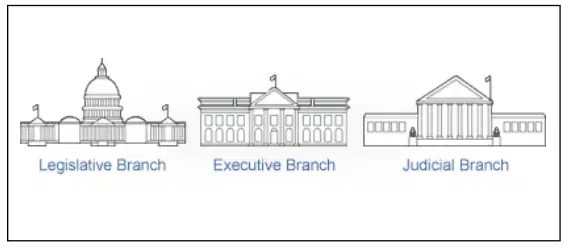
The image concerns the government.
Which Enlightenment idea is represented by the image?
Separation of powers
Checks and balances
Social contract
Natural law
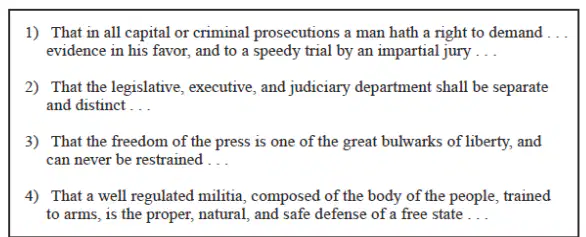
The statements are from the 1776 Virginia Declaration of Rights.
Which statement reflects the Enlightenment ideas of government as expressed by Montesquieu?
1
2
3
4
Which documents influenced the colonists’ views of government?
Common Sense, Articles of Confederation, Declaration of the Rights of Man
Virginia Declaration of Rights, Common Sense, Bill of Rights
Magna Carta, Mayflower Compact, Common Sense
Magna Carta, Iroquois Constitution, Common Sense
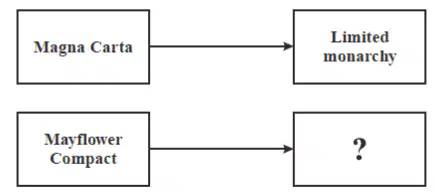
The diagram shows that the colonists formed some of their political views from some historical documents.
Which phrase completes the diagram?
separation of powers
economic freedom
self-government
individual rights
Which document addressed colonial concerns about English policies?
Declaration of Independence
Mayflower Compact
U.S. Constitution
Bill of Rights
The text below is from a historical document.
"We hold these truths to be self evident, that all men are created equal, that they are endowed by their Creator with certain unalienable Rights, that among these are Life, Liberty, and the pursuit of Happiness."
Which document contains this passage?
Declaration of Independence
Articles of Confederation
English Bill of Rights
U.S. Constitution
What is one way that the ideas stated in the Declaration of Independence are evident today?
equal employment opportunities
voting rights amendments
selective service
term limits
Which part of the U.S. Constitution states the six purposes of government?
Bill of Rights
Article IV
Preamble
Article 1
In the Preamble to the U.S. Constitution, what is the meaning of the phrase “We the People”?
The people express their will through political parties.
The people express their will by directly creating laws.
Government receives taxes from the people and exists to support them.
Government receives its power from the people and exists to serve them.
What check does the U.S. Senate have on the president?
overriding vetoes
appointing judges
declaring laws unconstitutional
refusing to confirm appointments

The passage is from Federalist No. 47, written by James Madison in 1788.
Based on this passage, which constitutional principle does Madison describe?
separation of powers
checks and balances
popular sovereignty
judicial review
Which statement describes an impact of the rule of law?
state of nature
checks and balances
separation of powers
transparency of institutions
Which characteristic serves as a long-term protection against tyranny and is a foundation of liberty in the United States?
the commerce clause
the elastic clause
the right to trial
rule of law
The Code of Hammurabi (1772 BC) includes laws focusing on contracts. What type of U.S. law is based on the Code of Hammurabi?
civil
constitutional
criminal
military
What right do citizens have?
attending public schools
owning property
holding a job
voting
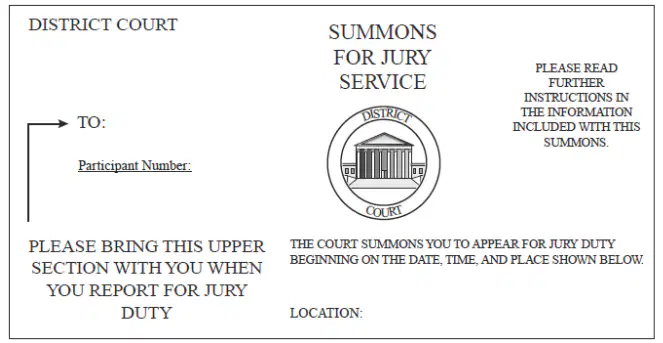
The illustration shows a legal document.
Why are citizens obligated to respond to such documents?
to guarantee court hearings remain public
to guarantee courts provide probable cause
to protect the constitutional right to be tried by one’s peers
to protect the constitutional right to confront one’s accuser
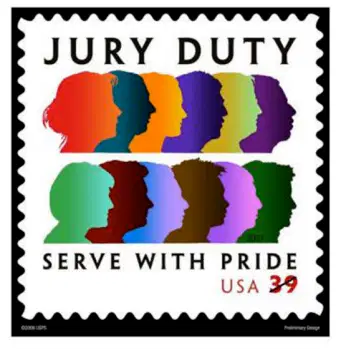
The image describes a citizen obligation.
Based on this image, what can be presumed about citizen obligations?
Citizens support attending civic meetings
Citizens support securing individual rights.
Citizens resist registering for selective service
Citizens resist contributing to the common good.
Which individual protection is found in the Fifth Amendment to the U.S. Constitution?
privacy rights
property rights
forced internment
civil disobedience
How did the passage of the women's suffrage amendment to the U.S. Constitution impact the political process in the United States?
Women were allowed to contribute to political campaigns.
Women were allowed to hold citizenship rights.
Women were allowed to hold public offices
Women were allowed to vote in national elections.
Which was an outcome of the U.S. Supreme Court decision in Brown v. Board of Education (1954)?
Administrators may limit the content of student publications.
Public school districts that segregate deny equal protection.
Students have a reduced expectation of privacy in school.
Criminal defendants have the right to an attorney.
What lessons did future U.S. leaders learn from the 1974 U.S. Supreme Court case United States v. Nixon?
The president is accountable for obeying the law.
The president is responsible for enforcing the law.
The president is not allowed to hold secret talks with foreign governments.
The president is not allowed to have private meetings with Cabinet members.
Which is a constitutional requirement to run for Congress?
U.S. permanent resident
at least 25 years old
at least 30 years old
U.S. citizen
Who do lobbyists represent in their attempts to influence government?
military officers
elected officials
interest groups
circuit judges
Based on the government system in the United States, which individual activity is used to directly influence legislative decisions?
watching political debates on television
discussing political issues at work
collecting opinions for a yearbook
gathering signatures for a petition
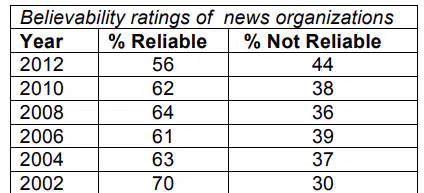
The table describes ratings for news organizations.
According to the table, what impact has media had on government?
Government is less likely to regulate the press.
Government is more likely to regulate the press.
Government is less likely to respond to public concerns.
Government is more likely to respond to public concerns
Which option presents a clear point of view?
Bias
Metaphor
Propaganda
Symbolism
The poster was created in 1917.
Which type of communication is shown in this poster?
accurate
biased
informational
propagandized
Who would a citizen contact about a problem with city roads?
The county commissioner
The president
The governor
The mayor
What is a responsibility of the U.S. Senate in foreign policy?
nominating ambassadors
introducing tax bills
negotiating treaties
ratifying treaties
Which statement correctly describes communism?
The central government controls all economic planning.
Workers are considered to be the lowest social class.
Property ownership is determined by family status.
Wealth is distributed according to social class.
What do an absolute monarchy and an autocracy have in common?
a single ruler
a written constitution
a national court system
a single legislative house
Which government system gives states the most power?
confederal
federal
parliamentary
unitary
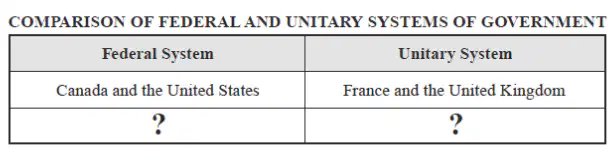
The image shows a comparison of two different systems of government.
Which information completes the table?
power divided among the branches/power held by one branch
role of government expanded/role of government limited
power shared/power delegated
rule by a democracy/rule by a monarchy
Which branch of federal government makes laws?
bureaucracy
executive
judicial
legislative

The newspaper headline describes an event in U.S. history.
Which parts of the national government participated in the process described in the newspaper headline?
Supreme Court and President
Senate and President
House of Representatives and Senate
Supreme Court and House of Representatives
Which is delegated to the national government?
conducting elections
establishing courts
coining money
taxing citizens
Which statement describes a similarity between the state and the federal governments under the U.S. Constitution?
Both levels of government allow for the election of judges.
Both levels of government have the power to ratify treaties.
Both levels of government have the power to appoint ambassadors.
Both levels of government allow for the collection of taxes.
Which is the last step in amending the U.S. Constitution?
The voters approve the amendment in a national election.
The president signs the amendment in a public ceremony.
Three-fourths of the state legislatures ratify the amendment.
Two-thirds of both houses of Congress ratify the amendment.
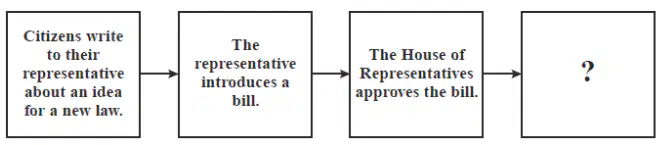
The diagram shows some of the steps involved in creating a Florida state law.
What is the next step in the lawmaking process?
The governor signs the bill into law.
The bill goes to the Senate for action.
The people vote on the bill in an election.
The bill goes to the Supreme Court for a hearing.
What do the highest courts of Florida and the United States have in common?
Both have the same number of justices.
Justices serve for life with good behavior.
Justices serve for set terms of office
Both have chief justices.
What is the correct order of Florida's courts, from lowest to highest authority?
circuit courts, Florida Supreme Court, county courts, District Court of Appeals
District Court of Appeals, Florida Supreme Court, county courts, circuit courts
county courts, circuit courts, District Court of Appeals, Florida Supreme Court
Florida Supreme Court, circuit courts, District Court of Appeals, county courts

The diagram provides details about the U.S. court system.
Which court completes the diagram?
Court of Appeals
Court of Veterans Appeals
Military Courts
Claims Courts
Which part of the Florida Constitution protects individual rights?
Declaration of Rights
Bill of Rights
Amendments
Preamble
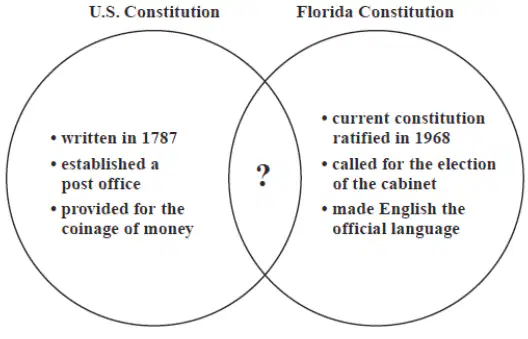
The Venn diagram compares some features of the U.S. and Florida constitutions.
Which feature completes the Venn diagram?
created property taxes
established a zoning board
required a balanced budget
guaranteed individual freedoms
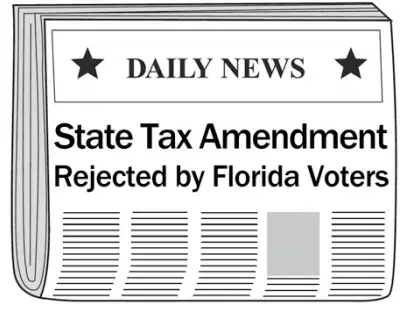
The headline describes an action by citizens.
What conclusion can be drawn from the headline?
Citizens can be involved in policy making through their representatives.
Citizens can be directly involved in policy making.
Only elected officials may change constitutions.
Only elected officials make policy.
Which level of government regulates drivers’ licenses?
county
federal
municipal
state
Which of these rights from the Bill of Rights helps people accused of crimes?
the right to bear arms for self defense
the right to have the assistance of counsel
the right not to have troops quartered in one's home
the right to petition government for a redress of grievances
While Alex was at school, police officers broke into his home and took his computer. They did not have a warrant and there was no reason to believe that Alex had broken any laws. Alex was not avoiding the police or planning to move away from his home. Which right did the police officers violate?
the right to due process of law in the Fourteenth Amendment
the right to assistance of legal counsel in the Sixth Amendment
he right to the equal protection of the laws in the Fourteenth Amendment
the right against unreasonable searches and seizures in the Fourth Amendment
Which statement best defines "due process" of law?
Decisions affecting individuals are made by a jury of peers.
Procedures used to enforce the law are fair, reasonable, and just.
People have guaranteed rights that can only be taken away in emergencies.
Government decisions affecting individuals are made in secret to avoid publicity.
Why is freedom of the press so important to democratic government?
It keeps talented and creative writers employed.
It helps government officials keep track of public opinion.
It keeps citizens informed about the acts of their government leaders.
It provides a place where candidates can advertise in election campaigns.
Which statement describes an impact of the "due process" and "equal protection" clauses of the Fourteenth Amendment?
Women were guaranteed the right to vote in all states.
African American freedmen were guaranteed the right to vote.
Americans were protected against abuses by state governments.
Opponents of the government no longer feared forced internment.
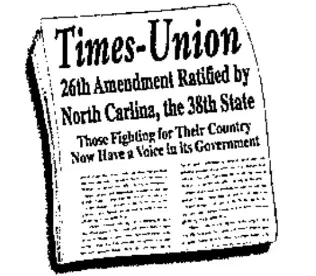
The newspaper headline announces an amendment to the U.S. Constitution.
What was the impact of the passage of this amendment to the U.S. Constitution on the American political process?
Women were allowed to vote in elections in all states.
Citizens between 18 and 21 years of age were allowed to vote in elections.
Those who could not afford to pay poll taxes could still vote in federal elections.
Restaurants and hotels could not practice discrimination against Vietnam veterans.
What was the significance of the U.S. Supreme Court decision in Marbury v. Madison?
It gave the Court the power the mediate disputes between different states.
It gave the Court original jurisdiction in disputes involving foreign governments.
It established the power of the Court to declare an act of Congress unconstitutional.
It established the right of the Court to advise Congress in advance on the validity of proposed laws.
Which statement describes the significance of the U.S. Supreme Court's decision in Miranda v. Arizona?
Southern states could no longer maintain racially segregated public schools.
States could no longer have racial quotas as part of their affirmative action programs.
Individuals accused of serious crimes unable to pay for an attorney were entitled to a state-sponsored one.
Suspects had to be told of their right to have any attorney present or to remain silent during police interrogations.
Which statement describes the significance of the U.S. Supreme Court decision in Brown v. Board of Education?
It overturned racial segregation in public schools.
It overturned the earlier decision of Gideon v. Wainwright.
It upheld state laws requiring the payment of poll taxes to vote.
It upheld state laws requiring racial segregation on railroad cars.
What lesson did state courts learn from the 1963 U.S. Supreme Court case Gideon v. Wainwright?
Minors are entitled to many of the same "due process" rights as adults.
Evidence cannot be presented in a court trial if obtained by police in an unlawful search.
Suspects must be informed of their 5th and 6th Amendment rights prior to police interrogation.
A person accused of a felony who cannot afford an attorney is entitled to have one appointed by the court.
Which is an example of a reserved power?
the power to collect taxes
the power to establish post offices
the power to educate young citizens
the power to declare war on foreign enemies
What is an example of a concurrent power?
the power to borrow money
the power to regulate interstate commerce
the power to set admission requirements for state universities
the power to make naturalization rules for immigrants
How does the process for amending the Constitution of Florida compare to that of amending the U.S. Constitution?
It is more difficult to amend the U.S. Constitution than the Florida Constitution.
It is more difficult to amend the Florida Constitution than the U.S. Constitution.
The Florida Constitution and the U.S. Constitution follow the same procedures for amendment.
The U.S. Constitution required two steps for amendment, while the Florida Constitution is amended in a single step.
Which obligation is owed by state governments to their citizens?
making local zoning ordinances
defending the nation against foreign attack
negotiating trade agreements with nations
regulating the activities of professionals such as doctors and lawyers
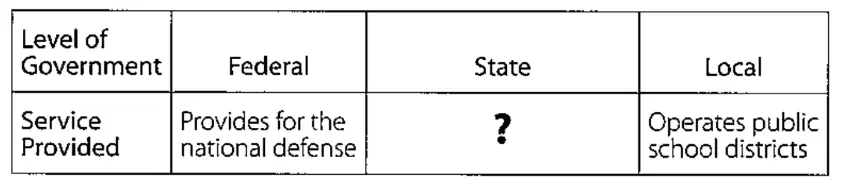
The table identifies services provided by different levels of government.
Which completes the diagram?
Enforces local building codes
Operates police and fire departments
Conducts diplomacy with foreign leaders
Establishes high school graduation requirements
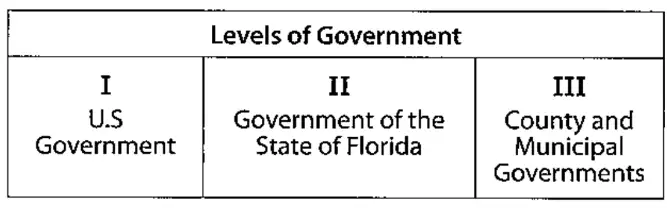
Use the chart to answer the following question.
Which governments provide garbage collection services to homes and businesses?
I only
I and II only
III only
I, II, and III
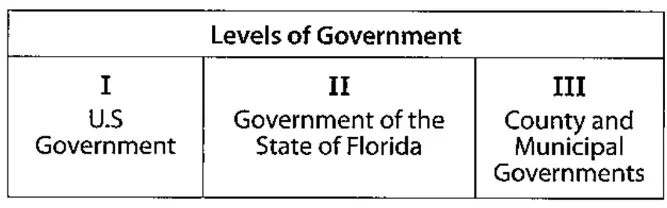
Use the chart to answer the following.
Which levels of government establish and implement educational requirements for minors?
I only
I and II
II and III
I, II, and III
Which statement identifies a basic similarity between the U.S. and Florida Constitutions?
Both have a preamble, articles, and amendments.
Both prohibit the collection of personal income taxes.
Both provide details of the qualifications for voting in elections.
Both have detailed provisions on public education and local government.
Which document does the Florida Declaration of Rights most closely resemble?
Magna Carta
The Bill of Rights
The U.S. Constitution
The Declaration of Independence
What is one way that the government of the state of Florida differs from the federal government?
Florida judges hold their positions with lifetime tenure.
Members of the Cabinet in Florida also sit in the state legislature.
Several Cabinet members in Florida are elected rather than appointed.
Unlike the Vice President of the U.S., the lieutenant governor of Florida is appointed.
What is a law passed by a Florida county or municipality called?
An act
A statute
A precedent
An ordinance
Based on the Tenth Amendment to the U.S. Constitution, which powers belong to either state governments or individual citizens?
All powers needed to conduct U.S. foreign policy.
All powers needed by Congress to carry out its enumerated powers.
All powers not delegated to the federal government by the Constitution.
All powers needed to prevent corruption and abuse by the federal government.
The list below identifies several activities:
Attending a school board meeting
Voting in a primary election
Helping on a phone bank for a mayoral candidate
Putting a candidate's sign in your yard
Registering voters at a community college
What do these activities illustrate?
ways that citizens can run for political office
opportunities for citizens to participate in national elections
opportunities for citizens to influence political action committees
ways in which citizens actively participate in the political process
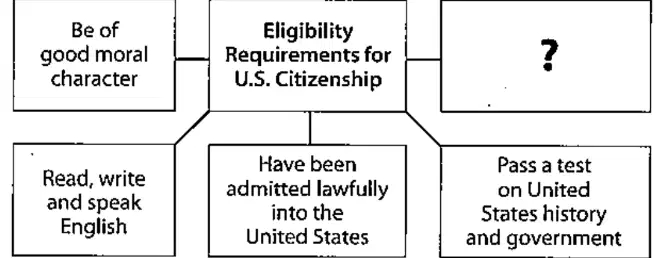
The diagram shows the requirements for becoming a naturalized citizen.
Which statement completes the diagram?
Pay federal income tax
Have an annual income of $20,000 or more
Have resided in the U.S. for five years
Have a close relative (parent, spouse, or child) who is a U.S. citizen
Which practice is part of the obligation of a U.S. citizen to help defend the nation?
serve on a jury
register for selective service
vote in all national elections
keep informed about national issues
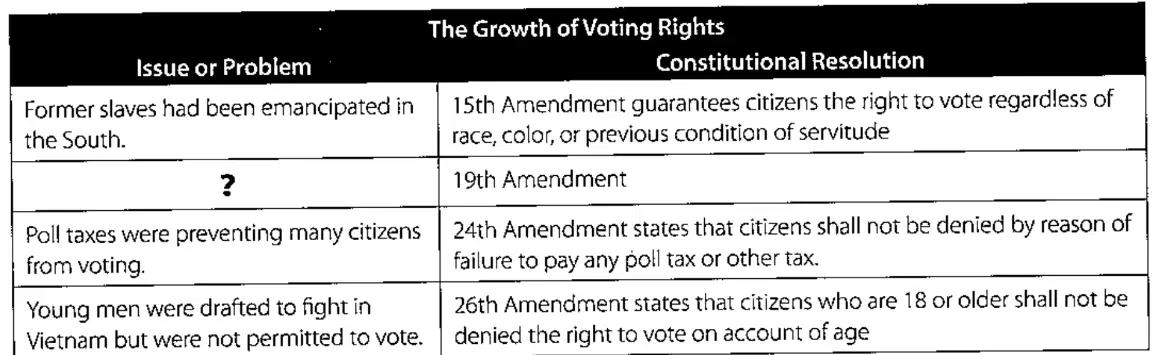
The table shows how U.S. voting rights have expanded in response to issues and problems.
Which statement best completes the table?
Women demanded the right to vote.
Native Americans demanded the right to vote.
Men without property demanded the right to vote.
African Americans demanded the right to vote without paying any special taxes.
What would be the most likely consequence to society if citizens began refusing to fulfill their citizenship responsibilites?
People would face the threat of losing their individual rights and freedoms.
People would have more free time because they would have fewer social obligations.
People would benefit from the direction of strong leaders who would guard their freedoms.
People would find that society was able to look after itself with the help of civic participation.
Which is considered a citizenship responsibility rather than an obligation?
obeying the law
paying taxes
attending civic meetings
registering for Selective Service
Which issue represents a basic disagreement between Socialists and Communists?
whether income taxes should be lowered
whether conditions for workers should be improved
whether all private businesses should be replaced by state ownership
whether the government should provide public services like free education and healthcare
How do the major parties select their candidate for President of the United states?
Party members select their party's candidate in a single run-off election.
Party "bosses" choose their party's candidate at their party's nominating convention.
All registered voters decide which candidates each party should choose in a national primary election.
After a series of caucuses and primary elections, delegates at each party's nominating convention chose their candidate.
What is an important difference between interest groups and political parties?
Interest groups have more members than political parties.
Interest groups have platforms addressing all issues of public concern.
Interest groups are organized to elect their candidates to political office.
Interest groups attempt to influence government directly on particular issues.
Which of the following is NOT one of the ways in which the media affect politics?
by providing information on both parties
by contributing to election campaign funds
by focusing public attention on particular issues
by providing in-depth coverage of national isues
The diagram gives details about the American political system.
Which title completes the diagram?
How interest groups decide an issue
How interest groups engage in electioneering
How interest groups use publicity to win support
How interest groups lobby state and federal legislators
Sarah felt very strongly about an issue in the news. She wrote to her representative in Congress and expressed her feelings on the issue. Then she wrote a short editorial for the local newspaper and sent it off. Which statement describes Sarah's activities?
She was acting as a lobbyist.
She was forming her own political party.
She was starting her own special interest group.
She was participating directly in government.
Which best describes the main objective of a lobbyist?
to raise campaign funds for political parties
to influence public decision-making for the common good
to influence state legislators or members of Congress on issues
to advise political candidates on how to manage their election campaigns
What is one way that citizens can directly influence public policy?
by becoming better informed about issues
by watching more news programs on television
by sending petitions signed by citizens to local officials
by expressing their views to their closest friends and relatives
What perspective did civil rights groups take on the issue of racial segregation in the South in the 1950s and 1960s?
They felt it would be better to be patient and accept gradual change in the South.
They believed Southern supporters of segregation should be threatened with acts of racial violence.
They believed it was time for radical policy alternatives, such as moving all African Americans to the North.
They felt it had become necessary to oppose segregation with marches, sit-ins, demonstrations, boycotts, and civil disobedience.
What do an absolute monarchy, dictatorship, and oligarchy have in common?
The head of state is chosen by Parliament.
Their citizens decide public issues for themselves.
Political power is exercised by representatives elected by the people.
A single individual or small group exercises control over government.
Which type of government selects its executive leadership from the majority party in the legislature?
unitary
federal
confederal
parliamentary
Which statement is true of a federal but not of a unitary system of government?
Its local governments are extensions of the central government.
Its local governments cannot be abolished by the central government.
Its central government usually appoints the leaders of local governments.
Its central government delegate responsibilities to local governments to carry out.
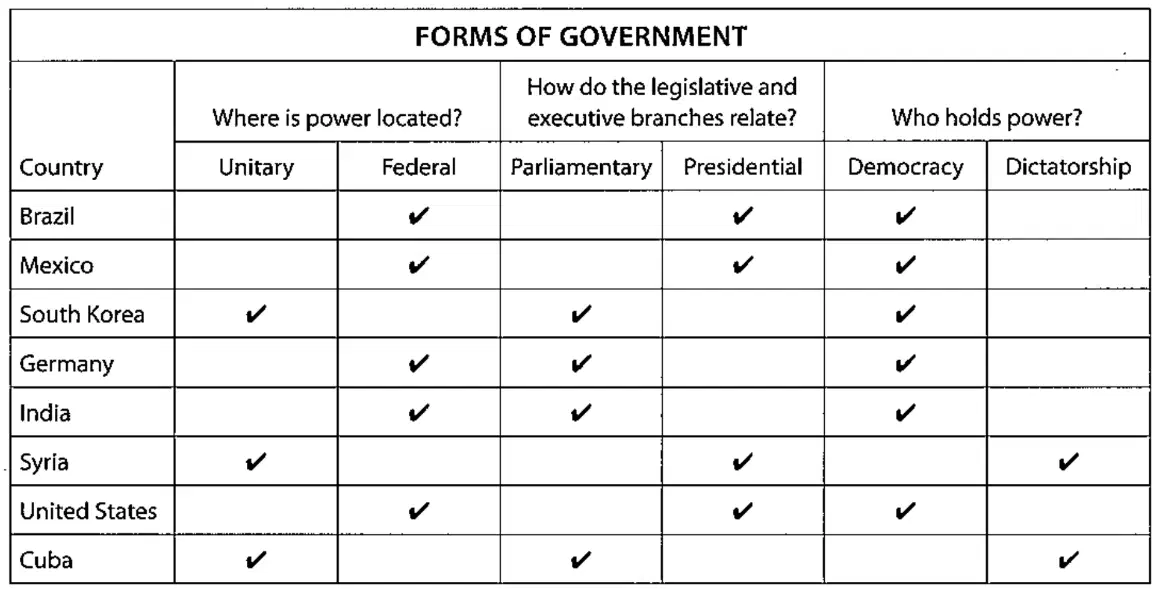
Based on the table, in which country is power held by a single person or small group?
Syria
India
South Korea
Mexico
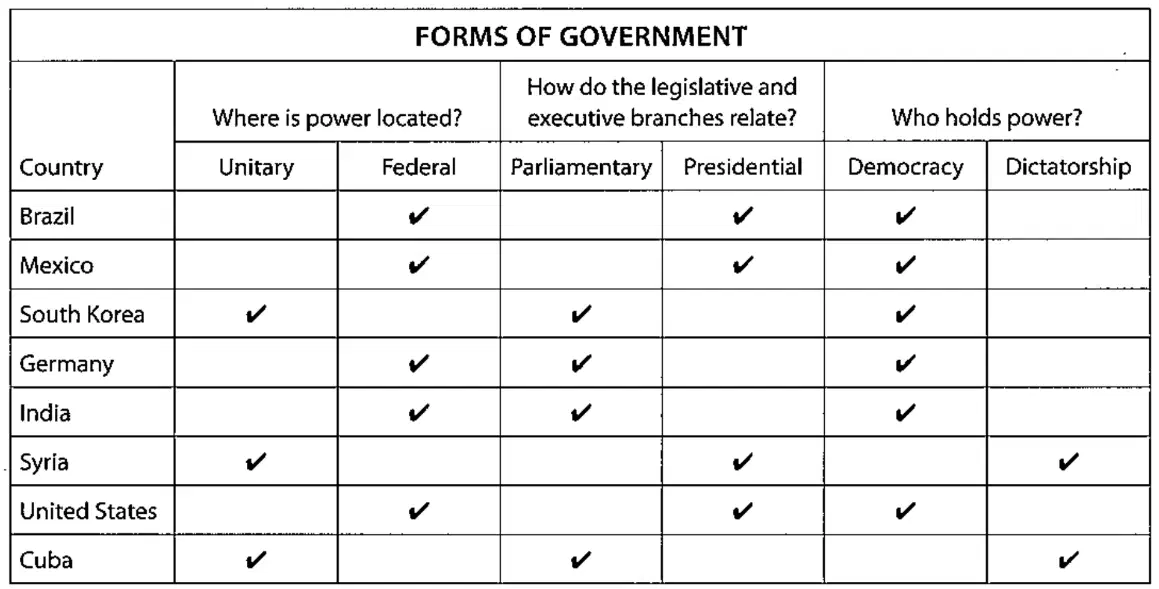
Based on the table, how are the governments of Syria, Mexico, and Brazil similar?
All three governments are party dicatorships.
All three governments are ruled by popular representatives.
All three governments have separate executive and legislative branches.
All three central governments have complete power over local government.
Why did the authors of the Constitution create a federal system of government rather than a unitary system?
They wanted to limit the role of the people in government.
They did not trust the state governments.
They had seen how inefficient a weak central government was under the Articles of Confederations.
They feared a central government that was too powerful.
Which list correctly identifies the three types of governments in the diagram?
1. Unitary; 2. Federal; 3. Confederal
1. Federal; 2. Presidential; 3. Unitary
1. Monarchical; 2. Parliamentary; 3. Communist
1. Communist; 2. Democratic; 3. Monarchical
Which constitutional power helps the President in the conduct of U.S. foreign policy?
the power to declare war on foreign nations
the power to receive ambassadors from foreign countries
the power to ratify treaties negotiated with foreign countries
the power to make final appropriations for the U.S. State Department
The diagram shows details about the federal government.
Which phrase best completes the diagram?
How Congress influences U.S. domestic policy
How Congress influences U.S. foreign policy
How the State Department manages U.S. foreign policy
How the House Committee on Foreign Affairs investigates issues
Which organization has the U.S. government as a member?
Doctors without Borders
International Red Cross
North Atlantic Treaty Organization
Organization of Petroleum Exporting Countries (OPEC)
During the ratification debates, Anti-Federalists demanded that the rights below be added to the Constitution in order for them to support it:
Guarantee of a speedy trial
Freedom from illegal searches and seizures
Right not to have troops quartered in one's home
Which document guaranteed these rights?
The Bill of Rights
The Federalist Papers
The Articles of Confederations
The Declaration of Independence
The final clause of Article I, Section 8, gives Congress the power to make all laws that are "necessary and proper" to fulfill its other responsibilities. What name is sometimes given to this clause?
Elastic Clause
Ex Post Facto Clause
Bill of Attainder Clause
Writ of Habeas Corpus Clause
How does the Supreme Court decide which cases to review each year?
It grants writ of certiorari to all cases that come before it on appeal.
It grants writ of certiorari to some of the cases it believes to be of national importance.
It grants writ of certiorari to all cases recommended to it by the President.
It grants writ of certiorari to most of those cases on which the U.S. Circuit Courts are already in general agreement.
Why does the Supreme Court have only limited jurisdiction?
People prefer to go to their local court because they are closer.
Supreme Court Justices have only limited time at their disposal.
Congress has decided to limit the jurisdiction of the Supreme Court.
The U.S. Constitution grants federal courts authority over only some matters.
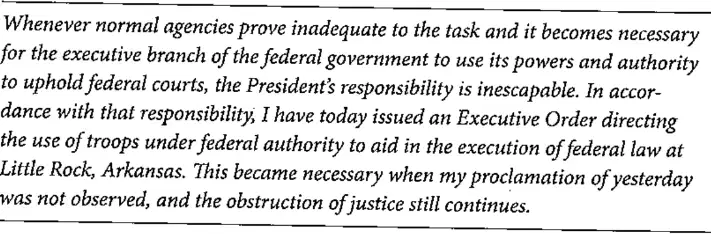
In September 1957, President Dwight Eisenhower issued an executive Order to protect nine African-American students facing racial violence at Central High School in Little Rock, Arkansas. President Eisenhower explained his actions to the nation in the televised address in the image.
What role was President Eisenhower exercising in issuing this Executive order?
Chief Diplomat
Chief Legislator
Chief Executive
Commander in Chief

