
 Worksheets
MAP SCIENCE 5TH GRADE MO
Total questions: 32
Worksheet time: 16mins
Name
Class
Date
1.
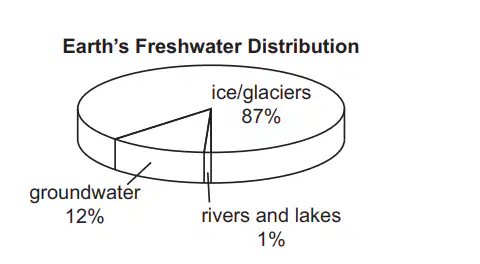
What percent of Earths water is in ice / glaciers?
a)
12
b)
1
c)
87
d)
0
2.
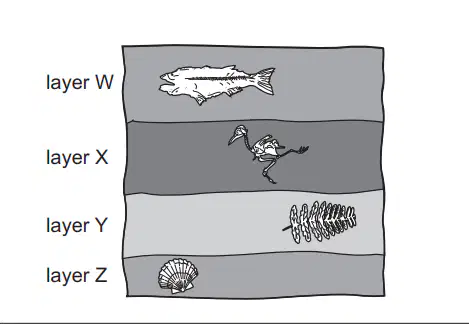
What is the oldest layer of rock?
a)
z
b)
y
c)
x
d)
w
3.

How will adding a bag of ice on top of the plastic wrap affect the water vapor rising from the cup in the water cycle model?
a)
Increase the rate of condensation.
b)
Decrease the rate of evaporation.
c)
Accelerate the rate of transpiration.
d)
Slow down the rate of precipitation.
4.
Which of the following is an example of a solid state of matter?
a)
Steam
b)
Water
c)
Air
d)
Ice
5.
What is the process by which soil and rock are worn away by water, wind, or ice?
a)
Condensation
b)
Evaporation
c)
Precipitation
d)
Erosion
6.
What is the systematic way of investigating the world around us by making observations, forming hypotheses, conducting experiments, and drawing conclusions?
a)
Random selection
b)
Guessing game
c)
Magic trick
d)
Scientific method
7.
What is an example of adaptation in the animal kingdom where a creature can change its skin color to blend in with its surroundings?
a)
Elephant
b)
Lion
c)
Chameleon
d)
Giraffe
8.
What is the ability to do work or cause change, and comes in forms such as light, heat, and electricity?
a)
Motion
b)
Energy
c)
Force
d)
Gravity
9.
Which of the following is an example of a force that can change an object's motion?
a)
Sun shining in the sky
b)
Rain falling from the clouds
c)
Gravity pulling an apple down from a tree
d)
Wind blowing through the leaves
10.
What is the condition of the atmosphere at a particular place and time, including temperature, precipitation, and wind?
a)
Erosion
b)
Climate
c)
Season
d)
Weather
11.
Which of the following is NOT one of the three main states of matter?
a)
Plasma
b)
Gas
c)
Liquid
d)
Solid
12.
Why is it important to study science in 5th grade?
a)
To learn about history
b)
To practice math skills
c)
To understand the human body
d)
To explore the natural world
13.
What is the main function of gravity on Earth?
a)
Generating electricity
b)
Creating new landforms
c)
Causing volcanic eruptions
d)
Keeping objects grounded
14.
What is matter?
a)
A type of animal
b)
A type of plant
c)
A type of energy
d)
Anything that has mass and takes up space
15.
What are the different forms of matter?
a)
Energy, force, motion
b)
Plants, animals, rocks
c)
Light, sound, heat
d)
Solid, liquid, gas
16.
Which of the following best describes a life cycle?
a)
The series of changes an organism goes through from birth to death
b)
The process of eating and digesting food
c)
The movement of organisms from one place to another
d)
The process of breathing oxygen
17.
What role does gravity play in the solar system?
a)
Keeping planets in orbit around the sun
b)
Causing earthquakes
c)
Generating heat on Earth
d)
Creating new stars
18.
What role does gravity play in the context of the solar system and planetary motion?
a)
Gravity causes earthquakes and volcanic eruptions on Earth
b)
Gravity generates heat and light in the solar system
c)
Gravity keeps planets in orbit around the sun and affects the motion of celestial bodies
d)
Gravity creates new landforms and shapes the Earth's surface
19.
Which of the following is an example of a producer in a food web?
a)
Eagles
b)
Wolves
c)
Deer
d)
Oak trees
20.
What is the carbon cycle?
a)
The movement of carbon atoms in a straight line
b)
The process of carbon being eliminated from the environment
c)
The process of carbon being converted into energy
d)
The process by which carbon is exchanged between different parts of the environment
21.
Which of the following is an example of a mixture?
a)
Pure water
b)
Oxygen gas
c)
Salt and sand
d)
Iron metal
22.
Which of the following is an example of a solution?
a)
Sand and rocks
b)
Saltwater
c)
Oxygen gas
d)
Iron metal
23.
What is gravity?
a)
A force that pulls objects towards each other
b)
A type of gas in the atmosphere
c)
A type of plant species
d)
A type of rock formation
24.
Which of the following is an example of a primary consumer in a food web?
a)
Oak trees
b)
Wolves
c)
Deer
d)
Eagles
25.
In a food web, what do secondary consumers eat?
a)
Producers
b)
Tertiary consumers
c)
Decomposers
d)
Primary consumers
26.
In a food chain, what typically starts the sequence?
a)
Producer
b)
Tertiary consumer
c)
Secondary consumer
d)
Primary consumer
27.
What is the importance of the carbon cycle?
a)
Regulating the temperature of the Earth
b)
Preventing natural disasters
c)
Maintaining the balance of carbon in the environment
d)
Creating new ecosystems
28.
What is a food web?
a)
A type of soil composition
b)
A type of plant species
c)
A single linear sequence of organisms
d)
A network of interconnected food chains
29.
What is the relationship between a food web and a food chain?
a)
A food web is a type of soil composition, while a food chain is a type of plant species
b)
A food web is a single linear sequence of organisms, while a food chain is a network of interconnected food chains
c)
A food web is a type of plant species, while a food chain is a type of soil composition
d)
A food web is a network of interconnected food chains, while a food chain is a single linear sequence of organisms
30.
Which of the following is an example of a secondary consumer in a food web?
a)
Eagles
b)
Oak trees
c)
Deer
d)
Wolves
31.
How does the carbon cycle contribute to the balance of carbon in the environment?
a)
By increasing carbon emissions and levels in the atmosphere
b)
By exchanging carbon between different parts of the environment to maintain equilibrium
c)
By eliminating carbon from the ecosystem entirely
d)
By converting carbon into energy for living organisms
32.
How does the concept of matter relate to the different forms it can take?
a)
Matter is a type of energy that can exist in various states
b)
Matter is a type of animal that can transform into different substances
c)
Matter is a type of plant that can change its composition
d)
Matter is anything that has mass and takes up space, existing in solid, liquid, and gas forms
100 %

