
 Worksheets
Zeros of Polynomials Test
Total questions: 135
Worksheet time: 1hrs 26mins
f(x) = (x-5)(2x+3)(7x-4)(x+6)

What do "zeros" represent?
something a polynomial can not be.
the place that the polynomial crosses the x axis/ the x value that makes the whole equation equal to zero
the place that the polynomial crosses the y axis/ the y value where x=0
the number zero
To find zeroes of polynomials, we...
say x=0
make pancakes
ask NASA
set factors equal to zero
Note that:
x2+4x−5=(x+5)(x−1)What are the factors of x2+4x−5 ?
(a)
For (x+5)(x−1)=0 , what is x equal to? (You can only select 1 answer!!!)
x=-5
x=-4 x=1
x=1
x=1 and x=-5
x=-1 and x=5
The degree of the function is...
the size of it
the number of terms
the greatest exponent on the variable
a BS in mathematics
The degree of a function is always equal to...
the number of petals on a daisy
the number of factors
one less than the number of zeros
the number of terms in the polynomial
A polynomial has 7 factors. What is the degree of that polynomial?
1
3
5
7
19
What is the degree of (x-1)(x+5)?
3
4
1
2
If a polynomial has 2 factors, it will have 2 zeros (or 1 zero with a multiplicity of 2).
True
False
How many zeros does x2+3x−4 have?
1
2
3
4
Even Multiplicities have which of the following effects on the x-axis?
touches and bounces back
wiggle
crosses the x-axis
y = x(x - 6)(x + 5)
y = (x + 2)(x - 7)3
f(x)= x3(x + 3)2(x – 5)
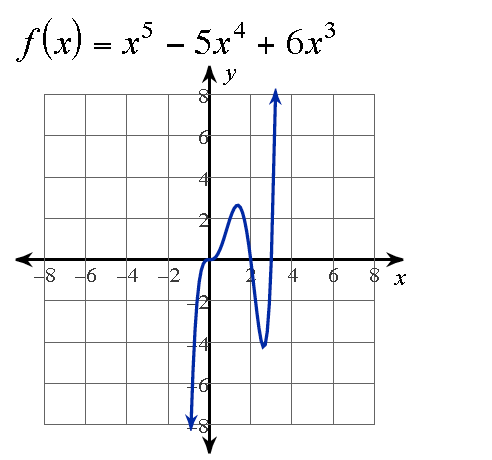
For each function, determine the real zeros and state the multiplicity of any repeated zeros.
{0 mult. 3, 5, 2}
{−2 mult. 3, 3, 1}
{0 mult. 3, 3, 2}
{2 mult. 3, 3, 3}
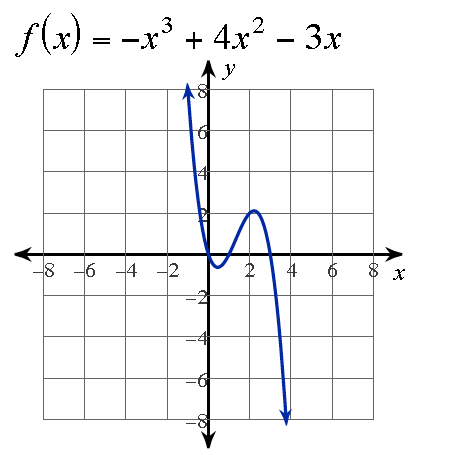
For each function, determine the real zeros and state the multiplicity of any repeated zeros.
{0 mult. 3}
{0, 3, 1}
{0, −2, −1}
{−2, 3, 1}
f(x) = (x+2)(x-3)2(x-4)
Which choice best describes the zeros?
-2, 3 (multiplicity 2), 4
-2 (multiplicity 2), 3, 4
2, -3 (multiplicity 2), -4
2 (multiplicity 2), -3, -4
Zeros: – 5(multiplicity of 3), 9(multiplicity of 2), – 2, 4.
y = 9(x + 2)(x - 7)3
List the zeros for this function.
f(x) = x4(x+3)2(x - 2)
Find and select each real zero and its multiplicity
Zeros: – 5(multiplicity of 3), 9(multiplicity of 2), – 2, 4.
Even Multiplicities have which of the following effects on the x-axis?
Cross the x-axis
touches and bounces back
Zeros: – 5(multiplicity of 3), 9(multiplicity of 2), – 2, 4 Degree: 7
f(x)= x3(x + 3)2(x – 5)
If the graph of a function crosses the x-axis, what does that mean about the multiplicity of that zero?
Even
Odd
None
y = (x + 2)(x - 7)3
The degree of a polynomial determines...
the maximum number of x-intercepts
the number of turning points
if the end behavior is up or down
the y-intercept
Find and select each real zero and its multiplicity
Find the zeros.
(x-5)(x+6)=0
{5,5 }
{ -5,-5 }
{ -5,-6 }
{5,-6 }
Find the zeros.
(x + 2)(x - 3) = 0
{ 2, 3 }
{ -2, -3 }
{ 2, 3 }
{ -2, 3 }
Find the zeros.
(2x - 1)(x + 4) = 0
{ 1/2, -4 }
{ 1/2, 4 }
{ 2, -4 }
{ -2, 4 }
0=x(x - 6)
Find the zeros.
5(x+12)(x-12) = 0
{5,12,-12}
{-12, 12}
{0,12,-12}
{12}
Find the zeros.
8x(2x + 4)(x - 6)
x = - 2, 6, - 8
x = 2, 6, 0
x = - 2, 6, 0
x = - 8, 4, 6
Solve by grouping.
12x(x + 2) + 2x + 4
(12x + 2x)(x + 6)
(12x + 2)(x + 2)
14x + 6
(12x + 1)(x + 2)
Which of the equations is equivalent to:
4x(x - 5) + 6(x - 5) = 0
(4x + 6)(x - 5) = 0
(4x + 6)(x + 5)2 = 0
4x(6)(x -5) = 0
Select the two numbers that add to 10 and multiply to 21.
7
6
3
4
Select the two numbers that add to 5 and multiply to 4.
1
4
2
3
Select the two numbers that add to - 4 and multiply to -32.
-8
-1
-3
4
Select the two numbers that add to -7 and multiply to 12.
-3
3
4
-4
Factor by grouping
x3 - 4x2 -4x + 16
(x+4)(x+2)
(x-4)(x2 -4)
(x+4)(x2 -4)
(x-4)(x-2)
63x4 - 7x2 + 28x
4p³+8p²+3p+6
x³+7x²-2x-14
Find the values of the zeros of the function y=(x+2)(x-3)(3x-5)
x=-2, x=3, x=5/3
x=2, x=-3, x= -5/3
x=-2, x=3, x=3/5
x=2, x=-3, x=-3/5

What are the zeros of the function?
4, 1
-3, -1, 2, 5
-3, -1, 30, 2, 5
3, 1, -2, -5
What are the roots of the function y=(x+2)(x−7)3
2, 7 multiplicity 3
-2, -7 mulitplicity 3
-2, 7 mulitplicity 3
2, -7 multiplicity 3
State the zeros of the polynomial function f(x)=x(x+3)2(x−2)
0, 2, -3
0, 2, -3 multiplicity 2
2, -3 mulitiplicity 2
0, -2, 3 multiplicity 2
How many zeros does the polynomial function f(x)=3x4+4x2 +8 have?
2
3
4
6
Write the polynomial in standard form given the zeros, x=0, -2, 1
y=x2 +x−2
y=x4+x3−2x2
y=x3 +x2−2x
y=x3 −x2−2x
Write the factored form of the polynomial with roots x=-2. x=5, x=2/3
y=(x-2)(x+5)(3x+2)
y=(x-2)(x+5)(2x+3)
y=(x+2)(x-5)(2x-3)
y=(x+2)(x-5)(3x-2)

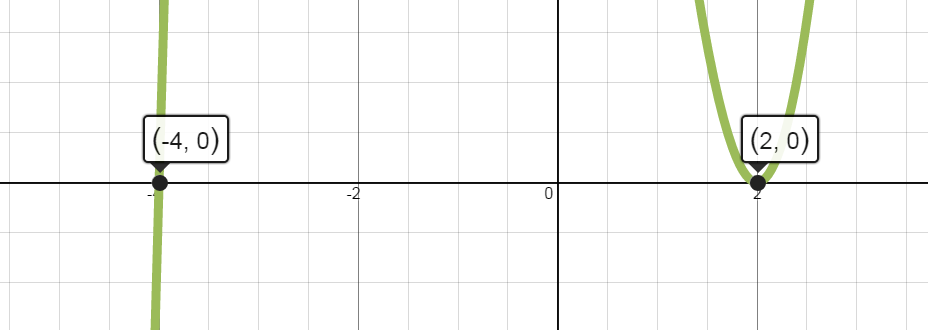
Which of the following is the correct equation for the function graphed?
f(x)=(x−1)2 (x+2)2
f(x)=(x+1)2(x−2)2
f(x)=(x−1)(x+2)
f(x)=(x+1)(x−2)

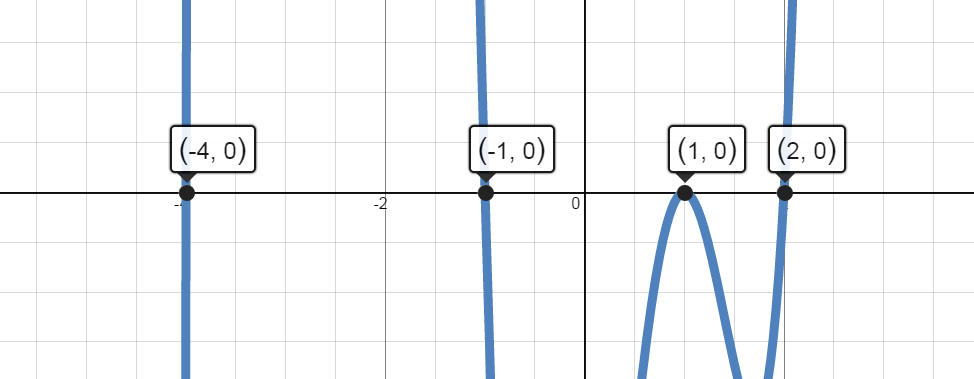
What is the equation in factored form of the function graphed?
f(x)=−(x+4)(x+1)2(x−2)(x−4)
f(x)=−(x−4)(x−1)2(x+2)(x+4)
f(x)=(x+4)(x+1)2 (x−2)(x−4)
f(x)=(x−4)(x−1)2 (x=2)(x+4)

Which is a possible equation in factored form of the function in the graph?
y=(x+2)(x−1)2
y=(x−2)(x+4)(x+1)2
y=−(x+2)(x−1)2
y=−(x+1)2(x−2)
How does a factor with multiplicity of 2 affect the graph of a polynomial function?
Touch and Turn
Straight Through
"Snake" Through
Touch, Flatten, and Turn
What is the degree of the polynomial? f(x)=−2x(x+3)2(x−7)(x+5)3
6
7
5
3
What is the degree of the polynomial? y=−4x5+3x2−8x+1
8
4
5
7

What is the degree of the function graphed?
5
1
3
2

What is the degree of the function graphed?
3
5
7
6

What is the degree of the function graphed?
2
4
6
8
What is the degree of the function:
f(x) = 6x2 + 4 - 3x4 + 5x - 9x3
1
2
3
4
What is the leading coefficient of the function:
f(x) = 6x2 + 4 - 3x4 + 5x - 9x3
6
3
-3
4
What type of function is:
f(x) = 6x2 + 4 - 3x4 + 5x - 9x3
linear
quadratic
cubic
quartic
A function with degree 3 is called
constant
cubic
linear
quadratic
Simplify:
(4x3 + 2x2 - 5x - 9) + (-3x3 - 5x2 - x + 11)
7x3 + 7x2 - 6x + 2
x3 - 3x2 - 6x + 2
7x3 - 3x2 - 6x + 2
x3 + 7x2 - 4x + 2
Simplify:
(4x3 + 2x2 - 5x - 9) - (-3x3 - 5x2 - x + 11)
7x3 + 7x2 - 4x - 20
7x3 - 3x2 - 6x + 2
x3 - 3x2 - 6x + 2
x3 + 7x2 - 4x - 20
Multiply (2x + 3)(2x - 3)
4x2 - 12x + 9
4x2 + 12x - 9
4x2 - 9
4x2 + 9
Match the following End Behavior to their Graphs

Degree is Odd, Leading Coefficient is Negative

Degree is Odd, Leading Coefficient is Positive

Degree is Even, Leading Coefficient is Negative

Degree is Even, Leading Coefficient is Positive

What makes the end behavior the same on both ends?
negative exponent
odd degree
even coefficient
even degree
Match the following:
Monomial
( −2x )
Binomial
( 3x2+7 )
Trinomial
( 5x2+7x−10 )
Polynomial
( 8x4+7x2+3x−9 )
Classify this polynomial by its degree and number of terms: 4x3
Cubic monomial
Linear binomial
Cubic binomial
6th degree (sextic) monomial
9x4
Quadratic polynomial
Quartic monomial
Quadratic monomial
Cubic monomial
Classify the polynomial
3x2
constant monomial
quintic monomial
linear binomial
quadratic monomial
quadratic binomial
−10x
linear monomial
9x5+4x4+3
quintic trinomial
4x−10x2−2x4
quartic trinomial
9x−4
linear binomial
3x−2x4+10−2x2
quartic polynomial
2x – 9
7x3 – 8x2 + 9
12 - 3x3 - 10x - x2
It is in Standard Form.
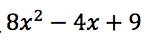
Name of polynomial with 3 terms
monomial
binomial
trinomial
polynomial
What is the name of 1 term?
Trinomial
binominal
term
monomial
What are the like terms in the following
( 5rt - 3rw - 8tw) + ( 6rt - 4rw + 2tw )
(Match the letters exactly).
5rt & 6rt
-3rw & -4rw
-8tw & 2tw
5rt & -4rw
-3rw & 2tw
-8tw & 6rt
*Remember
1-Match
2-Flip
3-Combine
( 8x3 + 3x2 + 4x + 10 ) - ( 3x3 - 4x2 + 2x + 1 )
11x3 + 7x2 + 6x + 12
5x3 + 7x2 + 2x + 9

5x3 - x2 - 2x + 11

The name of the polynomial is (a) (b)

The name of the polynomial is (a) (b)

The name of the polynomial is (a) (b)

The name of the polynomial is (a) (b)

The name of the polynomial is (a) (b)

The name of the polynomial is (a) (b)

The name of the polynomial is (a) (b)

The name of the polynomial is (a) (b)

(a) (b)

(a) (b)

(a) (b)

(a) (b)

(a) (b)

(a) (b)

(a) (b)

(a) (b)

(a) (b)

(a) (b)
Standard form is when terms are in order from least to greatest
True
False
A monomial has how many terms?
1
2
3
4+
A binomial has how many terms?
1
2
3
4+
A trinomial has how many terms?
1
2
3
4+
A polynomial has how many terms?
1
2
3
4+
2x3+5x Classify by the number of terms
Monomial
Binomial
Trinomial
Polynomial
x+3y+7 Classify by the number of terms
Monomial
Binomial
Trinomial
Polynomial
18x8y2z Classify by the number of terms
Monomial
Binomial
Trinomial
Polynomial
2x+8x4−4+3x2 Classify by the number of terms
Monomial
Binomial
Trinomial
Polynomial
The degree of a monomial is the sum of the exponents of all included variables
True
False
The degree of a polynomial is the sums of the exponents of all the terms
True
False
A constant has a degree of:
0
1
2
3
4+
A Linear has a degree of:
0
1
2
3
4+
A Quadratic has a degree of:
0
1
2
3
4+
A Cubic has a degree of:
0
1
2
3
4+
4xy
Classify by degree.
Constant
Linear
Quadratic
Cubic
5th Degree
3x +9x3+8x2
Classify by degree.
Constant
Linear
6th degree
Cubic
5th Degree
2+8+9+12
Classify by degree.
Constant
Linear
6th degree
Cubic
5th Degree
−6p5+4p +10p6−7p2
Classify by degree.
Constant
Linear
6th degree
Cubic
5th Degree
2+10b
Classify by degree.
Constant
Linear
6th degree
Cubic
5th Degree
2x3y+4x2
Classify by degree.
Constant
Linear
Quartic
Cubic
5th Degree
n3+8n2
Classify by degree.
Constant
Linear
8th degree
Cubic
5th Degree
6x2−8x +4
Classify by degree.
Constant
Linear
6th degree
Quadratic
Cubic

