
 Worksheets
Cell Biology - Test 5 :: Diffusion
Total questions: 73
Worksheet time: 2hrs 32mins
Diffusion & Facilitated Diffusion are both __________ transport.
Passive
Active
Easy
Free
Passive Transport is the movement of particles across the membrane from an area of [ ___ ] to an area of [ ___ ]
high to low
low to high
low to low
high to high
Passive Transport uses ____ energy
no
a lot of
a little bit of
some
_____________ is the free movement of particles across the membrane with the concentration gradient
diffusion
facilitated diffusion
active transport
fusion
Passive Transport is the movement of particles _________ the concentration gradient.
with
against
opposing
throughout
An example of diffusion is
CO2 and O2 exchange in the lungs
Glucose transport
Na+ / K+ Pumps
Exocytosis
What is the movement of particles with the concentration gradient using protein "helpers"?
diffusion
facilitated diffusion
active transport
enzymatic reactions
What is a difference between diffusion and facilitated diffusion?
movement of particles from [high] to [low]
a carrier protein
movement of particles from [low] to [high]
energy
The general name for movement of substances across cell membranes without need of energy input
passive transport
active transport
The condition in which all acting influences are balanced.
equilibrium
dynamic equilibrium
net movement
Small changes of particles moving across the membrane that sum together to produce no net change.
equilibrium
dynamic equilibrium
net movement
The number of molecules moving one direction minus the number of molecules moving in the other direction.
equilibrium
dynamic equilibrium
net movement


Diffusion occurs only in solids
True
False
The movement of particles is __________, resulting in the particles being spread throughout the container
Structured
In a straight line
Random
In curved, way motions
When does diffusion stop?
After a day and a night
When the particles are evenly spread out
When there are no particles left
When all the particles leave the system
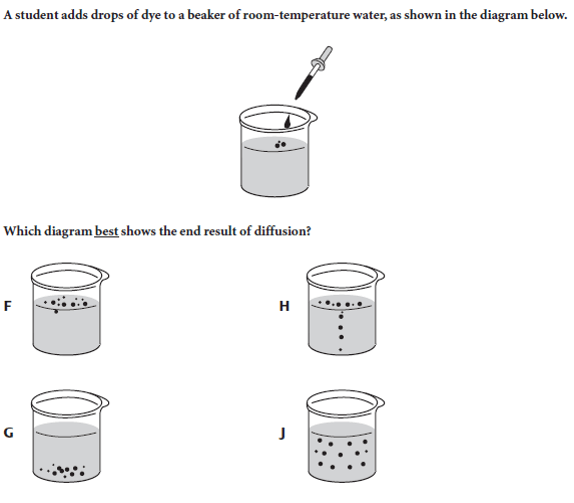
What is DIFFUSION?


Which of the following is a function (job) of the cell membrane>
breaks down lipids, carbohydrates, and proteins from food
stores water, salt, proteins, and carbs
keeps the cell wall in place
regulates the movement of materials into and out of the cell


During diffusion, movement of substances depends on ___________
Concentration Gradient
Pressure Gradient
Electrical Gradient
All of the above
None of the above
Diffusion depends on __________ movement of _________ and is a/an _________ process
Directional, Solvent, Exergonic
Random, Solute, Exergonic
Directional, Solvent, Endergonic
Random, Solute, Endergonic
The equation, ΔG = RT ln [CoCi] , explains the ________
Free Energy change of a non-electrolyte
Free Energy change of a charged solute
Free Energy change of an electrolyte
None of the above
In the equation, ΔG = RT ln [CoCi] , ΔG refers to the _________
Free Energy difference
Gas Constant
Absolute Temperature
Ratio of concentration of solute inside and outside
In the equation, ΔG = RT ln [CoCi] , R refers to the _________
Free Energy difference
Gas Constant
Absolute Temperature
Ratio of concentration of solute inside and outside
In the equation, ΔG = RT ln [CoCi] , [CoCi] refers to the _________
Ratio of concentration of solution inside and outside
Ratio of concentration of solvent inside and outside
Ratio of concentration of solute inside and outside
None of the above
In the equation, ΔG = RT ln [CoCi] , if the ratio of [CoCi] is less than 1.0, then the log of the ratio is _______, ΔG is _______ and the net influx of solute is thermodynamically favoured resulting in ________ process
Negative, Positive, Exergonic
Negative, Negative, Exergonic
Positive, Negative, Endergonic
Negative, Negative, Endergonic
Ability of an electrolyte to diffuse between 2 compartments, depends on _______
Chemical Gradient
Electrical Gradient
Chemical and Electrical Gradient
Chemical, Electrical and Pressure Gradient
Factors that affect Net Rate of Diffusion are ________ (Tick all that are correct)
Permeability
Concentration Gradient
Pressure Gradient
Electrochemical Gradient
Energy
The net rate of diffusion of the substance through each unit area of the mebrane for a unit concentration or Pressure or Electrical Difference is called as (a)
Factors Affecting Net Rate of Diffusion
Surface area plays a crucial role in determining the net rate of diffusion. A larger surface area allows for more molecules to come into contact with the membrane, leading to increased diffusion rates.
Temperature is another significant factor influencing the net rate of diffusion. Higher temperatures generally result in faster molecular movement, leading to increased diffusion rates. Conversely, lower temperatures can slow down the rate of diffusion due to reduced molecular motion.
Molecular size also impacts the net rate of diffusion. Smaller molecules tend to diffuse more rapidly than larger ones due to their ability to move through the membrane more easily. Larger molecules may experience more resistance and therefore diffuse at a slower rate.
How do higher temperatures generally affect molecular movement?
Decrease molecular movement
Have no effect on molecular movement
Lead to increased diffusion rates
Cause molecular movement to stop
How does surface area impact the net rate of diffusion?
It has no effect on diffusion
It decreases the rate of diffusion
It increases the rate of diffusion
It only affects the concentration gradient
Why do smaller molecules tend to diffuse more rapidly than larger ones?
Smaller molecules have a higher surface area to volume ratio
Smaller molecules have less mass to hinder their movement
Smaller molecules experience less resistance from the medium
Smaller molecules have stronger intermolecular forces
Thickness of the cell membrane is directly proportional to the rate of diffusion. True (T) or False (F)
(a)
Lipid solubility is directly proportional to the rate of diffusion. True (T) or False (F)
(a)
Number of protein channels in the plasma membrane is indirectly proportional to the rate of diffusion. True (T) or False (F)
(a)
Temperature is directly proportional to the rate of diffusion. True (T) or False (F)
(a)
Molecular weight of the substance is indirectly proportional to the rate of diffusion. True (T) or False (F)
(a)
Area of the plamsa membrane is calculated by the formula ________
P x T
A x T
P x A
P x ΔG
Which of the following, penetrate the plasma membrane easily _______
Lipid - soluble substances
Small, charged molecules
Large, uncharged molecules
All of the above
Lipid solubility of a substance is measured by its ________
Polarity
Non-polarity
Ability to mix with water
Hydrophilic nature
Transport of water takes place by _________
Simple diffusion
Facilitated Diffusion
Osmosis
Simple diffusion and Osmosis
Who disocered Ion Channels in the giant nerve cells of squid for the first time?
Nernst & Donnan
Hodgkin, Katz and Huxley
Gibbs, Nernst
Nernst, Hodgkin and Gibbs
Ion channels of the plasma membrane are ______ and ______
Non-specific, Unidirectional
Selective, Unidirectional
Non-specific, Bidirectional
Selective, Bidirectional
Transport of ions is dependent on __________
Concentration gradient
Pressure gradient
Electrochemical Gradient
All of the above
The ion channels, whose conformational change depends upon the difference in ionic charge on both sides of the mebrane are called as (a) gated channels
The ion channels, whose conformational change depends on the binding of a particular substance are called as (a) gated channels
Though ions are smaller than any other polar molecules that can diffuse, the reason why ions cannot diffuse through lipids is __________ (Tick all that are appropriate)
Electrical charge makes them hydrated ions
Electrical charge repels them because polar lipids have excess negative charge
Electrical charge makes them insoluble
Electrical charge repels them because polar lipids have excess positive charge
Facilitated diffusion involves a/an ________
Channel
ATPase
Carrier
Signal
The transport proteins of facilitated diffusion are __________
Extracellular proteins
Cytoplasmic proteins
Extrinsic proteins
Integral proteins
Which of the following is not true of facilitated diffusion? (Tick all that are appropriate)
It requires a transporter protein
It depends on gradient
It is stereo-specific
It exhibits saturation kinetics
It allows the passage of polar solvents that are not able to penetrate the lipid bilayer
In facilitated diffusion, saturation means _______
Binding of solute on one side brings about a conformational change in the carrier
It discriminates between Dextro and Levo isomers
The rate of transport of substances is dependent on the number of carrier proteins
It allows the passage of polar solutes
In facilitated diffusion, stereo specifity refers to _______
Binding of solute on one side brings about a conformational change in the carrier
It discriminates between Dextro and Levo isomers
The rate of transport of substances is dependent on the number of carrier proteins
It allows the passage of polar solutes
GLUT refers to (a)
Cardiac muscle, skeletal muscle and fat cells are specific for _______
GLUT 1
GLUT 2
GLUT 3
GLUT 4
GLUT proteins are example for _______
Simple Diffusion
Facilitated Diffusion
Primary Active Transport
Cotransport
Anion Exchange Permease of RBC is an example for _______
Simple Diffusion
Facilitated Diffusion
Primary Active Transport
Cotransport
Deficiency of GLUT-4 proteins results in _________ (Tick all that are correct)
Juvenile diabtetes
Adult Diabetes
Type I diabetes
Type II diabetes
Which of the following small, uncharged molecules penetrated very rapidly, by dipping between adjacent phospholipids?
Oxygen, CO2, NO
Oxygen, CO2, NO, H2O
Oxygen, CO2, NO, H2O, Ethanol
Na+, K+, Cl-

