
 Worksheets
BIOLEAD WEEK 15 TRANSPORT SYSTEM
Total questions: 15
Worksheet time: 8mins
Which of the following stages of cardiac cycle would be affected first if the nerve fibers within bundle of His were cut
diastole
atrial systole
ventricular systole
stimulation of the AV node
Which of the following statements about the lymph vascular system is NOT true? The lymph vascular system...
recovers and transport interstitial fluid back to bloodstream
absorb glucose from the small intestine and transport to the brain
transport lipids absorbed from small intestine to the bloodstream
serve the body system of the defense againts bacteria and other infectious agents
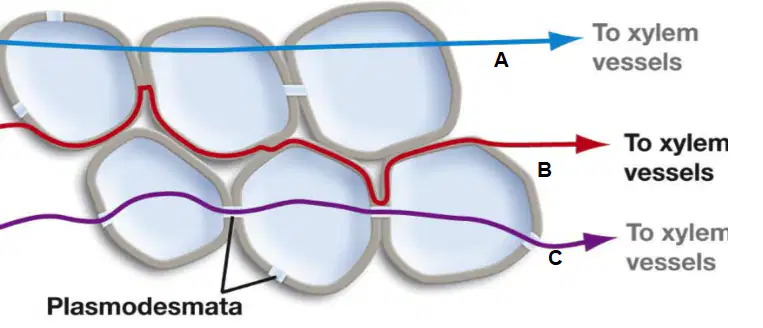
Figure shows the pathway for movement of water into xylem root. Which of the pathway is prevented by Casparian strip in endodermis
A & B pathway
B & C pathway
A & C pathway
A, B & C pathway
The pressure flow model for phloem translocation states..
that sink strength drives transport in the phloem
that transport in treachery elements is pressure dependent
the water potential gradient in the sieves elements drives transport
the pressure gradient between the sieves elements at the source and the sink drives phloem transport
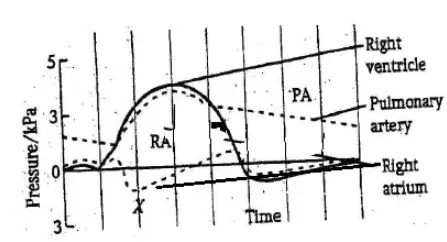
The graph shows the pressure of the right side of a mammalian heart during a cardiac cycle. Which events occur at X?
Atrium contracts, blood flows into the ventricle
Ventricle begins to contract, atrioventricular valve close, pulmonary valves remain closed
Pulmonary valves are forced open, blood flows from ventricle into pulmonary artery
Pulmonary valves close, ventricular volume begins to increase
Which theory of water transport states that hydrogen bonding allows water molecules to maintain a continuous fluid column as water is pulled from roots to leaves?
Fusion
Evaporation
Pressure flow
Cohesion-tension
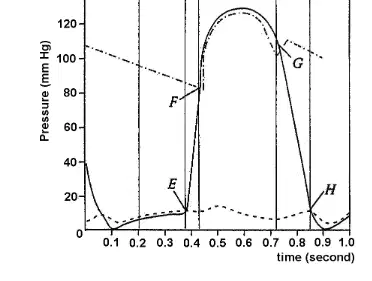
With reference to the graph, which label refer to the opening of atrioventricular valve
E
F
G
H
the endodermis with its Casparian strips
carries out active transport
facilitates root pressure
ensure water and minerals enter the xylem via the apoplastic pathway
controls and regulates the mineral ions that enter the xylem
Which of the following causes the first sound after atrial systole in the cardiac cycle
Opening of the atrioventricular valves
Closing of the atrioventricular valves
Opening of the semilunar valves
Closing of the semilunar valves
Which statement about transport in plants is NOT true
The high root pressure will cause transpiration pull
The Casparian strip forms a barrier that forces water to pass by the symplastic pathway
When the root pressure is very high, it forces water into the leaves and cause guttation
In the apoplastic pathway, water diffuse into the roots between the walls of the root epidermal cells
Cardiac muscle are myogenic because
it requires impulse from the parasympathetic nerve to increase the heartbeat rate
it requires impulse from the sympathetic nerve to decrease the heartbeat rate
it does not require impulse from the central nervous system to start contraction
it muscles are branches and connected by the intercalated disc
Movement of water across the endodermis cell can occur through the..
Apoplastic
Symplastic
Transmembrane
active transport
Which of the following is NOT true about sinoatrial node
it acts as a pacemaker
it initiates atrial systole
it is controlled by the cardiovascular center
it is linked to bundle of His
Which of the following events in a normal cardiac cycle takes the longest time?
atrial systole and ventricular diastole
ventricular systole and atrial diastole
atrial and ventricular systole
atrial and ventricular diastole
Systole is..
the relaxation of cardiac muscle
the contraction of cardiac muscle
the relaxation of coronary artery
the contraction of cocronary artery

