wayground logo

Free Printable Worksheets

Font size

S
M
L
XL
Worksheets

Technology and Design

Total questions: 177

Worksheet time: 2hrs 26mins

Name
Class
Date
1.

what is a conductor?

a)
A conductor is a material or object that allows the flow of electrical current.
b)
A conductor is a device used to measure temperature.
c)
A conductor is a type of insulator.
d)
A conductor is a person who directs an orchestra.
2.

what is an insulator?

a)
A material that does not easily allow the flow of electricity or heat.
b)
An element that is a good conductor of electricity
c)
A substance that easily allows the flow of heat
d)
A material that conducts electricity well
3.

an example of a conductor is.....

a)
Copper
b)
Aluminum
c)
Silver
d)
Gold
4.

an example of an insulator is....

a)
rubber
b)
glass
c)
plastic
d)
metal
5.

what is the difference between an insulator and a conductor?

a)
Insulators are always made of metal.
b)
Insulators do not conduct electricity, while conductors do.
c)
Conductors are used to block the flow of electricity.
d)
Insulators conduct electricity better than conductors.
6.

what are some of the safety rules in the workshop?

a)

do not enter!!! (unless told to by a member of staff)

b)

bags under desks

c)

jewellery and watches removed

d)

no loose clothing eg. ties!

e)

long hair tied back!

7.

what are some of the safety rules for the technology lab?

a)

all bags and chairs removed during practical

b)

wear goggles when using tools and machines or if safety signs on wall say so

c)

don't use a machine you haven't been taught to use

d)

no distracting!

e)

don't go in store!

8.

some health and safety rules are....

a)

replace tools once you have used them

b)

no food or drink allowed!

c)

all accidents/breakages must be reported asap

d)

only drink water in the workshop

9.

how can you be responsible in the workshop?

a)

keep your bench tidy

b)

move carefully-never run

c)

know where the STOP button is

d)

don't leave machines unattended

10.

what is a hazard?

a)
A hazard is a type of candy
b)
A hazard is a type of music
c)
A hazard is a type of flower
d)
A hazard is a potential source of harm or adverse health effect.
11.

what does mandatory mean?

a)
Required or obligatory
b)
Flexible or adaptable
c)
Unnecessary or dispensable
d)
Voluntary or optional
12.

what does prohibition mean?

a)
The act of forbidding something, usually by law.
b)
The act of promoting something, usually by law.
c)
The act of regulating something, usually by law.
d)
The act of allowing something, usually by law.
13.

what sign is a hazard sign?

a)
Yellow triangle with a black border and a black pictogram
b)
Blue circle with a red border and a red pictogram
c)
Red square with a white border and a white pictogram
d)
Green diamond with a yellow border and a yellow pictogram
14.

what colour is prohibition?

a)

Black, white and red

b)
Red
c)
Green
d)
Blue
15.

what colour is mandatory?

a)
green
b)
blue
c)

blue and white

d)
yellow
16.

what colour is 'safe condition'?

a)

green and white

b)

blue and white

c)

red and white

d)

yellow and white

17.

what is the colour for emergency stop?

a)
blue
b)

red and white

c)

green and white

d)
yellow
18.

what does PRIME stand for?

4 lines
19.

what is the design brief?

a)
A document outlining the color scheme for a design project.
b)
A list of potential clients for a design project.
c)
A summary of the final design project outcomes.
d)
A document outlining the objectives, scope, and requirements for a design project.
20.

for the problem identification what must you ask yourself?

a)

the 5 Ws

b)

why am I doing this?

c)

what is the point of this?

d)

Is there more to life than studying?

21.

what does research and investigation consist of?

a)
Research and investigation consist of guessing randomly
b)
Research and investigation consist of ignoring all available data
c)
Research and investigation consist of making up facts without evidence
d)

Research and investigation consist of gathering information about existing similar designs on market

22.

what does a good manufacturing sequence contain?

a)

annotated diagrams

b)

a sequence of steps

c)

measuring and marking out

d)

shaping and finishing

e)

assembling

23.

what is involved in evaluation of a design?

a)

testing

b)

predicting

c)

questioning

24.

what should you be evaluating?

a)

function

b)

aesthetics

c)

safety

d)

ergonomics

e)

manufacture

25.

what is ergonomics?

a)
Ergonomics is the study of the Earth's geological formations.
b)
Ergonomics is the study of economics related to energy consumption.
c)
Ergonomics is the study of the human brain and its functions.
d)
Ergonomics is the study of designing equipment and devices that fit the human body and its cognitive abilities.
26.

what does function mean?

a)

how well the product works

b)

how well the product sells

c)

how well the product looks

27.

what does aesthetics mean?

a)

overall appearance, proportion and finish

b)
A branch of mathematics
c)
A method of cooking
d)
A type of exercise routine
28.

what makes a product safe?

a)
Minimal testing
b)
Unclear instructions
c)

safe to use

d)
Ignoring safety standards
29.

what are modifications?

a)
Changes or alterations made to nothing.
b)
Changes or alterations made to something.
c)
Changes or alterations made to something else.
d)
Changes or alterations made to everything.
30.

what is current in circuitry?

a)
Flow of electric charge carriers through a conductor
b)
The color of the wires
c)
The resistance in the circuit
d)
The brightness of the light bulbs
31.

what is a circuit?

a)
A circuit is a type of cloud formation
b)
A circuit is a type of dance move
c)
A circuit is a closed loop through which an electric current can flow.
d)
A circuit is a type of fruit
32.

current will only flow if...

a)
there is a broken circuit
b)
the battery is fully charged
c)
the switch is off
d)

there is a closed circuit and the circuit is complete

33.

electrons=?

a)
Positively charged subatomic particles found in atoms.
b)
Neutral subatomic particles found in atoms.
c)

electricty

d)
Protons
34.

current is measured in.....

a)
Watts
b)

Amps (A)

c)
Ohms
d)
Volts
35.

what is a switch used in circuitry?

a)
A switch in circuitry is used to cook food.
b)
A switch in circuitry is used to predict the weather.
c)
A switch in circuitry is used to open or close a circuit to control the flow of electricity.
d)
A switch in circuitry is used to amplify sound waves.
36.

what is the battery's role in a circuit?

a)
To provide electrical energy and power the components in the circuit.
b)
To provide mechanical support to the circuit
c)
To transmit data between components
d)
To cool down the circuit components
37.

a battery has....

a)

positive terminal (red)and a negative terminal (black)

b)
positive terminal and a ground terminal
c)
positive terminal and a neutral terminal
d)
positive terminal and a positive terminal
38.
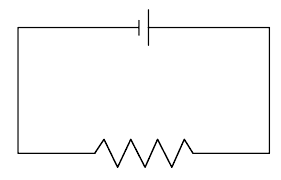
The picture shows an electrical circuit. This circuit is a series circuit because: 
a)
It has 3 light bulbs.
b)
The same current flows through all three light bulbs.
c)
It uses a single battery.
d)
The electrical current is divided between the three light bulbs.
39.
This is the symbol for a _____?
a)
switch
b)
light 
c)
battery
d)
wires
40.
This is the symbol for a _____?
a)
an AC current source
b)
a DC current source
c)
a battery
d)
a single cell
41.
This is the symbol for a _____?
a)
Lamp
b)
Water wheel
c)
Loudspeaker
d)
Motor
42.
current is measured in....
a)
volts
b)
amps
c)
watts
d)
mph
43.

Calculate current if a charge of 10 Coulombs flows past a point in 5 seconds

a)

2 Amps

b)

50 Amps

c)

0.5 Amps

44.
Voltage is measured in __.
a)
volts.
b)
watts.
c)
coulombs. 
45.

What is the energy given off by a 20V bulb which has 10C passing through it?

a)

200J

b)

2J

c)

0.5J

d)

250J

46.
What size resistor would produce a 3 Amp current flow with a 12 Volt battery
a)
1 Ohm
b)
3 Ohms
c)
4 Ohms
d)
12 Ohms
47.

Ohm's Law states that...

a)

...the electricity is a series circuit will always be constant

b)

...current is directly proportional to potential difference when temperature is constant

c)

...current is directly proportional to power in a wire at constant potential difference

d)

...voltage and current increase except in a thermistor

48.

The graph shows the change in current with potential difference for

a)

an LED

b)

a filament lamp

c)

a diode

d)

a thermistor

49.

Which component has the highest resistance?

a)

1

b)

2

50.

Where would you place a voltmeter in the circuit?

a)

Green ?

b)

Red ?

51.

the formula to find current when the values of V and R are known is

a)

I = V2R

b)

I = V/R

c)

I = R/V

d)

I=VR

52.
a)
A2 = A3
b)
A2 + A3 = A1
c)
A1 + A2 = A3
d)
A4 = A2 - A3
53.

____________ __________ assumes that current flows out of the positive side of the battery, through the circuit, and back to the negative side of the battery.

a)

Conventional Current

b)

Ohms Law

c)

Electron Flow

d)

Kirchoff's Current Law

54.

In a series circuit, there are multiple paths for current to flow.

a)

True

b)

False

55.

The total resistance (RT) is equal to the sum of all of the resistances (i.e., R1 + R2 + R3) in a series circuit.

a)

True

b)

False

56.

The sum of all of the voltage drops (VR1 + VR2 + VR2) is equal to the total applied voltage (VT) in a series circuit.

a)

True

b)

False

57.

true or false...water is a good conductor

a)
maybe
b)
sometimes
c)
false
d)
true
58.

examples of insulators are.....

a)
rubber, glass, plastic, wood
b)
copper
c)
aluminum
d)
metal
59.

examples of conductors are...

a)

copper, iron and other metals

b)

rubber

c)

wood

d)

plastic

60.

what is an electrical resistor?

a)
An electrical resistor is a component that stores electrical energy
b)
An electrical resistor is a device that amplifies electrical current
c)
An electrical resistor is a type of battery
d)

An electrical resistor is a special component made to resist the flow of electricity in a circuit

61.

what are the 2 types of resistors?

a)
digital resistors
b)
fixed resistors and variable resistors
c)
dynamic resistors
d)
tunable resistors
62.

draw the symbol for a battery

63.

draw the symbol for a fixed resistor

64.

draw the symbol for a variable resistor

65.

what are the benefits of fixed resistors?

a)
Fixed resistors offer a constant resistance value, ease of use, stable performance over time, and cost-effectiveness.
b)
High cost
c)
Unstable performance over time
d)
Variable resistance value
66.

what are the benefits of variable resistors?

a)

Precise control of resistance in a circuit, adjustment of current flow and voltage levels.

b)
Variable resistors do not affect current flow
c)
Variable resistors are only used for decoration
d)
Variable resistors cannot be adjusted
67.

electrical resistance is measured in....

a)
Amps
b)
Watts
c)
Ohms
d)
Volts
68.

what is the colour code for resistors?

a)
The colour code for resistors is a series of coloured bands that represent the resistance value and tolerance.
b)
The colour code for resistors is a series of letters that represent the resistance value.
c)
The colour code for resistors is a series of shapes that represent the resistance value.
d)
The colour code for resistors is a series of numbers that represent the resistance value.
69.

can resistors ever be made to a precise value?

a)

yes

b)

no

c)

maybe

d)

sometimes

70.

which band is the tolerance band on a resistor?

a)
First band
b)
Second band
c)
Third band
d)
Fourth band
71.

what is the tolerance band on a resistor?

a)
The tolerance band on a resistor specifies the minimum percentage by which the actual resistance can deviate from the stated resistance value
b)

The tolerance band on a resistor specifies the maximum PERCENTAGE % of how close the resistor is to its coded value

c)
The tolerance band on a resistor is used to determine the power rating of the resistor
d)
The tolerance band on a resistor indicates the color coding of the resistor
72.

what color is the tolerance band?

a)
Black or White
b)
Green or Yellow
c)
Silver or Gold
d)
Red or Blue
73.

A resistor's first three color bands are brown, black, and red. What is its value?

a)

10 ohms

b)

10K ohms

c)

200 ohms

d)

1000 ohms

74.

Which digit on the 1st band does the color yellow denote on a resistor color band?

a)

3

b)

2

c)

4

d)

7

75.

A 47K ohm resistor would have which colors on its first three bands?

a)

Yellow, Violet, White

b)

Yellow, Violet, Orange

c)

Red, White, Blue

d)

Orange, Yellow, Violet

76.

Which digit does the color orange denote on a resistor color band?

a)

2

b)

4

c)

3

d)

5

77.

Which of these colors is NOT used in the resistor value color code?

a)

White

b)

Black

c)

Violet

d)

Pink

78.

The gold color band refers to__________tolerance.

a)

+ / - 20%

b)

+ / - 10%

c)

+ / - 5%

d)

zero

79.

What are the color codes for a 470K ohm resistor?

a)

Orange, Grey, Orange

b)

Yellow, Violet, Yellow

c)

Yellow, Violet, Orange

d)

Orange, Grey, Yellow

80.

What is the tolerance for a Red, Brown, Brown, Silver resistor?

a)

1%

b)

20%

c)

5%

d)

10%

81.

What color that has a multiplier of x1000

a)

Red

b)

Orange

c)

Blue

d)

Brown

82.

What is the tolerance for a Green, Red, Black, Gold resistor?

a)

1%

b)

20%

c)

5%

d)

10%

83.

What is the color code for a Orange, Black, Red resistor?

a)

3K Ohms

b)

200 Ohms

c)

2K Ohms

d)

300 Ohms

84.

What is the purpose of a resistor?

a)

allow current flow

b)

control current flow

c)

prevent current flow

d)

allow heat to build up

85.

What is the resistance for a Red, Green, Blue color resistor?

a)

250,000 ohms

b)

25K ohms

c)

25,000,000 ohms

d)

250K ohms

86.

What is the maximum value in the tolerance range of a resistor with color code Red-Violet-Orange-Gold?

a)

29.7 K Ω

b)

32.4 K Ω

c)

28.35 K Ω

d)

27 kΩ

87.

What is the minimum value in the tolerance range of a resistor with color code Brown-Red-Brown?

a)

108 Ω

b)

144 Ω

c)

116 Ω

d)

96 Ω

88.

What is the multiplier for color Green?

a)

x10,000

b)

x1,000,000

c)

x100,000

d)

x1,000

89.

What are the building blocks of circuits?

a)
Potentiometers, switches, and fuses
b)

input control, output

c)
Microcontrollers, sensors, and actuators
d)
Diodes, transformers, and relays
90.

what is the input of a circuit?

a)
Power source
b)
Output
c)

Signal causing a system to do something eg switch

d)
Voltage regulator
91.

what do you adjust a variable resistor with?

a)
dial or lever
b)
switch or button
c)

screwdriver

d)
wheel or pedal
92.

what does LDR stand for?

a)
Light Dependent Reactor
b)
Laser Detection Radar
c)
Low Density Resistor
d)
Light Dependent Resistor
93.

what is a toggle switch?

a)
A toggle switch is a type of sandwich
b)
A toggle switch is a type of bird
c)
A toggle switch is an electrical switch that controls the flow of electricity by toggling between two positions.
d)
A toggle switch is a type of car
94.

what does LED stand for?

a)
Luminous Electric Device
b)
Light Energy Detector
c)
Laser Emitting Device
d)
Light Emitting Diode
95.

examples of input devices are...

a)

LDR, Thermistor, switches

b)
printers
c)
monitors
d)
speakers
96.

what is a thermistor?

a)
A thermistor is a type of capacitor used in electronic circuits.
b)
A thermistor is a type of resistor whose resistance changes significantly with temperature.
c)
A thermistor is a type of wire used for conducting electricity.
d)
A thermistor is a device used to measure pressure in a closed system.
97.

name some output devices

a)
Keyboard
b)
Mouse
c)
Headphones
d)

LED, Buzzer, bulb, motor

98.

draw an LDR

99.

draw a thermistor

100.

draw a single pole single throw switch

101.

draw a push to make switch

102.

draw a push to break switch

103.

draw an LED

104.

draw a buzzer

105.

draw a motor

106.

draw a bulb

107.

a battery converts....

a)
Mechanical energy into thermal energy
b)
Chemical energy into electrical energy
c)
Solar energy into kinetic energy
d)
Nuclear energy into sound energy
108.

a battery provides _ which allows electrons to flow

a)
resistance
b)
current
c)

pressure

d)
power
109.

electrical pressure is measured in...

a)
Watts
b)
Ohms
c)
Amps
d)
Volts
110.

what is the difference between ohms and volts

a)
Ohms measure resistance, while volts measure voltage.
b)
Ohms measure power, while volts measure resistance.
c)
Ohms measure current, while volts measure resistance.
d)
Ohms measure voltage, while volts measure current.
111.

each battery cell = ? volts

a)
1.5
b)
3.0
c)
1.0
d)
2.0
112.

how many cells does a 3v battery contain?

a)
5
b)
2
c)
4
d)
1
113.

how many cells does a 9V battery contain?

a)
6
b)
4
c)
8
d)
10
114.

which batteries are the cheapest?

a)
Rechargeable batteries are the cheapest
b)
Brand name lithium batteries are the cheapest
c)

zinc chloride

d)
Heavy-duty batteries are the cheapest
115.

what are the cons of using zinc chloride batteries?

a)

don't last long

b)

too expensive

c)

too big

d)

too heavy

116.

which kind of batteries are more expensive?

a)
Alkaline batteries
b)

zinc -chloride batteries

c)
Nickel-metal hydride batteries
d)
Lead-acid batteries
117.

why are batteries safer than mains electricity?

a)
Batteries have higher voltage and current levels.
b)
Batteries are more prone to short circuits.
c)
Batteries have lower voltage and current levels.
d)
Batteries are always connected to the power source.
118.

why are batteries more useful than mains electricity?

a)
Batteries are more expensive than mains electricity
b)
Batteries are portable, can be used in areas without access to electricity, and provide backup power during outages.
c)
Batteries are less reliable than mains electricity
d)
Batteries are heavier than mains electricity
119.

what kind of battery is rechargeable?

a)
Nickel-cadmium battery
b)

nickel cadmium battery

c)
Alkaline battery
d)
Lead-acid battery
120.

what are the benefits of nickle cadmium batteries?

a)

The benefits of nickel cadmium batteries include longer lifespan

b)
Short lifespan, low discharge rates
c)
Fragile, high self-discharge rate
d)
Limited durability, slow charging speed
121.

how is voltage measured?

a)

Using a voltmeter

b)
Using a thermometer connected in series to the circuit
c)
By counting the number of electrons flowing through the circuit
d)
Measuring the temperature of the circuit
122.

what is current measured using?

a)
ohmmeter
b)
voltmeter
c)
thermometer
d)
ammeter
123.

what is current measure in

a)
Watts (W)
b)

Amps (A) or Milliamps (mA)

c)
Ohms (Ω)
d)
Volts (V)
124.

What is used to measure resistance?

a)
Voltmeter
b)
Ohmmeter
c)
Ammeter
d)
Multimeter
125.

if resistance (R) is high the current (I) is ....

a)
equal
b)
high
c)
negative
d)
low
126.

the most important law in electronics is....

a)
Kirchhoff's Law
b)
Faraday's Law
c)
Ohm's Law
d)
Newton's Law
127.

what is OHM's law?

a)
Ohm's Law is P = V * I, where P is power, V is voltage, and I is current.
b)
Ohm's Law is V = R / I, where V is voltage, R is resistance, and I is current.
c)
Ohm's Law is I = V / R, where I is current, V is voltage, and R is resistance.
d)

Ohm's Law is V = I x R, where V is voltage, I is current, and R is resistance.

128.

what is the equation to work out current?

a)
I = V * R
b)
I = R / V
c)
I = V / R
d)
I = V + R
129.

what is the formula for resistance?

a)
R = V/I
b)
R = I/V
c)
R = P/I
d)
R = V^2/I
130.
What size resistor would produce a 3 Amp current flow with a 12 Volt battery
a)
1 Ohm
b)
3 Ohms
c)
4 Ohms
d)
12 Ohms
131.
What is the Voltage of a circuit that has a resistance of 5 Ω and a current of 2 A?
a)
25 V
b)
10 V
c)
2.5 V
d)
0.4 V
132.
If the Voltage stays the same and Resistance is increased, Current will 
a)
Increase
b)
Decrease
c)
Stay the same
d)
X
133.
If the Voltage is increased and the resistance stays the same, Current will
a)
Increase
b)
Decrease
c)
Stay the same
d)
X
134.
How many Volts would we need to produce a current flow of 8 Amps through a 6 Ohm resistor
a)
12 volts
b)
24 volts
c)
1.3333
d)
48 volts
135.
This circuit has a 24 volt battery and the resistor is 8 ohms. How many amps are running through the circuit?
a)
3 Amps
b)
192 Amps
c)
2 Amps
d)
4 Amps
136.
How many Volts would it take to push 1 Amp through a resistance of 1 Ohm
a)
10 volts
b)
1 volt
c)
48 volts
d)
5 volts
137.
What size resistor would produce a 3 Amp current flow with a 12 Volt battery
a)
1 Ohm
b)
3 Ohms
c)
4 Ohms
d)
12 Ohms
138.
What would the circuit resistance be if a 7.5 Amp draw was present with the engine running and the charging system producing 15 Volts
a)
15 Ohms
b)
4 Ohms
c)
0.3333 Ohms
d)
2 Ohms
139.

what is a darlington pair

a)
A Darlington pair is a configuration of two bipolar transistors that provide a very high current gain.
b)
A Darlington pair is a type of fruit
c)
A Darlington pair is a type of dance move
d)
A Darlington pair is a type of computer software
140.

what is solder

a)
A fusible metal alloy used to create a permanent bond between metal workpieces.
b)
A type of paint used in automotive applications
c)
A type of fabric used in clothing manufacturing
d)
A type of glue used in woodworking
141.

soldering tips

a)

sweet spot

b)

steady hand

c)

hold like a pen

d)

dont touch hot piece

e)

make sure the sponge is damp

142.

LEDs must be....

a)
non-polarized
b)

connected the correct way round

c)
reversible
d)
magnetic
143.

how can you tell an LED is the right way?

a)
The LED will light up if it's the wrong way.
b)
The shorter leg is the positive side.
c)

The longer leg is the positive side. The negative side has a flat edge on the rim

d)
The LED will make a sound if it's the right way.
144.

what does an LED need?

a)
water
b)
sunlight
c)
love
d)

a protective resistor

145.

draw an LED (birds eye view) with labels for positive and negative

146.

what is a transistor?

a)
A transistor is a type of fruit.
b)
A transistor is a type of bird.
c)

A transistor is a semiconductor device. It is a controlling device

d)
A transistor is a type of vehicle.
147.

draw the symbol for a transistor

148.

label the transistor

149.

transistors are....

a)
organic devices
b)

sensitive electronic switches

c)
metallic devices
d)
plastic devices
150.

it is often a good idea to connect a......... to the base leg of a transistor to prevent it from being damaged

a)
resistor
b)
LED
c)
diode
d)
capacitor
151.

when the input at the base leg rises to _ volts the transistor switches on the output side and allows current to flow

a)

1V

b)

0.1V

c)

0.5V

d)

0.6V

152.

What are the 3 parts of a transistor?

a)
emitter, base, collector
b)
collector, emitter, base
c)
base, collector, emitter
d)
emitter, base, emitter
153.

Transistors act like tiny "____________."

a)

Electron sources

b)

Switches

c)

Batteries

d)

Bees?

154.

What are the names of the terminals X, Y and Z?

a)

X = Base, Y = Collector, Z = Emitter

b)

X = Emitter, Y = Base, Z = Collector

c)

X = Collector, Y = Base, Z = Emitter

d)

X = Collector, Y = Emitter, Z = Base

155.

As well as acting like a switch, another function of the transistor is to____________signals?

a)

rectify

b)

amplify

c)

limit

d)

control

156.

transistor has 3 electrodes namely

a)

PNP

b)

NPN

c)

Base/ Collector/ Emitter

d)

Drain/ Gate/ Source

157.

A transistor is a …………… operated device

a)

Voltage

b)

Both Voltage and Current

c)

Current

d)

None of the Above

158.

The shorter leg of an LED is what?

a)

Positive

b)

Negative

159.

What family is the transistor part of?

a)

LED

b)

Diode

c)

Semiconductor

d)

Resistor

160.

What is this pin called with the arrow?

a)

Emitter

b)

Base

c)

Collector

d)

Transistor

161.

What is this pin called with the arrow?

a)

Emitter

b)

Base

c)

Collector

d)

Transistor

162.

What is this pin called with the arrow?

a)

Emitter

b)

Base

c)

Collector

d)

Transistor

163.

What is this?

a)

Vacuum Tube

b)

Transistor

c)

Circuit

d)

Star Wars Character

164.

what does LDR stand for?

a)
Light Dependent Resistor
b)
Laser Detection Radar
c)
Light Dependent Reactor
d)
Low Density Resistor
165.

what is vacuum forming?

a)
Vacuum forming is a manufacturing process where a plastic sheet is heated and then stretched over a mold using vacuum pressure to create a specific shape.
b)
Vacuum forming is a method of cooking food using a vacuum
c)
Vacuum forming is a process used to clean carpets
d)
Vacuum forming is a technique for creating sculptures out of ice
166.

how does an LDR work?

a)
An LDR changes its resistance based on the amount of light it is exposed to.
b)
An LDR generates sound waves in response to light
c)
An LDR changes its color based on the light intensity
d)
An LDR emits light based on the resistance it detects
167.

true or false. An LDR has low resistance in the dark

a)
true
b)
false
c)
high
d)
medium
168.

true or false. An LDR has low resistance in bright light

a)
true
b)
medium
c)
high
d)
false
169.

what does PCB stand for?

a)
Personal Computer Backup
b)
Printed Circuit Board
c)
Power Control Box
d)
Portable Charging Bank
170.

what doses SPST stand for?

a)
Single Point, Single Turn
b)
Single Pole, Single Hold
c)
Double Pole, Double Throw
d)
Single Pole, Single Throw
171.

what does PTM and PTB stand for?

a)

push to make and push to break

b)
Pre-Translational Modification, Protein Tyrosine Binding
c)
Post-Transcriptional Modification, Phosphorylation Transcriptional Binding
d)
Protein Translation Modification, Protein Tyrosine Binding
172.

when a darlington pair is used, the circuit is much more...

a)
sensitive and has a higher current gain
b)
inaccurate and has a lower power dissipation
c)
unstable and has a lower voltage gain
d)
less efficient and has a lower current gain
173.

the darlington pair acts as a high speed _ ?

a)

switch turning on the output

b)
resistor
c)
switch
d)
transistor
174.

why is it so important for a vacuum mould to have a tapered side?

a)
To allow for easier removal of the moulded object without causing damage.
b)
To increase the weight of the mould
c)
To make the mould more difficult to handle
d)
To improve the taste of the moulded object
175.

what type of plastics can be used for vacuum form?

a)
PVC
b)
Polypropylene
c)
Polyethylene
d)
Thermoplastic materials like ABS, polystyrene, acrylic, and PETG.
176.

list 3 advantages of vaccum moulding

a)
Vacuum moulding allows for complex shapes to be formed easily, is cost-effective, and produces high-quality finished products.
b)
Vaccum moulding is expensive and not cost-effective
c)
Vaccum moulding produces low-quality finished products
d)
Vaccum moulding is slow and inefficient
177.

why is it important to cover the mould with a release agent

a)
To increase the weight of the moulded object
b)
To prevent the moulded object from sticking to the mould surface
c)
To speed up the moulding process
d)
To add color to the moulded object