
NEW
Font size
S
M
L
XL
 Worksheets
INTRODUCTION TO LINGUISTICS
Total questions: 41
Worksheet time: 1hrs 11mins
Name
Class
Date
1.
I solemnly swear that I will not cheat during the exam.
a)
Yes, I swear I will not cheat for my own future benefits.
b)
YES! I will never cheat in my online exams.
2.
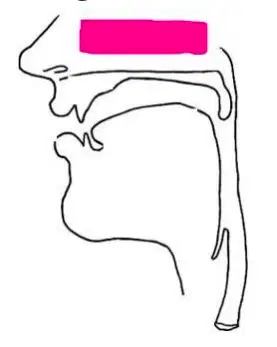
1. What organ of speech is highlighted in this image?
a)
Oral
b)
Nose
c)
Pharynx
d)
Nasal
3.
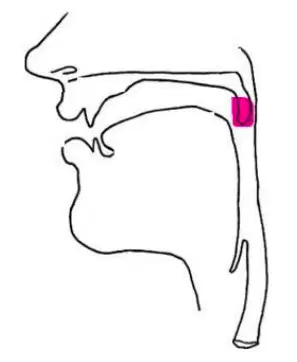
2. What organ of speech is highlighted in this image?
a)
Velum
b)
Pharynx
c)
Uvula
d)
Glottis
4.
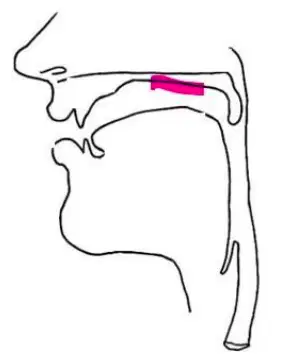
3. What organ of speech is highlighted in this image?
a)
Uvular
b)
Alveolar
c)
Palatal
d)
Velum
5.
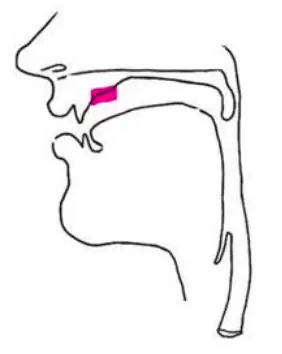
4. What organ of speech is highlighted in this image?
a)
Uvular
b)
Alveolar
c)
Palatal
d)
Velum
6.
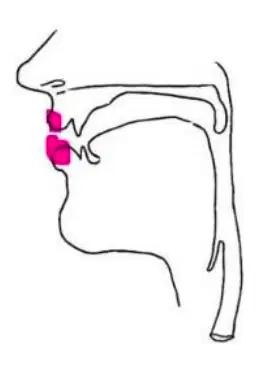
5. What organ of speech is highlighted in this image?
a)
Bilabial
b)
Interdental
c)
Labiodental
d)
Alveolar
7.
6. Choose the correct sets of minimal pair!
a)
fine-shine, rhyme-time, judge-jam
b)
she-sea, fall-fault, choke-coke
c)
choke-coke, jam-jump, pair-spare
d)
choke-coke, sea-she, fine-shine
8.
7. Which allophone is NOT the variation of phoneme /t/?
a)
[tʃ]
b)
[r]
c)
[th]
d)
[ʔ]
9.
8. These are sets of voiced phonemes, EXCEPT...
a)
/b/, /g/, /z/, and /m/
b)
/d/, /n/, /m/, and /ð/
c)
/v/, /g/, /f/, and /ŋ/
d)
/ʒ/, /ð/, /dʒ/, and /d/
10.
9. What does [ː] mean in phonetic representation [ɡuːs]?
a)
aspiration
b)
nasalization
c)
assimilation
d)
vowel lengthening
11.
10. What type of phonological alternation is in the Javanese word "tenteng" /tenteŋ/ -> [tẽntẽŋ].
a)
aspiration
b)
nasalization
c)
assimilation
d)
elision
12.
11. In written language of Bahasa Indonesia we have verb "buka" /buka/, but it turns into [mbuka] in spoken language. What type of phonological alternation occurs here?
a)
aspiration
b)
nasalization
c)
assimilation
d)
elision
13.
12. Which sentence illustrates a proper application of English syntax rules?
a)
Tom and Sue both has a cat named Cookie.
b)
We prepare and deliver workshops and training students.
c)
Sarah and I write and release materials to various media.
d)
Toast have I for breakfast every morning Monday.
14.
13. In Syntax, Universal Grammar appears to provide ...
a)
differences among languages
b)
alternatives from which individual languages may choose
c)
all languages with the same general type of syntactic mechanisms
d)
same moving words and phrases in particular ways
15.
14. As a component of grammar, syntax is concerned with the form of grammatical sentences. Syntax analyzes units of language, except!
a)
Sentence
b)
Phrase
c)
Word
d)
Clause
16.
15. What is the most important word or a head in an NP?
a)
Preposition
b)
Novel word
c)
Verb
d)
Noun
17.
16. If we combine Noun Phrase (NP) + Verb Phrase (VP) we can construct...
a)
Sentence or Clause
b)
NVP
c)
PP
d)
(N) (V) (PP)
18.
17. Semantics is...
a)
the study of word formation.
b)
the study of sound meaning.
c)
the study of meaning of words, phrases, and sentences.
d)
the study of the sound system of language.
19.
18.
"If Jasmine cannot go to the morning appointment, she will go to the afternoon one."
This is an example of what type of linguistic reference?
a)
Anaphora
b)
Deixis
c)
Co-reference
d)
Coherence
20.
19.
"You’re wasting my time."
The word "wasting" has broad network, which match with one of semantics conceptual system in...
a)
Fuzzy
b)
Lexicalization
c)
Metaphor
d)
Motions
21.
20. Lexical ambiguity refers to...
a)
words that have the same meaning.
b)
a word that has more than one meaning.
c)
a word that contains the meaning of a more general words.
d)
words that have different meanings.
22.
21. A property of languages that is crucial in understanding the meaning of words, like "won" and "one" in a sentence, and in interpreting the meaning of the entire utterances is...
a)
Productivity
b)
Modularity
c)
Reliance on context
d)
Recursion
23.
22. Which is NOT a universal property of language?
a)
Constituency
b)
Arbitrariness
c)
Discreetness
d)
Duality
24.
23. ...means that words have no systematic connection with what they mean.
a)
Arbitrariness
b)
Productivity
c)
Modularity
d)
Onomatopoetic
25.
24. In the past, negation ‘not’ was used after a verb, e.g.: I cometh “not” from this world. However, English implemented its recent format that “not” comes after certain types of verbs, e.g.: “do, have, will”. Which property of grammar is explained through this example?
a)
Parity
b)
Generality
c)
Mutability
d)
Conventionality
26.
25. ...is a word formation process where already existing words are put together to create new words.
a)
Affixation
b)
Clipping
c)
Compounding
d)
Conversion
27.
26. What is a morpheme?
a)
The minimal pair of a chosen phrase.
b)
The smallest meaningful unit of a word.
c)
The smallest unit of a particular language.
d)
The minimal item of a linguistic unit.
28.
27. Which is NOT an example of a derivational morpheme?
a)
move --> remove
b)
paint --> painter
c)
entertain --> entertainment
d)
walk --> walked
29.
28. How many morphemes are in the word “incomprehensible”?
a)
3
b)
4
c)
5
d)
6
30.
29. How many morphemes are in the word "internationalization"?
a)
3
b)
4
c)
5
d)
6
31.
30. What is the root of the word "internationalization"?
a)
internation
b)
international
c)
internationalize
d)
nation
32.
31. What is the base of the word "internationalization"?
a)
internation
b)
international
c)
internationalize
d)
nation
33.
32. Which one is a compound verb?
a)
proofread
b)
ingrown
c)
afterthought
d)
overripe
34.
33. The suffix -s can combine with virtually any noun that allows a plural form. On the other hand, derivational affixes apply to restricted classes of bases. This is one of the many differences between inflectional and derivational affixes. Which criteria does this illustrate?
a)
Categorical change
b)
Semantic transparency
c)
Productivity
d)
Endocentric aspect
35.
34. Which one is the correct morphological tree diagram for the word friendlessness?
a)
a
b)
b
c)
c
d)
d
36.
35. ...is a word formation process where already existing words are put together to create new words.
a)
Affixation
b)
Clipping
c)
Compounding
d)
Conversion
37.
36.
Zoo <-- zoological garden,
fax <-- facsimile,
van <-- caravan
What is the name of this morphological process?
a)
Affixation
b)
Clipping
c)
Compounding
d)
Conversion
38.
37. Which sentence is UNACCEPTABLE?
a)
“He made hers a sandwich.”
b)
“Hers is really good.”
c)
“I cleaned up the garden.”
d)
“I cleaned the table up.”
39.
38. A student uses informal Indonesian language when speaking to his friends. On the other hand, he uses formal Indonesian when speaking to his lecturers at the university. It can be seen that different types of language can be used in certain situations. This illustration suits which of the following universal properties of language?
a)
Modularity
b)
Creativity
c)
Reliance on Context
d)
Variability
40.
39. Which sentence is incorrect?
a)
“We water the grass.”
b)
“She had the final say”
c)
“The team dialogued.”
d)
All sentences are correct.
41.
40. The ability to recognize whether novel utterances are acceptable is included in which competence?
a)
Communicative competence
b)
Linguistic competence
c)
Novelty competence
d)
Creative competence
Reset

