wayground logo

Free Printable Worksheets

NEW

Font size

S
M
L
XL
Worksheets

g9 light by khayrattee yasser

Total questions: 40

Worksheet time: 2hrs 0mins

Name
Class
Date
1.

LIGHT IS A FORM OF

a)

SOUND

b)

ENERGY

c)

ILLUSIONS

d)

MOVEMENT

2.

LIGHT WAVES TRAVEL IN...

a)

ZIG ZAG LINES

b)

LOOP-DE-LOOPS

c)

WAVY LINES

d)

STRAIGHT LINES

3.

DOES LIGHT REFLECT MORE OFF OF LIGHT COLOURED OR DARK COLOURED SURFACES

a)

LIGHT COLOURED

b)

DARK COLOURED

4.

WHAT DO WE CALL A DIAGRAM THAT SHOWS THE POSSIBLE PATHS OF LIGHT?

a)

WAVE DIAGRAM

b)

INCIDENT DIAGRAM

c)

REFLECTIVE DIAGRAM

d)

RAY DIAGRAM

5.

TRUE OR FALSE: THE 2 RAYS OF A RAY DIAGRAM ARE CALLED REFLECTED RAY AND INCIDENT RAY

a)

TRUE

b)

FALSE

6.

WHICH RAY IS THE INCOMING RAY FROM A LIGHT SOURCE?

a)

REFLECTIVE RAY

b)

INCIDENT RAY

7.

WHEN LIGHT HITS A _____ SURFACE IS REFLECTS IN THE SAME DIRECITON IN A REGULAR PATTERN

a)

SMOOTH

b)

ROUGH

8.

A PLANE MIRROR IS AN EXAMPLE OF A _____ SURFACE

a)

SMOOTH

b)

ROUGH

9.

WHAT HAPPENS WHEN LIGHT REFLECTS OFF A ROUGH SURFACE?

a)

IT TRAVELS IN THE SAME DIRECTION

b)

IT SCATTERS

c)

IT DIES

d)

IT MOVES IN A REGULAR PATTERN

10.
The Law of Reflection:
The angle of incidence is _________ the angle of reflection
a)
bigger than
b)
the same as
c)
smaller than
11.

Images seen in a plane mirror are always

a)

Upright and Virtual

b)

Upright and Real

c)

Inverted and Virtual

d)

Farther and Virtual

12.
A real image is formed in plane mirror.
a)
True
b)
False
13.

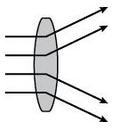
Which lens represents the path light takes through a diverging lens?

a)
b)
c)
d)
14.

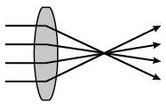
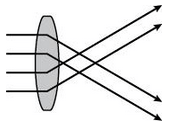
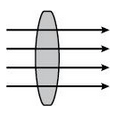
Which figure represents the path light takes through a converging lens?
a)
b)
c)
d)
15.

Light is a form of ___________ that travel in a straight line.

a)

energy

b)

resources

16.

During thunder, light in the form of __________ will be seen first before sound is heard.

a)

rain

b)

lightning

17.

Look at the picture. How does light travel?

a)

Light travels in a straight path.

b)

Light travels in a zig zag path.

c)

Light does not move.

d)

Light travels in a wavy path.

18.

The colors we see from different objects is what type of light?

a)

reflected

b)

refracted

c)

transmitted

d)

absorbed

19.

when light strikes a surface and bounces back in the opposite direction

a)

absorbtion

b)

transmission

c)

reflection

20.
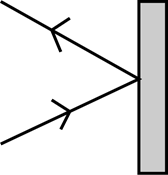
The illustration shows a light ray striking an object.
In the illustration, the light ray striking the object is-
a)
absorbed
b)
stopped
c)
reflected
d)
refracted
21.
The bouncing off of light rays from the surface of an object such as a mirror or other shiny surface is called:
a)
mirror
b)
laser
c)
reflection
d)
refraction
22.
The ray of light that strikes a reflecting surface is called ________.
a)
incident ray
b)
reflected ray
c)
normal ray
d)
none of the above
23.
The angle produced as a source of light bounces off a reflecting surface is called ______.
a)
angle of crookedness
b)
angle of reflection
c)
angle of incidence
d)
angle of bounce
24.
MCQ 02
Why can you see most objects?
a)
A. they emit light
b)
B. light refracts through them
c)
C. light reflects off them
d)
D. they absorb light
25.
Section B1a
Given that the angle of incidence = 30 degrees
a. Draw a ray diagram, labelling clearly the normal, incident ray, angle of incidence, reflected ray and angle of reflection accurately.
Which is the correct diagam? 
a)
A
b)
B
c)
C
d)
D
26.

Which is NOT a source of light?

a)

sun

b)

lightbulb

c)

fire

d)

car

27.

Your light-sensing organ is your

a)

ear

b)

finger

c)

brain

d)

eye

28.

In order to see a picture it must

a)

produce light

b)

reflect light

c)

absorb light

29.
MCQ 011
According to the laws of reflection, if i = angle of incidence and r = angle of reflection,
a)
A. i =  r
b)
B. i >  r
c)
C. r >  i
d)
D. i is not equal to r
30.
MCQ 08
If a capital letter R is seen in an ordinary mirror, what does it look like?
a)
A
b)
B
c)
C
d)
D
31.
Which of the following is not a source of light? 
a)
A. candle
b)
B. caver’s lamp
c)
C. mirror
d)
D. sun
32.
Law of reflection state that - The angle of incidence is .................. to the angle of reflection.
a)
equal
b)
double
c)
half
33.
What is reflection?
a)
Reflection is the bouncing  of light off the surface that it strikes on.
b)
Reflection is the absorbing of light off the surface that it strikes on.
c)
Reflection is the bending of light off the surface that it strikes on.
d)
Reflection is the scattering of light off the surface that it strikes on.
34.

In the diagram, which letter represents the angle of incidence?

a)

A

b)

B

c)

C

d)

D

35.
........... – the angle between the normal and the reflected ray.
a)
Angle of incidence
b)
Angle of reflection
c)
Angle of coincidence
d)
Angle of direction
36.
........... – the angle between the normal and the incident ray.
a)
Angle of incidence
b)
Angle of reflection
c)
Angle of coincidence
d)
Angle of direction
37.
The imaginary line perpendicular to a reflecting surface is called _____.
a)
crooked line
b)
parallel line
c)
angular line
d)
normal line
38.
MCQ 05
Light is a form of energy produced by a ______.
a)
A. luminous object
b)
B. transparent object
c)
C. non-luminous object
d)
D. opaque object
39.
MCQ 06
An example for non-luminous object is ___________.
a)
A. a candle
b)
B. the sun
c)
C. an electric bulb
d)
D. the moon
40.
MCQ 09
When you look at your face in a mirror, where does your face appear to be?

a)
A. an equal distance behind the mirror to what you are in front
b)
B. a long way behind the surface of the mirror
c)
C. on the surface of the mirror
d)
D. just in front of the mirror