
 Worksheets
Unit 6: Newton's Laws of Motion
Total questions: 50
Worksheet time: 25mins

1. Tendency of an object to resist being moved or stopped.
3. If a tennis ball and a giant boulder are dropped from the same height at the same time in a scientific vacuum, what will hit the ground first?
the boulder lands first
the tennis ball lands first


6. Acceleration of an object depends on the mass and the amount of force applied is which law?


9. Which of the following objects has the most acceleration? (moves the fastest)
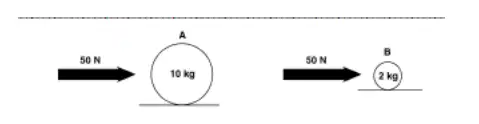
15. Which law does the example demonstrate? You need more force to move a big desk than a small pencil box.

16. Which law does the example demonstrate?

17. Which law does the example demonstrate?

21. This is the tendency of an object to resist being moved or stopped.
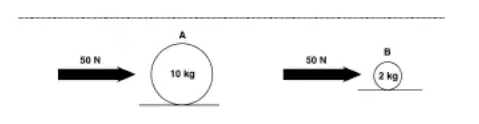
A golf ball and bowling ball are moving at the same velocity. Which of the two has more momentum?
Golf ball
Bowling ball
they have the same
neither
What would hit the ground first here on Earth?
Feather or Hammer
Feather
Hammer
Both hit the ground at the same time
What would hit the ground first here on Earth?
A basketball or a medicine ball?
basketball
medicine ball
both
What would hit the ground first
HERE ON EARTH?
a crumpled piece of paper or a flat piece of paper?
crumpled paper
flat paper
both
Newton’s 1st Law of Motion is sometimes called
Law of Momentum
Law of Gravity
Law of Inertia
When a car accelerates, it can change
speed
speed and direction
direction
Which of the following has the least momentum?
a loaded truck driven at 60 mph
A track athlete running a race
A baby crawling on the floor
A jet airplane being towed toward an airport
A shopping cart has a mass of 405 kg.
How much force would it take to make the cart accelerate to 8 m/s2?
F = m x a
3,240 N
413 N
397 N
50.6 N
Momentum can be transferred but cannot be lost within a system.
When one moving object collides with another moving object, the motion of both objects changes.
Law of Universal Gravitation
Law of Conservation of Momentum
Law of Inertia
Law of Mass
The rate at which velocity changes over time;
An object accelerates if its speed, direction, or both change
air resistance
acceleration
force

