
 Worksheets
Unit 9 Exam
Total questions: 15
Worksheet time: 8mins
Name
Class
Date
1.
Which of the following is most characteristic of the Cold War?
a)
The growth of nuclear arsenals in the US and the Soviet Union
b)
The expansion of national borders by imperialistic European countries
c)
The implementation of isolationist foreign policies in Great Britain and China
d)
The rapid industrialization of many Southeast Asian countries
2.
Organizing the Berlin airlift, implementing the Marshall Plan, and fighting the Korean War were early events in the United States policy of-
a)
imperialism
b)
containment
c)
isolationism
d)
neutrality
3.

This is a cross-sectional diagram of a major 1948 operation ordered by President Truman. The flight pattern illustrated was designed to allow an airplane to land every 3 minutes. Why was this operation undertaken?
a)
To enable a rapid withdrawal of troops from a war-torn city
b)
To deploy substantial invasion forces
c)
To provide supplies to a blockaded city
d)
To rescue thousands of stranded political refugees
4.
The North Atlantic Treaty Organization (NATO) and the Warsaw Pact are examples of
a)
dollar diplomacy
b)
Lend-Lease
c)
mutual defense
d)
Manifest Destiny
5.
In the late 1940s, hearings by the House of Un-American Activities Committee and the use of loyalty oaths illustrate concerns over the -
a)
impact of union strikes on the economy
b)
United States participation in the North Atlantic Treaty Organization (NATO)
c)
desegregation of the military
d)
influence of communists within the federal government
6.
Senator Joseph McCarthy is best known for his involvement in -
a)
the war effort of the 1940's
b)
the Red Scare of the 1950's
c)
the Vietnam War of the 1960's
d)
the political scandals of the 1970's
7.
What was the most significant result of the 1957 launch of Sputnik?
a)
US military troops were deployed to Korea
b)
The United States ended its involement in the Vietnam War
c)
A space race between the US and USSR began
d)
The US government implemented the Marshall Plan
8.

One way President Kennedy responded to the Soviet action referred to in the telegram was to support-
a)
a decrease in the budget for space exploration
b)
an expansion of the Peace Corps to aid impoverished nations
c)
the removal of Soviet troops from East Berlin
d)
the commitment to a Moon landing by the end of the decade
9.
In 1962, President John F. Kennedy responded to the discovery of nuclear missiles in Cuba by
a)
ordering a naval quarantine of Cuba
b)
capturing strategic locations in Cuba
c)
threatening to invade the Soviet Union
d)
prohibiting travel to the southeastern United States
10.

Which action is most closely associated with the foreign policy concern expressed by President Dwight D. Eisenhower in this passage?
a)
authorizing U-2 flights over the Soviet Union
b)
increasing United States involvement in Vietnam
c)
overthrowing military dictatorships in Central America
d)
defending oil producing countries in the Middle East
11.
During the time between the passage of the Gulf of Tonkin Resolution and the start of the Tet Offensive, what happened in the Vietnam War?
a)
All US civilians were evacuated from Vietnam
b)
Peace talks between South and North Vietnam were conducted in Paris
c)
The US government deployed more troops to Vietnam
d)
South Vietnam surrendered to North Vietnam
12.
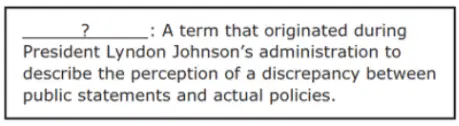
Which term completes this text box?
a)
hawk mentality
b)
credibility gap
c)
living-room war
d)
flexible response
13.
During the mid-1960s, United States participation in the Vietnam War resulted in -
a)
public support for an expanded military draft
b)
mandatory rationing of consumer goods
c)
mass demonstrations by groups protesting the war
d)
national attention for a third-party presidential candidate
14.
As part of the Nixon's administration's policy of Vietnamization, the US military -
a)
trained South Vietnamese forces to take over combat responsibilities from the US troops
b)
shared military technology with North Vietnam
c)
imposed martial law in North Vietnam
d)
installed a puppet government in South Vietnam
15.
The goal of the War Powers Act of 1973 was to-
a)
allow the president to declare war without congressional approval
b)
give Congress the sole power to authorize the use of military force
c)
limit the president’s power to use military force without congressional approval
d)
require a declaration of war for all uses of military forces
100 %

