wayground logo

Free Printable Worksheets

Font size

S
M
L
XL
Worksheets

9th Grade ISASP's Review

Total questions: 138

Worksheet time: 2hrs 4mins

Name
Class
Date
1.

What does the term displacement mean?

a)

The direction of motion

b)

The distance traveled divided by time

c)

The change of position of an object

2.
Which of the following is the closest match to the definition of motion?
a)
An objects change in position relative to a reference point
b)
The change in position of an object
c)
Constant speed
3.
What is the definition of velocity?
a)
A force that opposes motion
b)
Uniform circular motion
c)
The speed of an object in a particular direction
4.
What is the definition of speed?
a)
Distance/Time
b)
Change in velocity/Time
c)
A change in momentum
5.
How is velocity different than speed?
a)
Speed opposes velocity
b)
Velocity is speed with a direction
c)
None of the answers are correct
6.
Which of the following represents the equation for acceleration?
a)
a = ƒt/v
b)
a = Δt/f
c)
A = Λd/t
d)
a = Δv/t
7.
An object traveling in a circular motion is always changing its ______ and ______.
a)
rotation, velocity
b)
direction, velocity
8.
A force is an action exerted on a body in order to change the body's state of ______.
a)
Balance
b)
Being
c)
Proximity
d)
Motion
9.
A force that opposes motion between two surfaces that are in contact.
a)
Speed
b)
Velocity
c)
Friction
d)
Force
10.
The force that opposes the motion of two surfaces that are in contact and are sliding over each other.
a)
Static Friction
b)
Kinetic Friction
11.
a)
Balance Force
b)
Unbalanced Force
12.
a)
Speed
b)
Acceleration
c)
Displacement
13.
a)
Velocity
b)
Speed
c)
Uniform Circular Motion
14.
a)
Static Friction
b)
Kinetic Friction
c)
Sliding Friction
15.

Which one of Newton's laws is shown

a)

3rd law

b)

2nd law

c)

1st law

16.

What does this picture represent

a)

Force,magnetism,acceleration

b)

Force, money, Apples

c)

Force, Mass, Acceleration

d)

Funny, monkeys, Arrive

17.

Which one of Newton's laws are displayed

a)

2nd law

b)

1st law

c)

3rd law

18.

Which of Newton's laws is shown

a)

1st law

b)

3rd law

c)

2nd law

19.

This is Newton's 3rd law

a)

True

b)

False

20.

This is Newton's 2nd law

a)

True

b)

False

21.

An object in motion will stay in motion and an object at rest will stay at rest unless acted upon by an outside force. Which law does this describe

a)

2nd law

b)

1st law

c)

3rd law

22.

If there is a big mass, it would need a stronger force to accelerate it. Which law does this describe?

a)

3rd law

b)

1st law

c)

2nd law

23.

What force slows objects down and keeps them from moving?

a)

Acceleration

b)

Gravity

c)

Friction

d)

Net Force

24.

When there is a change in motion?

a)

When forces are balanced

b)

When the forces are unbalanced

c)

Whe forces are equal

d)

Never

25.

If your teacher falls down these stairs, what would happen to his potential energy?

a)

Increase

b)

Decrease

c)

Remain constant

26.

Which formula should you use to calculate work?

a)

W = m·g

b)

W = m + g

c)

W = F·d

d)

W = F + d

27.

A plastic marble rolls along this rollercoaster ramp without friction or air drag. Where will it have the most potential energy?

a)

A

b)

B

c)

C

d)

D

28.

Four toy cars of equal mass are rolling on the floor. Their velocities are listed below. Which has the most potential energy?

a)

The one moving at 4 m/s backward

b)

The one moving at 2 m/s backward

c)

The one moving at 3 m/s forward

d)

The one moving at 1 m/s forward

e)

all the same

29.

How much kinetic energy does a 0.2kg mouse-trap car have when it is rolling at 4 m/s?

a)

0.08 J

b)

0.4 J

c)

1.6 J

d)

3.2 J

e)

8 J

30.

If the mouse-trap car from the previous question was rolling twice as fast, which statement would be true?

a)

It would have 2× times as much potential energy

b)

It would have 2× as much kinetic energy

c)

It would have 4× as much potential energy

d)

It would have 4× as much kinetic energy

31.

This table is 400 cm long, 160 cm wide and 80 cm tall. How much potential energy does the 1kg microscope have?

a)

0.8 J

b)

4 J

c)

8 J

d)

40 J

e)

80 J

32.

This graph describes the motion of a 60 kg dog. Calculate its kinetic energy.

a)

1,800 J

b)

27,000 J

c)

54,000 J

d)

432,000 J

e)

864,000 J

33.

A man pushes this 50ºF box 5 meters across the floor. He does this by applying 20 N for 4 seconds. How much work did he do?

a)

16 J

b)

25 J

c)

80 J

d)

100 J

e)

125 J

34.
A 40 kg crate is picked up by a crane to a height of 50m. The crate falls. What is the velocity of the crate just before it hits the ground?
a)
2000 Joules
b)
19,600 Joules
c)
19,600 m/s
d)
31.3 m/s
35.

1. A ball has a 17 J of kinetic energy and its mechanical energy is 25 J. If the ball has a mass of 3.2 kg, what is its height above the ground?

a)

0.26 m

b)

0.52 m

c)

5.2 m

d)

25 m

36.
Conduction is heat transfer by -
a)
Touch
b)
Circles
c)
Waves
37.
Warm air rises and the cool air sinks demonstrates this type of heat transfer. 
a)
conduction
b)
convection
c)
radiation
d)
Insolation 
38.
The heat from a hot burner to a pot is transferred by ______.
a)
convection
b)
insulation
c)
radiation
d)
conduction
39.
The sun warming your skin is an example of heat transfer through 
a)
conduction
b)
convection
c)
radiation
d)
thermal electricity
40.
Radiation is a method of thermal energy transfer that moves -
a)
through empty space.
b)
when objects touch.
c)
only through solids.
d)
in the motion of fluids.
41.
Which of the following are kinds of heat transfer.
a)
Conduction
b)
Convection
c)
Radiation
d)
All of the above
42.
In what direction do hot liquids and gasses move?
a)
Side to Side
b)
Down
c)
Up
d)
Back and Forth
43.

What type of heat transfer takes place in liquids and gasses?

a)

Conduction

b)

Convection

c)

Radiation

d)

Thermal Equilibrium

44.
What type of heat transfer takes place in solids?
a)
Conduction
b)
Convection
c)
Radiation
45.
Which example below is an example of convection?
a)
Standing on a hot metal bridge
b)
The attic is warmer than the basement
c)
The Sun heating the Earth
d)
Touching hot sand with your feet
46.
Which example below is an example of radiation?
a)
Standing on a hot metal bridge
b)
The attic is warmer than the basement
c)
The Sun heating the Earth
d)
Touching hot sand with your feet
47.
This is an example of a(n)
a)
Conductor of heat
b)
Insulator of heat
c)
Insulator of electrical
d)
None of the above
48.
What happens to particles as they heat up?
a)
They slow down
b)
Nothing
c)
They don't move
d)
They speed up
49.
What type of material makes the best insulators?
a)
Aluminum
b)
Copper
c)
Styrofoam
d)
Metal
50.
A net gain or loss of electrons 
a)
Electric Charge
b)
Electricity
c)
Electric Circuit
d)
Energy
51.
A machine that will convert mechanical, nuclear, or chemical energy into electrical energy 
a)
Motor
b)
Conductor
c)
Generator
d)
Insulator 
52.
A material that lets electrons pass through it easily
a)
Insulator
b)
Ohm
c)
Conductor 
d)
Alternating Current
53.
A circuit with only one path for electricity to flow
a)
Battery
b)
Electron
c)
Parallel Circuit
d)
Series Circuit
54.
A device that uses chemical energy to make electricity
a)
Conductor
b)
Battery
c)
Motor
d)
Generator 
55.
The unit of measure for resistance
a)
Ohm
b)
Joule
c)
Watt
d)
Inches
56.
A complete path along which an electric current flows
a)
Alternating Current
b)
Direct Current
c)
Electric Circuit
d)
Electric Circus 
57.
An electric current that switches direction rapidly
a)
Direct Current
b)
Alternating Current
c)
Electric Charge
d)
Resistance 
58.
A material that does not let electricity pass through it easily
a)
Conductor 
b)
Battery 
c)
Copper
d)
Insulator 
59.
An electric current that flows in only one direction
a)
Direct Current
b)
Parallel Circuit
c)
Alternating Current
d)
Ohm
60.
A circuit in which electricity can follow two or more paths
a)
Conductor
b)
Resisitance 
c)
Parallel Circuit
d)
Series Circuit
61.
How much a substance opposes the flow of electrons
a)
Resistance 
b)
Electric Charge
c)
Electricity
d)
Parallel Circuit 
62.
A machine that converts electrical energy into mechanical energy
a)
Generator 
b)
Motor
c)
Battery
d)
Power
63.
Flow of electrons that creates a charge, one of the fundamental forms of energy
a)
Electric Charge
b)
Friction
c)
Circuit 
d)
Electricity
64.
Magnetism is generated by moving
a)
protons.
b)
electrons.
c)
neutrons.
d)
elements.
65.
What do the lines around this magnet represent?
a)
North Pole
b)
South Pole
c)
Magnetic Declination
d)
Magnetic Field
66.
If you place the North pole of a magnet next to the South pole of another magnet, they will:
a)
Attract
b)
Repel
c)
Do nothing
d)
Shatter
67.
What happens when two north poles of a magnet are placed together?
a)
they repel
b)
they attract
c)
they cancel each other out
d)
the strength of the magnet is doubled
68.
In un-magnetized materials the domains are __________ aligned.
a)
super
b)
slightly
c)
randomly
d)
always
69.
Electric motors are devices that convert _____ energy into  _____ energy.
a)
electrical; mechanical
b)
mechanical; electrical
c)
chemical; potential
d)
mechanical; kinetic
70.
What kind of magnet can be turned on and off?
a)
refridgerator magnet
b)
electromagnet
c)
magnetite
d)
iron
71.
Magnets that are arranged like this will _______. 
a)
move away from each other (repel)
b)
move towards each other (attract)
72.
The strongest part of a magnet is...
a)
the bars.
b)
the force field.
c)
the poles. 
d)
the middle.
73.
Iron and steel can become _____.
a)
magnetized
b)
transformed into plastics
c)
lined up to the poles
d)
part of the equator
74.
A simple electromagnet can be made with which of the following?
a)
an electric current
b)
a turbine and nail
c)
a nail, a wire, and a battery
d)
a compass and a battery
75.

Match the term to the statement

a)

proton

1.

positive charge

b)

neutron

2.

neutral charge

c)

electron

3.

negative charge

76.

Match the following

a)

magnetic field

1.

the area around a magnetic material in which a magnet would be close enough to respond

b)

force

2.

a push or pull

c)

magnet

3.

a material whose atoms are arranged so that it attracts or repels

d)

core

4.

the deepest layer of the earth

77.

Alexandra was preparing to go on a hike in the woods. She gathered the equipment she would need and placed it on the kitchen counter. By chance, she placed her compass near an electrical outlet. Although the compass was not moving, the compass needle turned because ______.

a)

the electric current in the outlet produced a magnetic field

b)

the compass could only be used outdoors

c)

the kitchen counter was made of a magnetic substance

d)

the kitchen had a microwave oven

78.

Label the parts of the electromagnet.

79.

Which of the following is a type of fossil fuels

a)

Coal

b)

Wind

c)

Solar

d)

Biomass

80.

True or False: Fossil Fuels are renewable

a)

True

b)

False

81.
Nuclear power uses ____ for fuel.
a)
steel
b)
coal
c)
uranium
d)
hydrogen
82.
Nuclear Power is - 
a)
Renewable
b)
Non-renewable
83.
Nuclear energy uses _____ to turn turbines to power a generator.
a)
wind
b)
water
c)
steam
d)
solar
84.

Waves transfer _______.

a)

particles

b)

matter

c)

energy

85.

_____ waves have vibrations that run parallel to the direction the wave travels, and _____ waves have vibrations that run perpendicular to the direction the wave travels.

a)

transverse, longitudinal

b)

longitudinal, transverse

86.

Examples of this type of waves include water waves, waves on a string/jump rope, and light waves.

a)

transverse

b)

longitudinal

87.

Examples of _____ waves include sound waves and earthquake P-waves.

a)

transverse

b)

longitudinal

88.

_______ is the distance between waves, measured from one crest to the next crest.

a)

Wavelength

b)

Frequency

c)

Amplitude

89.

The _______ is the highest point on a transverse wave, and the ____ is the lowest point.

a)

Trough, Crest

b)

Crest, Trough

c)

Compression, Rarefaction

d)

Rarefaction, Compression

90.

The _______ is the size or height of a wave, measured from the equilibrium to the crest or trough.

a)

Amplitude

b)

Wavelength

c)

Frequency

91.

The _______ of a wave is how many waves pass a given point every second.

a)

Frequency

b)

Wavelength

c)

Amplitude

92.

Frequency is measured in _______.

a)

Hertz (Hz)

b)

Meters per second

c)

Meters

d)

Newtons

93.

Frequency is how many waves pass a point in 1 second. If 100 waves pass a given point in 4 seconds, what is the wave's frequency?

a)

25 Hz

b)

100 Hz

c)

4 Hz

d)

400 Hz

94.

In a longitudinal wave, a ____ is an area where the particles are spread apart and a ____ is an area where the particles are close together.

a)

crest, trough

b)

compression, rarefaction

c)

rarefaction, compression

d)

trough, crest

95.

Examples of ________ waves include visible light, xrays, ultraviolet, and radio waves.

a)

transverse

b)

longitudinal

96.

Waves that can travel through empty space are called _____ waves. Waves that require a medium to travel, such as air or water, are called _____ waves.

a)

mechanical, electromagnetic

b)

electromagnetic, mechanical

c)

crest, trough

d)

compressional, rarefactional

97.

In the diagram of a compressional wave, A is showing a ___ while B is showing a ___.

a)

compression, rarefaction

b)

trough, crest

c)

rarefaction, compression

d)

crest, trough

98.

In this diagram of a transverse wave, A is showing the wave's _____ and B is showing the wave's _____.

a)

amplitude, trough

b)

amplitude, crest

c)

wavelength, trough

d)

wavelength, crest

99.

In this diagram of a transverse wave, C is showing the wave's _____ and D is showing the wave's _____.

a)

crest, amplitude

b)

trough, amplitude

c)

crest, wavelength

d)

trough, wavelength

100.
When solid particles gain energy, vibrate faster and break free from their fixed position, this is: 
a)
freezing
b)
condensation
c)
melting
101.
Which has particles that are NOT orderly (randomly) arranged?
a)
Solid
b)
Liquid
c)
Gas
d)
Gas & Liquid
102.
A kind of matter that keeps its shape and volume is a 
a)
solid
b)
liquid
c)
gas
103.
When the particles of a gas lose thermal energy, they move
a)
faster
b)
slower
c)
at the same speed
104.
According to Boyle's Law, as the volume of a gas is made smaller, the pressure of the gas
a)
stays the same
b)
gets higher
c)
gets lower
105.
Matter that can take the volume and the shape of its container is 
a)
a solid
b)
a liquid
c)
a gas
106.
Which container shows the particles of a liquid?
a)
Container A
b)
Container B
c)
Container C
107.
What gas law is shown in this graph?
a)
Third Gas Law
b)
Charles' Law
c)
Boyle's Law
108.
This diagram shows the relationship between 
a)
volume and pressure
b)
volume and temperature
c)
temperature and pressure
109.
From 30 degrees to 55 degrees, what state of matter is the substance?
a)
Solid
b)
Liquid
c)
Gas
d)
Plasma
110.
What state of matter is segment 5?
a)
Solid
b)
Liquid
c)
Gas
d)
Plasma
111.

Vertical columns on the periodic table are called ___?

a)

groups

b)

periods

c)

rows

d)

families

112.

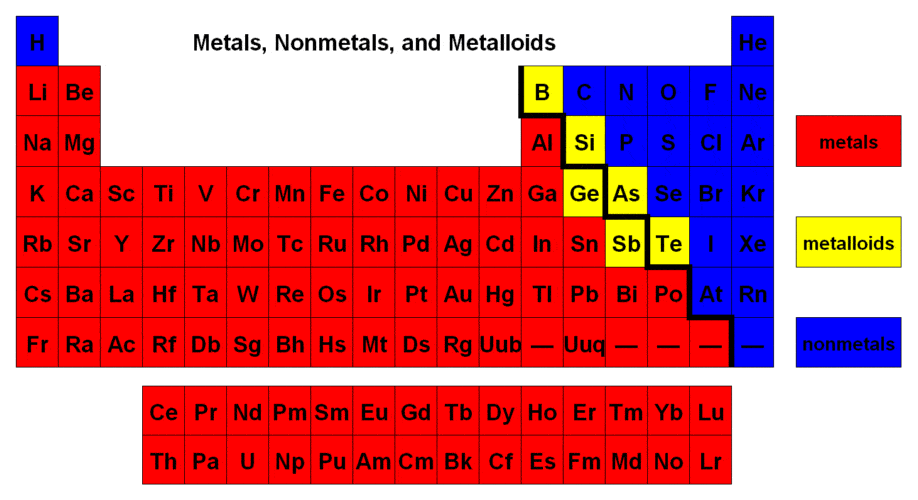
Which color on the image of the periodic table corresponds with the halogens.

a)

red

b)

black

c)

blue

d)

orange

113.

Which color on the image of the periodic table corresponds with the lanthanides.

a)

red

b)

black

c)

blue

d)

orange

114.

Which color on the image of the periodic table corresponds with the noble gases.

a)

red

b)

black

c)

blue

d)

orange

115.

Which color on the image of the periodic table corresponds with the transition metals.

a)

red

b)

black

c)

blue

d)

orange

116.

Which color on the image of the periodic table corresponds with the metalloids.

a)

bright yellow

b)

gold

c)

teal

d)

light blue

117.

Which color on the image of the periodic table corresponds with the alkaline earth metals.

a)

yellow

b)

dark yellow

c)

blue/green

d)

teal

118.

Mendeleev first ordered the periodic table of elements by increasing

a)

atomic number

b)

atomic mass

c)

atomic symbol

d)

atomic weight

119.

Horizontal rows on the periodic table are called ___?

a)

groups

b)

periods

c)

rows

d)

families

120.

Most metals share four common physical characteristics. Which of the options is not one of the four?

a)

Luster

b)

Conductivity

c)

Ductility

d)

Malleability

e)

Reactivity

121.

Which family of elements reacts violently with water and exposure to oxygen?

a)

alkali metals

b)

alkaline earth metals

c)

lanthanides

d)

actanides

e)

transition metals

122.

Which two families of elements are soft and silvery and have low densities? Choose two.

a)

alkali metals

b)

alkaline earth metals

c)

lanthanides

d)

actanides

e)

transition metals

123.

The periodic table is mostly comprised of what type of element?

a)

Metals

b)

Nonmetals

c)

Metalloids

124.

What are the four most common nonmetals in the human body?

a)

Oxygen

b)

Hydrogen

c)

Nitrogen

d)

Phosphorus

e)

Carbon

125.

What is the most reactive nonmetal?

a)

Fluorine

b)

Iodine

c)

Chlorine

d)

Bromine

126.

When a halogen such as Chlorine, combines with an alkali metal to produce a what?

a)

compound

b)

salt

c)

mineral

d)

acid

127.

Which of the following is not true of metalloids?

a)

Silicon and Germanium are common metalloids used in computers.

b)

Metalloids contain properties similar to both metals and nonmetals.

c)

Metalloids are found in a stair step line between metals and nonmetals on the periodic table.

d)

Metalloids are the first choice in building materials.

128.

Which family of elements does not combine with other elements unless under special conditions in a laboratory?

a)

Noble gases

b)

Halogens

c)

Metalloids

d)

Alkaline earth metals

e)

Actinides

129.

An engineer is building a sun reflector which must withstand storms, large winds, and reflect sunlight well, what would suggest they use?

a)

Alkali metal

b)

Alkaline earth metal

c)

Transition metal

d)

Metalloid

e)

Lanthanide

130.

Which of the following is most reactive?

a)

Lithium

b)

Potassium

c)

Sodium

d)

Cesium

131.
What are ionic bonds?
a)
Valence electrons transferred between atoms
b)
Inner most electrons transferred between atoms
c)
Sharing electrons
132.
What bond involves the sharing of electrons?
a)
Ionic
b)
Transitive
c)
Covalent
133.
What elements generally make an ionic bond?
a)
metal and nonmetal
b)
2 or more nonmetals
c)
metal
d)
none of the above
134.
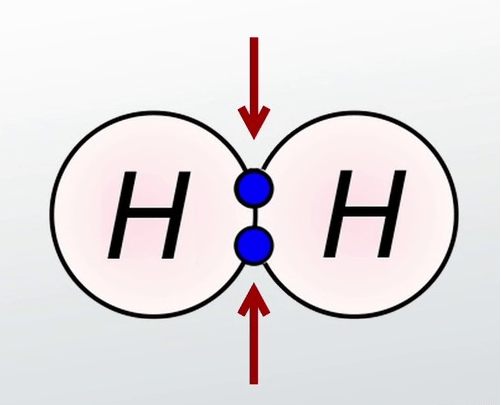
What type of bond is shown in this image?
a)
Ionic
b)
Polar Covalent
c)
Nonpolar Covalent
d)
Van der Waals Force
135.

In a polar covalent bond, electrons are shared:

a)

equally

b)

unequally

c)

between two metals

d)

between a metal and a non-metal

136.

What is meant when it is said that atoms "share electrons"?

a)

electrons orbit both atoms

b)

electrons are split with half of the charge going to each atom

c)

one atom gives extra electrons to the other

d)

atoms have a charge

137.

What type of bonds make a compound hydrophobic?

a)

Nonpolar only

b)

Any type of covalent bond

c)

Polar bonds only

d)

Polar or ionic bonds

138.

What type of bonds make a compound hydrophilic?

a)

Nonpolar only

b)

Any type of covalent bond

c)

Polar bonds only

d)

Polar or ionic bonds