
Font size
 Worksheets
PS3-4 Second Law of Thermodynamics
Total questions: 10
Worksheet time: 8mins
Your teacher has created a thermodynamics lab that involves heat transfer while making tea. Each lab group is given a teapot containing 250 mL (=0.25 kg) of water at room temperature, 20° C which is 68° F the teacher makes the tea which is at the boiling point of water, 100° C.
You must request the correct quantity of water to bring the tea to a temperature where you can drink it without burning your tongue. Your lab group determines that a good drinking temperature is 65° C which is about 150° F and proceeds with that hole in mind.
Complete the sentence below.
The room temperature water (a) (gives cold energy to / gains heat from) the hot tea in order to chill it to a drinkable temperature.
Your teacher has created a thermodynamics lab that involves heat transfer while making tea. Each lab group is given a teapot containing 250 mL (=0.25 kg) of water at room temperature, 20° C which is 68° F the teacher makes the tea which is at the boiling point of water, 100° C.
You must request the correct quantity of water to bring the tea to a temperature where you can drink it without burning your tongue. Your lab group determines that a good drinking temperature is 65° C which is about 150° F and proceeds with that hole in mind.
What quantity of heat, in kJ, is transferred to raise the temperature of the water in the teapot to 65° C? cwater = 4,186 j/kg•º C
47
68
155
188
A cup containing 25 mL of hot water and a similar cup containing 25 mL of cold water are place on a table in a room at 21° C.
Which of the following graphs shows the most likely change in temperature for each cup from 0 min to 40 min?


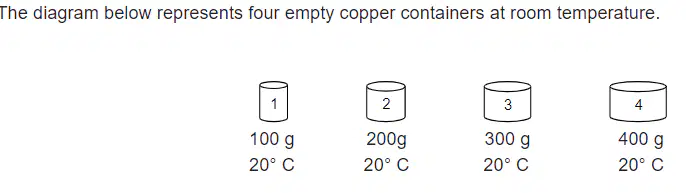
An equal amount of water at 90° C is added to each copper container. Assume there is no loss of heat to the environment.
Which container will have the greatest change in temperature when the water and the container reach equilibrium?
1
2
3
4
A cup of tea with a temperature of 80° C is placed on a table in a 20° C room.
What happens to the thermal energy and molecular motion of the tea when it is left on the table?
The thermal energy increases and the molecules move faster.
The thermal energy decreases and the molecules move faster.
The thermal energy increases and the molecules move more slowly.
The thermal energy decreases and the molecules move more slowly.
When 100 g of 20° C water is mixed with 50 g of 50° C water in a closed system, what is the final water temperature?
20
30
35
50

Which mechanism of heat transfer does not require a medium?
Conduction
Convection
Radiation
All of the above require a medium
What does thermal equilibrium mean?
It is the point at which two substances reach the same temperature and heat no longer flows between them.
It is the condition under which a substance changes from solid to liquid.
It is the condition under which a substance emits the maximum amount of radiation.
It is the point at which a substance can no longer absorb heat.

