
 Worksheets
Meteorology Quiz #2 Review
Total questions: 52
Worksheet time: 4hrs 16mins

Winds that blow from 300 latitude to the equator are called:
westerlies
polar easterlies
trade winds
horse latitudes

What is the process of global winds curving due to the Earth's rotation called?
Coriolis effect
Doldrums
Trade winds
Convection
Warm air rises causing __________ pressure and cool air sinks causing __________ pressure.
high, low
low, high
high, high
low, low
Winds always blow from areas of _________ pressure to areas of _________ pressure.
high, high
low, low
low, high
high, low
Wind is caused by convection currents due to:
Too much Taco Bell
Differences in elevation
The uneven heating of the Earth by the sun
The currents in the ocean
Which heats up and cools more quickly?
Land
Water (Oceans)
They heat and cool equally
Which global winds move FROM the east to the west?
Westerlies
Tradewinds
Easterlies
Easterlies and Tradewinds
Due to the Coriolis effect, global winds in the northern hemisphere deflect:
clockwise
counter-clockwise
Due to the Coriolis effect, global winds in the southern hemisphere deflect:
Clockwise
Counter-clockwise
The Coriolis Effect is caused by what?
The wind blowing
Earth's gravity pulling things down
The rotation of the Earth
The pull of the Moon
Constant, predictable winds that move over long distances are called:
land breezes
mountain breezes
global winds
sea breezes
The source of energy that creates global winds is:
the moon
the sun
the Earth's surface
the rotation of the Earth

Which areas typically have high pressure?
A and E
C
B and D
A, C, and E

The temperatures at band A are __________ than the temperatures at Band C.
warmer
colder

If A is a low pressure band and B is a high pressure band, which direction does a global wind want to flow between these two areas?
North to south
South to north
East to west
West to east
Where is the Jet Stream
East to west, very high
West to east, a low level wind
Near the equator, west to east
Over the Gulf Stream
West to east, very high
Which statement correctly defines wind?
The movement of air from areas of low pressure to areas of high pressure
The movement of air to a colder area in the atmosphere.
The movement of air from areas of high pressure to areas of low pressure.
The movement of air pushed around and bouncing off Earth's surface.
The Coriolis effect causes ___________.
the Earth to rotate on its axis
earthquakes
global winds to move in a curved path instead of a straight line
the Earth to revolve around the sun


At the equator warm air rises creating a windless area known as the...
doldrums
horse latitudes
prevaililng westerlies
polar easterlies
What is the Coriolis effect?
The Coriolis effect is the apparent deflection of moving objects caused by the rotation of the Earth.
The Coriolis effect is a phenomenon that occurs only in the Northern Hemisphere.
The Coriolis effect is caused by the Earth's magnetic field.
The Coriolis effect is the result of gravitational forces between the Earth and other celestial bodies.
How do jet streams affect weather patterns?
Jet streams cause earthquakes and volcanic eruptions.
Jet streams affect weather patterns by steering storms and air masses, influencing the speed and direction of weather systems.
Jet streams have no effect on weather patterns.
Jet streams only affect the temperature, not the direction, of weather systems.
During the day, cooler air over water blowing toward land is called a:
Land breeze
Sea breeze
Bay breeze
Continental breeze
At night, cooler air over the land blowing toward the water is called a:
Land breeze
Sea breeze
Bay breeze
Continental breeze
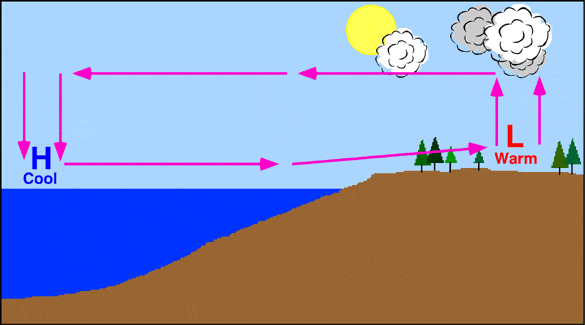


Air moves from _______ pressure to ________ pressure.
high to low
low to high
high to high
low to low

During the night, the _______ has an area of low pressure, and the ______ has an area of high pressure.
land, water
water, land



