Worksheets
Studio Art 3 T2Q1 Proficiency 2024
Total questions: 65
Worksheet time: 4hrs 33mins

Translucent
Able to see through
Unable to see through
the texture of paper
an even and light layer of color
What is watercolor?
is a painting method in which the paints are made of pigments suspended in a water-based solution. Watercolor refers to both the medium and the resulting artwork.
like acrylic paint
watery paint
paint that doesn't need water

The surface on which watercolors are mixed before applying to surface.
wells
mixing board
dry board
Paint palette
Another name for color.
Wash
Color
Hue
Paint that is NOT transparent.
Tempera
Transparent
Opaque

When creating a wet on wet sky you must
use dry paint on dry paper
first wet the paper with water and then drop wet paint on it to spread
keep the paper dry and drop wet paint on it
all of the above
To make a color lighter in watercolor you
add more color
add water
add white crayon
add black

How to create more vivid colors with watercolors?
Add more water than paint.
50/50 of water and paint
Add more paint than water.
Which list has the 8 Principles of Design?
Unity, Balance, Emphasis, Contrast, Repetition, Rhythm, Proportion, Movement
Line, Shape, Color, Form, Value, Texture, Space, Scale/Size
Background, Foreground, Middle Ground, Vanishing Point, Horizon Line, Converging Lines, Picture Plane, Composition
Which image shows Rhythm the LEAST?


When all of the elements in a work look as though they belong together it is called
form
unity
contrast
emphasis
This is used by artists to direct the viewer's eyes through their work often to focal areas.
Balance
Space
Pattern
Movement
This is used to create dominance and focus as a work if art
Unity
Movement
Line
Emphasis
This is the repetition of visual Movement- Colors, shapes, or lines
Rhythm
Movement
Value
Unity
The principles of design are
The ingredients used to create an artwork
Concepts used to organize or arrange the structural elements of art/design
What Leonardo da Vinci used to become famous
The vocabulary created by Isaac Newton to describe art
The distribution of visual weight in a work of art is known as
Balance
Contrast
Space
Emphasis
Which one of these images best shows the principle of contrast?


Which one of these images best shows the principle of emphasis?


Is this picture of balance symmetrical or asymmetrical?
Symmetrical
Asymmetrical

A definition of rhythm in art is
a sense of action / dynamism
the repetition of activity (a pattern or visual beat)
a variety of elements arranged to create visual interest
an element of design is used to dominate the work
A definition of symmetrical in art is
a sense of action / dynamism
both sides are mirror images
a variety of elements arranged to create visual interest
an element of design is used to dominate the work
A definition of asymmetrical in art is
a sense of action / dynamism
not a mirror image but still provides a feeling of balance
a variety of elements arranged to create visual interest
an element of design is used to dominate the work
A definition of radial in art is
based on a circular plan; everything radiates out from a central point
not a mirror image but still provides a feeling of balance
a variety of elements arranged to create visual interest
an element of design is used to dominate the work

When washing your paint brush you should...
throw it in the sink
let someone else wash your brush
rinse thoroughly and place in cup with the bristles up
leave it at your table

Colors that remind you of things that are cool (rain, water, snow, ice). They are relaxing and recede (move away from the viewer) when used in a painting.
monochromatic
cool
analogous
complimentary

These colors are energetic and exciting. When used in a painting they come towards the viewer and stand out.
warm colors
cool colors
monochromatic colors
complimentary colors

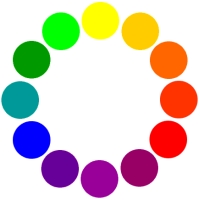
These are created when you mix the primary colors.
secondary
tertiary
cool
tones

This is the element of art that is the area between, around, above, below or
within things.
Space
Line
Form
Value

This is concerned with the size relationships of one part to another.
Emphasis
Variety
Proportion
Balance

Uses lots of different shapes, colors, forms, textures, etc. might be used to make the work more interesting.
Emphasis
Balance
Variety
Rhythm
Assemblage is what type of process?
Additive
Subtractive
Manipulative
What is Assemblage?
What does it mean if a sculpture is "in the round"?
3D figures and forms that you can walk around
3D artworks that rise above a flat plane
3D artworks that have moving parts
What does it mean if a sculpture is "kinetic"?
3D figures and forms that you can walk around
3D artworks that rise above a flat plane
3D artworks that have moving parts

These images in black and white show us negative and positive _____________.
tone
color
space
compostition
Which of the choices below are a medium for drawing?
Watercolors
Graphite pencil
Oil paints
Gouache

This refers to the way things feel, or look as they might feel if touched.
Line
Texture
Value
Form


What type of balance is seen in this image?
Symmetrical
Asymmetrical
Radial
Formal

What type of balance do you see in this image?
Symmetrical
Asymmetrical
Radial
Informal

Which shading technique is this?
cross-hatching
stippling
blending
hatching

Which shading technique is this?
hatching
blending
cross-hatching
stippling

What side of the apple is the light source on?
the right side
the left side
the top
the bottom

What sentence is correct for this picture?
It is 2-D and a cube.
It is 3-D and a square.
It is 3-D and a cube.
It is 3-D and a sphere.

"The feeling of harmony between all parts of the art piece."

"Works with pattern; Repeated elements do not have to be identical to each other."

"Using multiple principles of design to hold the viewer's attention."


"The path in which the viewer's eye travels across the work of art."

What is this area?
Highlight
Cast Shadow
Mid tone

What is a shade in painting?
Dark glasses
Sun protection
Darker value of a color
All answers
Translucent
Able to see through
Unable to see through
the texture of paper
an even and light layer of color

What is the art subject of the painting?
Portrait
Still-life
Landscape
Abstract
A photo to look at while drawing so that your work is more accurate
masterpiece
blocking out
reference photo
ratio
The way your paper is positioned is called?
Orientation
Portrait
Landscape
Position
________ is what you use to create art; the tools and materials.
Media
Subject Matter

This arrangement of objects that the artist Cezanne has painted here can also be called what?
A picture plane
A still life
Portraiture
Forms and shapes

This self-portrait by Rembrandt uses what pencil technique?
Hatching and Cross-hatching
Stippling
Blending
Lines and Shapes

Which type of line drawing is this?
Contour
gestural
Crosshatch
zig-zag
Choose the abstract shape below.