
 Worksheets
Environmental CFA Spring 2024
Total questions: 20
Worksheet time: 10mins
When a predator species invades an ecosystem, survival usually becomes —
more difficult for native predators, because they must compete for food
easier for native predators, because they will crossbreed
more difficult for prey, because they must compete with the invading species for food
easier for prey, because the invading species will compete with native predators
Feral pigs are an invasive species commonly found in the Pineywoods of East Texas. Areas where feral pigs are found often have damaged farmlands, grass, and tree roots. When the pigs live close to water sources, their presence erodes the soil. This disrupts the native vegetation and makes those plants vulnerable to invasive plant species. There are no known natural predators to feral pigs.
How will the removal of the feral pig affect existing populations in that ecosystem?
Removing the pigs will not affect the ecosystem because the pigs have no natural predators that will be affected by their removal.
Removing the pigs will cause the native vegetation to become quickly overgrown because the plants will no longer be the prey of the pigs.
Removing the pigs will cause an increase in native plant populations over generations because the pigs will no longer damage the land.
Removing the pigs will cause an increase in invasive plant populations because the pigs were the only organism eating invasive plants.
An invasive species of green algae has become established along the coasts of the Mediterranean Sea. Which of the following statements best explains why this species of algae has been so successful in the Mediterranean Sea?
It is not a good competitor.
It is not eaten by many animals.
It reproduces slowly in warm waters.
It requires more nutrients than most other algae.
Bees are considered a keystone species because of their role in plant reproduction in a wide variety of species. Colony collapse in bees causes entire hives to die. Currently, scientists do not know the cause of colony collapse. If the spread of colony collapse in bee populations continues, extinction of bees is a possibility. Which of the following best describes the effect on the ecosystem if bees become extinct?
Predators of bees would decrease, and plant populations that bees feed from would increase.
Bear populations would decrease because of the lack of honey in their diet.
The butterfly population would increase, and pollination would be unaffected.
Most consumer populations would decrease due to the lack of food production.
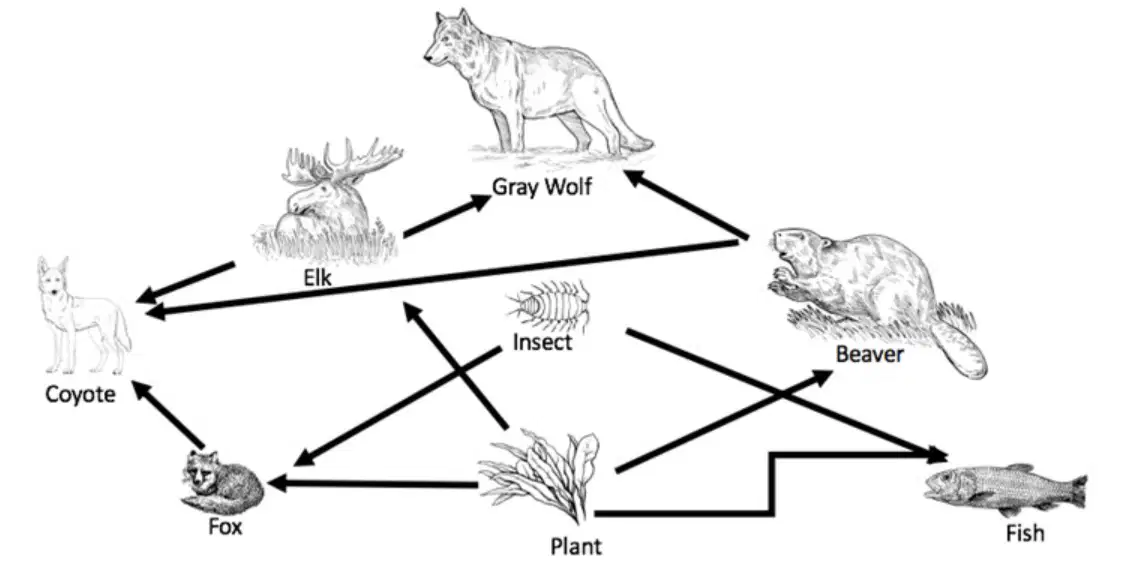
If the gray wolf became extinct, what conclusion about the coyote population would NOT be valid based on the relationships shown in the food web?
The coyote will become the apex predator and greatly reduce the populations of foxes.
The coyote population will decrease because the gray wolf is the coyote’s main competition for food sources.
If another wolf is introduced to fit the same niche, the coyote population will decrease.
As the number of coyotes increase, the number of beavers will decrease.
Certain natural selection pressures can cause genetic diversity within a species to decrease. What is a possible effect on a population that has had a decrease in the genetic diversity within the population?
The population will be less likely to find sources of food because all of the individuals in the population will be competing for the same types of prey.
The population will be more likely to adapt to changes in the ecosystem over time because the genes that remain in the population are more likely to mutate.
The population will have a greater chance of surviving when changes in the ecosystem occur because only those with advantageous genes have survived.
The population will be at risk if a new disease is introduced because a greater percentage of the population has the same traits that make them vulnerable to the disease.
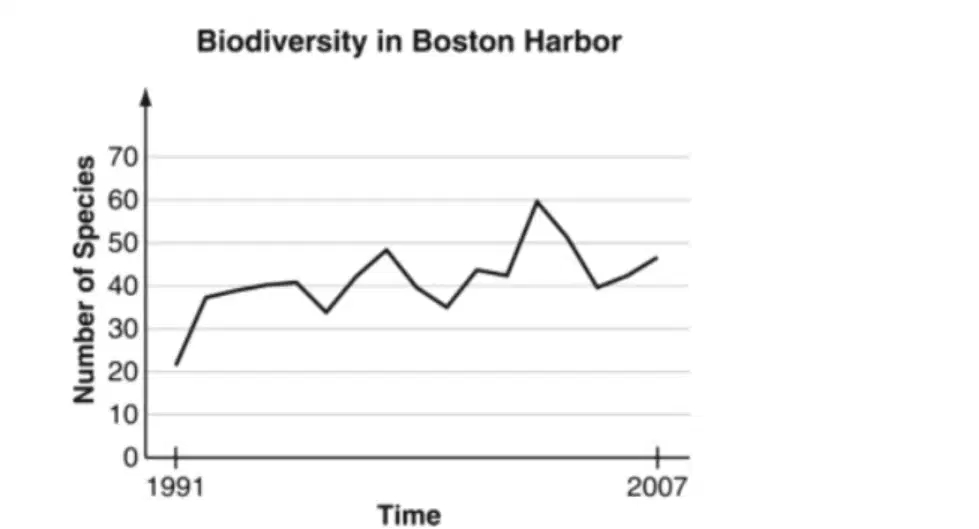
Sewage sludge was repeatedly dumped into Boston Harbor until 1991, which polluted the harbor. Scientists recorded the number of species in Boston Harbor from 1991 until 2007. The graph shows the results. Which prediction do the data in the graph most support?
The ecosystem will have fewer habitats because the number of species is increasing.
The ecosystem will become more stable because the number of species is increasing.
The ecosystem will become unstable because the number of species is decreasing.
The ecosystem will have fewer types of species because the number of species is decreasing.
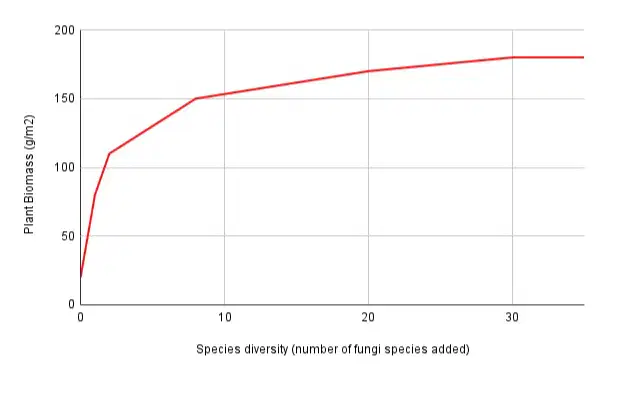
Scientists studied the effects of different species of fungi that live on plant roots and provide soil nutrients to the plants to help them grow. To determine the importance of fungi species diversity in a grassland ecosystem, scientists increased the number of different species in the soil and then compared it to the total plant biomass in that area. The graph shows their results.
What conclusion can be made from the information in the graph?
The more species of fungi found in the soil, the more plants can grow.
The more species of fungi found in the soil, the less plants can grow.
The more plants in the ecosystem, the less fungi species are found.
The more species of fungi found in the soil causes diseases
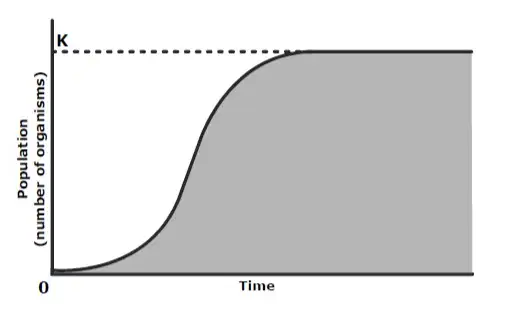
Students were given a graph of population over time. The letter K on the graph represents the —
production rate
carrying capacity
limiting factor
demographic transition
There is a limit to how large any given population can grow, which we define as carrying capacity. Which of the following statements best explains why a population must eventually stop growing?
A low female-to-male ratio develops in the population as it grows.
Old individuals outnumber juveniles in the population as it grows.
The resources available are fully used by the population as it grows.
Natural selection changes the gene pool of the population as it grows.
Exponential growth causes a population to double in a fixed amount of time. The doubling time depends on the annual growth rate according to the formula T = 0.7/r. If the annual growth rate (r) of Kenya's population is 10%, how long will it take for Kenya's population to double?
0.07 years
0.7 years
7 years
70 years
Recent forest fires of California completely destroyed vegetation in areas where they occurred. As California recovers, the first organisms to repopulate the burned areas are —
grasses
herbivores
slow-growing trees
small mammals
What happens during a temperature inversion?
Warm air is trapped below a layer of cold air.
Cold air is trapped below a layer of warm air.
Smoke is trapped below a layer of clouds.
Clouds are trapped below a layer of smoke.
Which of the following scenarios accurately describe how succession occurs as a natural process of ecosystem restoration?
Glaciers have been slowly melting for hundreds of years in Glacier Bay, Alaska. As the glaciers melt and earth is exposed, mosses and lichen begin to grow. This is followed by larger plants and eventually tall shrubs. Over time, the area is said to reach maturity.
In Indonesia, a rain forest is cleared for urban use. Once trees are cut down, lichen begins producing soil. Afterwards, decomposers are able to move into the area, followed by larger species such as birds and rodents.
In Haulalai, Hawaii, lava from volcano eruptions have covered portions of the island. Small weeds and native grasses emerge from the lava. Small insects feed on the grasses which attracts birds.
In California, a forest fire grows out of control. Once the fire is extinguished, seeds that were able to survive the fire begin to sprout. These seeds die off because there is no soil. The area remains barren.
The increased rate of eutrophication of a body of water due to agricultural and residential runoff is an example of —
acid precipitation
nonpoint source pollution
rising carbon levels
strategic irrigation
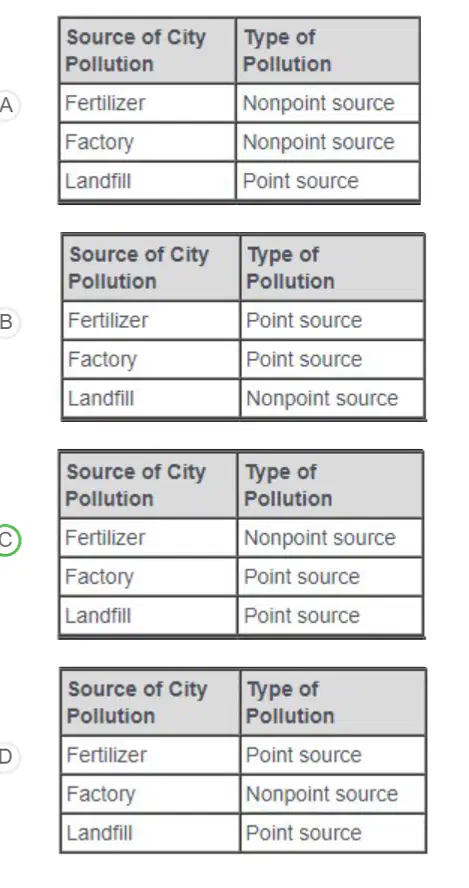
Students are studying sources of pollution from several locations at a nearby small town. They noticed in the spring that fertilizer from lawns washed into the local stream. Collected rainwater indicated that the city's factory was releasing pollutants in the air. Lastly, several students remembered a newspaper article about the city landfill that had no liner at the bottom. Which student table correctly displays the type of pollution?
Table A
Table B
Table C
Table D
Air pollution from industrial activities appears to be affecting the Arctic. Pollution, such as hydrocarbons, sulphates, and soot, is deposited, darkening the snow and hastening melting. If the polar ice caps were to melt, all of the following would occur EXCEPT —
more flooding in coastal regions
increased sea levels
ocean salinity levels decrease
decreased tidal action
Pollution has many causes and can affect air and water quality in a variety of ways. The burning of fossil fuels may contribute to an increase in global temperatures. What might lead to this increase in temperatures?
The combustion products reflect solar radiation away from Earth.
Carbon dioxide in the atmosphere attracts solar radiation.
Carbon dioxide in the atmosphere blocks energy from escaping into space.
The combustion products allow more energy to enter the earth.
John Christy is a respected climatologist who has found almost no sign of global warming in millions of measurements from weather satellites. Richard Alley, a glaciologist, discovered air bubbles found in an ice core that showed how our climate had drastically changed in the last 10 years. Which scientist(s) would be more likely to agree that reducing the amount of fossil fuels being burned could be a possible solution to global warming?
John Christy
Richard Alley
Both scientists
Neither scientist
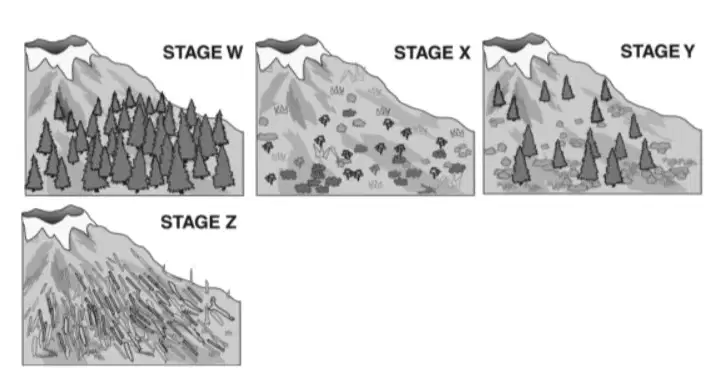
When the Mount St. Helens volcano erupted, the blast covered much of the surrounding area with ash.
X, Y, Z, W
Z, X, Y, W
W, Y, X, Z
Z, Y, W, X

