
 Worksheets
Supply and demand, PPF, elasticity, and CFM
Total questions: 77
Worksheet time: 58mins
Which statement describes the law of demand?
As prices rise, quantity demanded decreases
As prices rise, demand decreases.
As prices fall, quantity demanded decreases.
As prices fall, demand decreases.
Which explains why a supply line is upward sloping?
the Law of Demand states there is an indirect relationship between price and quantity
the Law of Supply states there is a direct relationship between price and quantity
the Law of Supply compares marginal costs and marginal benefits in a constant rate
the Law of Demand shows a positive relationship between two goods, creating the slope
Which is an example of the Law of Demand at work?
The price of the pizza goes up when the price of cheese goes up.
Demand for pizza goes down when tacos become more popular
The price of pizza falls when the demand for pizza falls
Demand for pizza rises when the price of pizza falls
What causes a shift in the demand curve?
A decrease in price
An increase in price
A change in an area other than price
A change in price and availability
The amount of a good or service that producers are willing and able to sell at all possible prices during a given period of time.
(a)

The diagram represents a(n)
increase in supply
decrease in supply
change in quantity supplied
none of the above
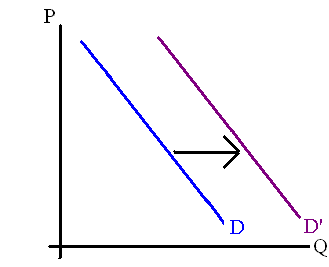
The diagram represents a
increase in demand
decrease in demand
change in quantity demand
none of the above
quantity demand goes up
demand goes up

Which condition would lead to the highest prices?
Low supply, high demand
High supply, high demand
High supply, low demand
Low supply, low demand
A change in the number of consumers.
Shift in Supply
Shift in Demand
A change in the cost of inputs.
Shift in Supply
Shift in Demand
A change in producer expectations.
Shift in Supply
Shift in Demand

What are Substitute Goods?
Items that people tend to buy more of when their incomes increase. This is true of most goods and services.
Items that people purchase more of when their incomes decrease. These items tend to be low-cost options for saving money.
Items that may replace each other when used or consumed.
Items that are almost always consumed or used together.
New robot technology increases productivity of car producers. What happens to market for cars?
Supply shifts left
Supply shifts right
No change in supply
Cost of steel increases. What happens to market for cars?
Supply shifts left
Supply shifts right
No change in supply

In an attempt to increase the production of oil and gasoline, Congress and the President have given the okay to drill in the Alaskan Arctic Preserve. What happens to the market for gasoline?
Supply for gasoline will decrease
Supply for gasoline will increase
Supply for gasoline will stay the same

Which of the following defines "Complementary Goods?"
Goods that can be used to replace the purchase of similar goods when prices rise
Goods that are commonly used with other goods
Goods that are independent of other markets
(a) is the different quantities of goods that consumers are willing and able to purchase.
If price increases for a product, consumers will buy less of that product and more of another (a) product.
The Law of Diminishing Marginal Utility states that as you consume more of any good, the additional satisfaction you receive will
increase with each new unit consumed
decrease with each new unit consumed
stay the same with more units consumed
not make a difference on the margin
The demand curve is (a) sloping, showing the inverse relationship between price and quantity demanded.
When there is a change in price, there is also a change in (a) supplied or demanded.
(a) DOESN'T SHIFT THE CURVE!
As income increases, demand increases -- but as income decreases, demand also decreases for this type of good:
(a)
For inferior goods, as income increases, demand decreases. As income decreases, demand will (a)
According to the Law of Supply, why is there a direct (positive) relationship between price and quantity supplied?
at lower prices, producers have incentives to produce more
at higher prices, consumers have incentives to buy less
at higher prices, producers have incentives to produce more
price stays the same no matter the quantity supplied
(a) are a government payment that supports a business or market. This causes the supply of a good to increase.
We all know price doesn't shift the curve. What does happen when there is a price change?
quantity (supply or demand) changes
the curve increases
the curve decreases
nothing
When you plot prices and quantity demanded on a graph, what is the result?
demand line
demand curve
a straight line
none of the above
Which of the following is NOT a reason why the demand curve slopes down?
substitution efect
income effect
government involvement
law of diminishing marginal utility
The (a) effect occurs when changes in price affect the purchasing power of customers. They can purchase less with the money they have.
As you consume a product or service, you will eventually get less additional utility from each unit consumed. This is called the _______
income effect
law of diminishing marginal utility
substitution effect
Which of the following is NOT a shifter of demand?
tastes/preferences
number of consumers
price of related goods
income
taxes
Which of the following are shifters of supply? Select all that apply.
prices of resources
number of producers
technology
income
subsidies/taxes
When the price of a product increases or decreases, what happens to the supply of the product?
increases
decreases
remains the same
A _______ exists when the quantity demanded is greater than the quantity supplied.
surplus
shortage
A group of buyer and sellers of a particular good or service
(a)

What does this curve represent?
(a)
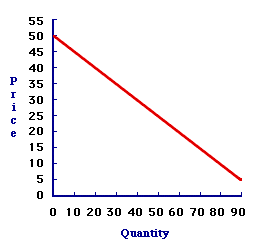
What does this curve represent?
(a)
Which of the following represents the equation for finding elasticity of demand?
% change in price / % change in quantity
% change in price / % change in market demand
% change in substitutes / % change in value demanded
% change in quantity demanded / % change in price

Businesses provide government with...
taxes
sales
private goods & services
interest

In terms of resources, what do households provide for businesses?
loans
savings
labor
private goods
Where are factors of production (land, labor, etc) exchanged in the circular flow model?
Resource Market
Product Market
Firms
Individuals
Someone buys a car in exchange for a large amount of money. They have completed an exchange in which part of the circuclar flow model?
Product Market
Factor Market
Firms
Individuals
Money exchanged between an individual and a store for a good or service.
Revenue
Wages
Rent
Donation
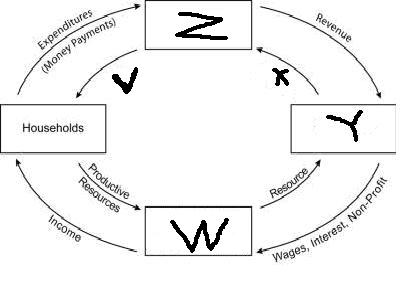
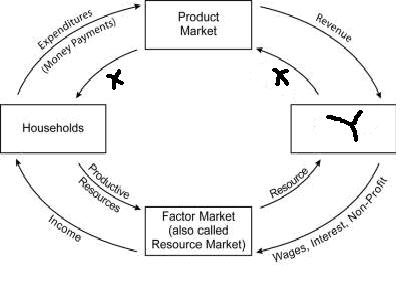
What does government provide with the revenue it takes in from taxes?
Headaches
Public goods and services
More Congressmen
Greater control of the media
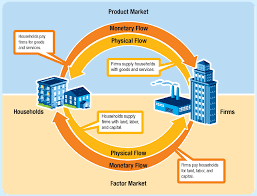
This diagram is called a:
Production Possibilities Curve
Supply and Demand Curve
Circular Flow Model
Circular Motion Equation
This circular flow model would be for a __________ economy
Traditional
Planned/Command
Free Market
Mixed Economy
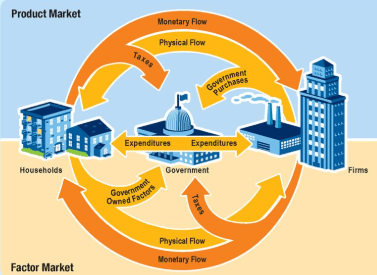
This circular flow model would be for a __________ economy
Traditional
Planned/Command
Free Market
Mixed Economy

What goes at point 6
Factors of Production
Revene
spending
wages, interest, revenue, profit
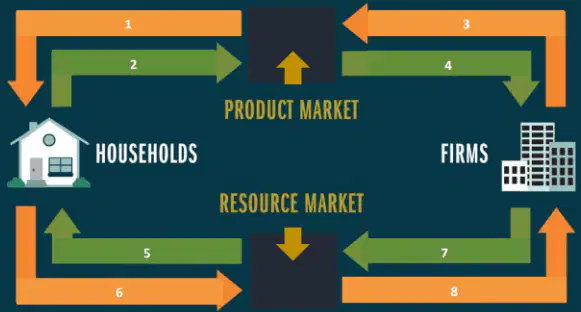
What goes at point 7
Goods and services
Factors of Production
wages, interest, revenue, profit
Land, labor, capital, entrepreneurship
ceteris peribus
everything else is equal
nothing is equal
supply is greater than demand
unlimited wants
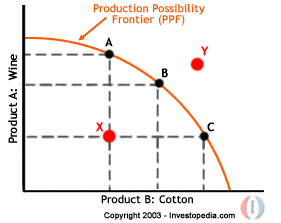
True or False, PPF assumes that you're only trading off between 2 things and everything else is equal
True
False
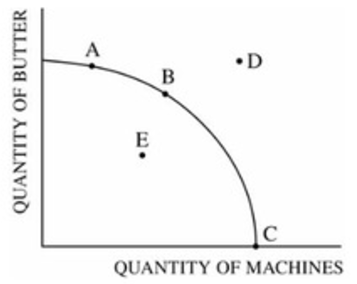
A point inside the PPF Curve is _______.
Efficient
Inefficient
Unattainable
Perfect
A point along the PPF curve is _______.
Efficient
Inefficient
Unattainable
Perfect
A point outside the PPF curve is _______.
Efficient
Inefficient
Unattainable
Perfect

The opportunity cost of increasing from producing 0 of Good B to 6 of Good B is...
1 of Good A
2 of Good A
3 of Good A
0 of Good A
What may cause a PPC/PPF to shift to the left or the right?
Improvements in technology
Availability of resources
Accessibility of labor
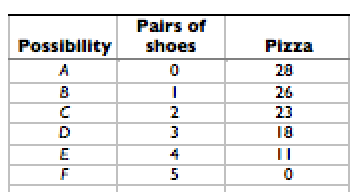

Describe your demand for a product if you buy the same amount of it or just a small amount less after a large price increase.
elastic
unitary elastic
inelastic
hyperelastic
Which of the following is an example of inelastic demand?
Jason wants the most expensive cellphone. He decides to get a cheaper model.
Priya wants to go to the season-opening game. Tickets to another game cost less, but she still buys tickets for the opener.
Tianna wants to try out a new, expensive restaurant. She goes to another restaurant whose food is excellent and costs less.
Shawn wants to buy a house in one neighborhood. But after searching, he decides to buy a house elsewhere instead.
How does elasticity affect potential revenue for a firm?
If demand for a good is inelastic, lowering the price could raise revenue.
If demand for a good is inelastic, raising the price could reduce revenue.
If demand for a good is elastic, raising the price must increase revenue.
If demand for a good is elastic, raising the price could reduce revenue.
Which of the following two goods is more likely to be inelastically demanded?
Demand for insulin
Demand for vitamins
During the COVID 19 Pandemic we are all experiencing now, and the information campaign from the Center for Disease Control highlighting that bacteria and other organisms cause and spread disease, will the demand curve for soap be more elastic or more inelastic?
More elastic
More inelastic
After the invention of nuclear power plants, will the demand curve for coal power plants be more elastic or more inelastic?
More elastic
More inelastic

