
 Worksheets
10-3 Entropy & Enthalpy
Total questions: 10
Worksheet time: 10mins
Based on Table I, which equation represents a reaction with the greatest difference between the potential energy of the products and the potential energy of the reactants?
4Al(s) + 3O2(g) → 2Al2O3(s)
2H2(g) + O2(g) → 2H2O(l)
C3H8(g) + 5O2(g) → 3CO2(g) + 4H2O(l)
C6H12O6(s) + 6O2(g) → 6CO2(g) + 6H2O(l)
Based on Table I, which compound dissolves in water by an exothermic process?
NaCl
NaOH
NH4Cl
NH4NO3
Based on Table I, what is the ΔH value for the production of 1.00 mole of NO2(g) from its elements at 101.3 kPa and 298 K?
+33.2 kJ
-33.2 kJ
+132.8 kJ
-132.8 kJ
At 101.3 kPa and 298 K, a 1.0-mole sample of which compound absorbs the greatest amount of heat as the entire sample dissolves in water?
LiBr
NaCl
NaOH
NH4Cl
Given the balanced equation representing a reaction occurring at 101.3 kilopascals and 298 K:
2H2(g) + O2(g) → 2H2O(l) + energy.
What is the net amount of energy released when one mole of H2O(l) is produced?
241.8 kJ
285.8 kJ
483.6 kJ
571.6 kJ
According to Table I, which equation represents a change resulting in the greatest quantity of energy released?
2C(s) + 3H2(g) → C2H6(g)
2C(s) + 2H2(g) → C2H4(g)
N2(g) + 3H2(g) → 2NH3(g)
N2(g) + O2(g) → 2NO(g)
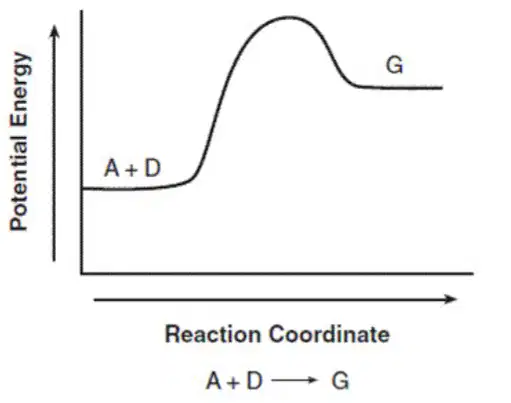
Given the potential energy diagram and equation representing the reaction between substances A and D:
According to Table I, substance G could be
HI(g)
H2O(g)
CO2(g)
C2H6(g)
For which compound is the process of dissolving in water exothermic?
NaCl
NaOH
NH4Cl
NH4NO3
Which equation represents an exothermic reaction at 298 K?
N2(g) + O2(g) → 2NO(g)
C(s) + O2(g) → CO2(g)
KNO3(s) → K+(aq) + NO3-(aq)
NH4Cl(s) → NH4+(aq) + Cl-(aq)
According to Table I, which potential energy diagram best represents the reaction that forms H2O(l) from its elements?



