
Font size
 Worksheets
G4 Science
Total questions: 73
Worksheet time: 47mins
Water Seekers
Roots always seek moisture so they usually grow downward.
Sensorial Aspect
Technical Aspect
Water Seekers
Roots change their direction, always towards water source.
Sensorial Aspect
Technical Aspect
Water Seekers
The blue line indicates water.
Sensorial Aspect
Technical Aspect
The amount of matter is called weight.
True
False
Almost all the things you buy in the market are bought in kilograms and grams.
True
False
It is the space occupied by an object.
Mass
Density
Volume
Force
It is the measure of how closely packed the matter in it is.
Mass
Density
Volume
Force
It describes the amount of particles of matter in a specific space.
Mass
Density
Volume
Force
The object with less space has greater density.
True
False
Ability of liquid to pass through narrow spaces without the assistance of an external force like gravity.
VISCOSITY
POROSITY
CAPILLARITY
Check all the objects that can absorb water


Which laboratory equipment can measure WEIGHT?
Spring Balance
Platform Balance
Graduated Cylinder
Which laboratory equipment can measure VOLUME?
Spring Balance
Platform Balance
Graduated Cylinder
Which laboratory equipment can measure MASS?
Spring Balance
Platform Balance
Graduated Cylinder
Students observed a piece of iron change from shiny to rusty. What caused this change?
a chemical reaction
a heat reaction
a cold reaction
a physical reaction
Which is the best example of a new substance forming?
lighting a match
cutting a piece of paper
popping a balloon
hitting a nail with a hammer
Which is an example of a different substance being formed?
glass breaking
metal melting
water freezing
wood burning
Identify the change:
Glass breaking
Physical
Chemical
Identify the change:
Wood burning
Physical
Chemical
Bending metal
Physical Change
Chemical Change
Boiling Water
Physical Change
Chemical Change
Ice cream melting
Physical Change
Chemical Change
Dissolving Sugar
Physical Change
Chemical Change
Crumpling paper
Physical Change
Chemical Change
A Candle Burning
Physical Change
Chemical Change
Nail Rusting
Physical Change
Chemical Change
Bleaching Clothes
Physical Change
Chemical Change
Egg Cooking
Physical Change
Chemical Change
Ice melting
Physical Change
Chemical Change
Condensation on a glass
Physical Change
Chemical Change
A chemical change is a change in
an item's properties such as size, shape, density
an item that creates a new substance, releases light or heat
an item's sound
an item's look or state of matter
A physical change is a change
in an item's properties like its shape, size or density.
that creates a new substance or emits light or heat
that creates a smell
that cannot be undone
What is matter?
Anything that has mass and takes up space.
The amount of space that an object occupies or takes up
a physical combination of 2 or more substances
a change of matter in size, shape or state of matter without any change in identity.
What are the three states of matter?
solid, liquid and gas
physical change, chemical change, solution
solution, mixture, volume
qualitative data, quantitative data, beaker
Please tick the basic needs for plant.
Water
Warmth
Light
Home
Mate
It is the fundamental need for plant. It is a major component of plants and takes part in almost every life activity.
light
nutrient
water
______ is needed for seed germination and for active plant to growth
Air
Warmth
Space
Without _______, plants could not do photosynthesis and plants will starve and eventually die.
Light
Warmth
Shelter
Plants make glucose in a part of their leaf cells called the chloroplast. Each chloroplast contains a green pigment called ________.
guard cell
chlorophyll
stoma
How plants absorb nutrients from the soil?
Plant take it from raindrops.
Plant absorbed from their leaves
Plant absorbed with the water by plant roots
What are the 3 important nutrients for plant?
Nitrogen
Phosphorus
Potassium
Calcium
What is the food manufacturing process in plants?
reparation
glucose
chlorophyll
photosynthesis
TRUE or FALSE: Plants make their own food and use the energy from the food that is made.
True
False
What two things are the product (end result) of photosynthesis?
Oxygen
Glucose
Chloroplasts
Carbon Dioxide
What is the waste product of photosynthesis?
Oxygen
Carbon Dioxide
Glucose
Chlorophyll
Where do the stem and leaves get their green color from?
glucose
carbon dioxide
oxygen
Chlorophyll
A force is a _____
push
pull
Both push and pull
Object
When we throw anything in air it always falls down because of _____
Friction
Gravity
Solid
motion


6 pieces of cardboard weigh 48 g. What is the weight of 1 piece of cardboard?
7 g
9 g
3 g
8 g
A glue stick weighs 57 grams and a stapler weighs 126 grams heavier than the glue stick. What is the weight of a stapler?
135
69
183
140
What does density tell you about an object?
how big it is
if it will sink or float
how heavy it is
what color it is
Which one is less dense than the water?
a ship
a peso coin
a metal spoon
big rock
It is the tendency of an object to float or rise when put in a liquid.
Density
Buoyancy
Volume
Water displaced
What units do we use to measure mass?
meter
Celsius
kilogram/gram
Newton
Mass, Volume and density are all properties of what?
Gravity
Formulas
Matter
Weight
What does Matter make up?
solids
gases
liquids
all of the above
What type of formula does length X width X height
is used to calculate the volume of?
gas
solid
liquid
plasma
Which of the following is not a unit of volume?
L
mL
m3
cm2
A graduated cylinder is used to measure the volume of what?
plasma
liquid
solid
gas
To calculate the density of an object, its mass is ________its volume?
added to
divided by
multiplied by
subtracted from
If the volume of an object is 5 cm3 and its mass is 55g, what is its density?
11g/ cm3
50cm 3/g
15 g/cm
275 g/ cm3
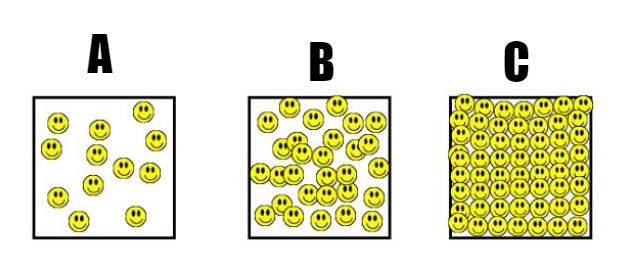
Which box shows the particles of an object that is the MOST DENSE?
A
B
C
they are all the same
If the volume of an object is 5 cm3 and its mass is 55g, what is its density?
11g/ cm3
50cm 3/g
15 g/cm
275 g/ cm3
An object has a mass of 21 g and a volume of 3 cm3. What's it's density?
7 g/l
7 g/m3
7 g/cm3
7 g/cm
An object has a mass of 15 g and a volume of 3 cm3. What's it's density?
4 g/cm3
15 g/cm3
3 g/cm3
5 g/cm3
An object has a volume of 25 cm3 and a mass of 100 g. What's it's density?
20 g/cm3
100 g/cm3
5 g/cm3
4 g/cm3
An object has a volume of 6 cm3 and a mass of 42 g. What's it's density?
7 g/cm3
48 g/cm3
42 g/cm3
6 g/cm3

