wayground logo

Free Printable Worksheets

Font size

S
M
L
XL
Worksheets

HHB 1.3 Gene Expression

Total questions: 82

Worksheet time: 1hrs 22mins

Name
Class
Date
1.
Which nucleotide would be correct for mRNA?
a)
uracil - deoxyribose sugar - phosphate
b)
thymine - ribose sugar - phosphate
c)
cytosine - deoxyribose sugar - phosphate
d)
adenine - ribose sugar - phosphate
2.
Which of the following are types of RNA?
a)
mRNA
b)
tRNA
c)
rRNA
d)
all of above
3.
Which bases would be present in RNA?
a)
adenine - thymine - cytosine - guanine
b)
adenine - uracil - thymine - guanine
c)
adenine- uracil - cytosine - guanine
d)
adenine - uracil - thymine - cytosine
4.
Each group of 3 bases on mRNA is known as a...?
a)
anti - codon
b)
codon
c)
triad
d)
tripod
5.
mRNA is formed in the nucleus by which process?
a)
Transcription
b)
Translation
6.
mRNA carries the code from DNA to which cell organelle?
a)
cell membrane
b)
mitochondria
c)
chromosome
d)
ribosome
7.
On tRNA the group of 3 specific bases is called ...?
a)
anti-codon
b)
codon
c)
tripod
d)
triad
8.

The production of a protein using the code from mRNA is known as...?

a)
Transcription
b)
Translation
9.
Which type of RNA has an amino acid attachment site?
a)
mRNA
b)
rRNA
c)
tRNA
10.
What type of RNA are ribosomes made of?
a)
tRNA
b)
mRNA
c)
rRNA
11.
What type of RNA is made by transcription in the nucleus?
a)
tRNA
b)
rRNA
c)
mRNA
12.
Which type of RNA has groups of 3 bases known as codons?
a)
mRNA
b)
tRNA
c)
rRNA
13.
Which type of RNA has a group of 3 bases known as an anti-codon?
a)
mRNA
b)
rRNA
c)
tRNA
14.
Which type of RNA exits the nucleus and joins to a ribosome?
a)
tRNA
b)
mRNA
c)
rRNA
15.
Transcription requires?
a)
Template DNA, ATP, Energy and Enzymes
b)
Template DNA, ATP and Enzymes
c)
Template DNA, ATP, RNA nucleotides and Enzymes
d)
Template DNA, ATP, RNA nucleotides and DNA polymerase
16.
Transcription-what enzyme is responsible for unwinding DNA & adding RNA nucleotides?
a)
Ligase
b)
DNA Polymerase
c)
RNA Polymerase
d)
Helicase
17.
How many codons on mRNA would be formed from the following DNA sequence?
a)
12
b)
4
c)
3
d)
8
18.
From the DNA sequence give the sequence of bases that would form mRNA?
a)
AATCGTGGTACC
b)
AAUCGUGGUACC
c)
TTAGCACCATGG
d)
AAUGCUGGUACC
19.
What type of chemical bond forms between the DNA base and the mRNA base during transcription?
a)
peptide bond
b)
hydrogen bond
c)
strong chemical bond
20.
Coding regions of DNA are known as...?
a)
Introns
b)
Exons
21.
The joining of exons after the removal of introns from the primary mRNA transcript is known as?
a)
Polymerase chain reaction
b)
RNA Splicing
c)
Translation
d)
Gene Expression
22.
Which answer below would show the stages of Transcription in order?
a)
3 5 1 4 2
b)
1 3 5 2 4
c)
3 1 5 4 2
d)
1 2 3 4 5
23.
What would be the translated base sequence for tRNA from the DNA sequence given?
a)
ATGCCGTTA
b)
AUGCCGUUA
c)
TACGGCAAT
d)
UACGGCAAU
24.
What type of bond forms between amino acids forming a protein??
a)
strong chemical bond
b)
hydrogen bond
c)
peptide bond
d)
protein bond
25.
Name molecule X?
a)
rRNA
b)
DNA
c)
tRNA
d)
mRNA
26.
Name molecule Y?
a)
mRNA
b)
tRNA
c)
rRNA
d)
DNA
27.
Name Structure S?
a)
nucleus
b)
ribosome
c)
protein
d)
tRNA
28.
Identify base 1?
a)
T
b)
A
c)
U
d)
G
29.
Identify base 8?
a)
T
b)
A
c)
U
d)
G
30.
Identify base 15?
a)
U
b)
A
c)
T
d)
G
31.
How many of the tRNA molecules will have anti-codons with at least 1 uracil base?
a)
6
b)
0
c)
4
d)
5
32.
T or F - Transcription occurs in the cytoplasm and translation occurs in the nucleus?
a)
TRUE
b)
FALSE
33.
A tRNA molecule can combine with ...?
a)
any amino acid
b)
one specific amino acid
c)
a polypeptide chain of amino acids
d)
three different amino acids
34.
T or F - Proteins are made of long chains of amino acids joined by strong hydrogen bonds?
a)
TRUE
b)
FALSE
35.
T or F -Triplets of bases on mRNA are codons and their complimentary tRNA bases are anticodons?
a)
True
b)
False
36.
T or F - A tRNA molecule will collect any available amino acid and bring it to the ribosome?
a)
True
b)
False
37.
T or F - After transcription the mRNA double helix leaves the nucleus via the nuclear membrane.
a)
True
b)
False
38.

RNA is ..................... stranded

a)

single

b)

double

39.

What is the function of mRNA?

a)

carries a copy of the DNA code from the nucleus to the mitochondrion

b)

carries a copy of the DNA code from the ribosome to the nucleus

c)

carries a copy of the amino acids from the nucleus to the ribosome

d)

carries a copy of the DNA code from the nucleus to the ribosome.

40.

where in the cell is mRNA transcribed from DNA?

a)

nucleus

b)

mitochondrion

c)

cytoplasm

d)

ribosome

41.

Where is mRNA translated into proteins?

a)

In the nucleus

b)

At the mitochondrion in the cytoplasm

c)

At the ribosomes in the cytoplasm

d)

In the cytoplasm

42.

What is each triplet of bases on the mRNA molecule called?

a)

a triplet

b)

a codon

c)

an anticodon

d)

a coder

43.

What does each codon code for?

a)

a specific amino acid

b)

a random amino acid

c)

a protein

d)

a ribosome

44.

Which of the following is a description of tRNA?

a)

simple, straight, single strand of nucleotides

b)

double stranded helix where nucleotides are held together by hydrogen bonds between complementary bases

c)

single strand that is folded and held in this shape by hydrogen bonds between complementary base pairs

45.

What does each tRNA molecule carry?

a)

A protein

b)

A ribosome

c)

A random amino acid

d)

A specific amino acid

46.

RNA polymerase moves along DNA unwinding the double helix and breaking the ........................................ bonds between the bases.

a)

deoxyribose

b)

sulfur

c)

hydrogen

d)

sugar-phosphate

47.

RNA splicing forms a (a)   mRNA transcript.

48.

The introns of the primary transcript are ........................

a)

coding regions and are removed

b)

noncoding regions and are removed

c)

coding regions and are retained

d)

noncoding regions and are retained

49.

The exons are joined together to form the ...................... mRNA transcript.

a)

primary

b)

mature

c)

secondary

d)

immature

50.

The order of the exons is changed during splicing.

a)

True

b)

False

51.

tRNA is involved in the translation of mRNA into a ............................. at a ribosome

a)

mature transcript

b)

carbohydrate

c)

polypeptide

d)

primary transcript

52.

What does translation end at?

a)

stop codon

b)

start codon

c)

end codon

d)

primary codon

53.

What bonds to codons by complementary base pairing?

a)

A polypeptide

b)

A ribosome

c)

An anticodon on mRNA

d)

An anticodon on tRNA

54.

Anticodons on tRNA bond to codons on mRNA by complementary base pairing, translating the genetic code into a sequence of ................................

a)

polypeptides

b)

ribosomes

c)

amino acids

d)

proteins

55.

Different proteins can be expressed from one gene, as a result of .................................

a)

alternative DNA splicing

b)

random mutations

c)

alternative RNA splicing

d)

Variation

56.

Different mature mRNA transcripts are produced from the same primary transcript depending on ...................................

a)

which introns are removed

b)

which introns are retained

c)

which exons are removed

d)

which exons are retained.

57.

Amino acids are linked by peptide bonds to form ...................................

a)

DNA

b)

ribosomes

c)

polypeptides

d)

mRNA

58.

Polypeptide chains fold to form the three-dimensional shape of a protein, held together by .................................. bonds and other interactions between individual amino acids

a)

sugar-phosphate

b)

peptide

c)

sulfur

d)

hydrogen

59.

Phenotype is determined by proteins produced as the result of gene ...................................

a)

structure

b)

sequence

c)

order

d)

expression

60.

Along with gene expression, what can also influence phenotype?

a)

Nothing else

b)

Genetics

c)

Environmental factors

d)

DNA

61.

The diagram above represents an RNA nucleotide. Structure B is...

a)

Phosphate

b)

Deoxyribose sugar

c)

Ribose sugar

d)

Base

62.

Name the structure shown in the diagram.

(a)  

63.

Name the stage of protein synthesis that is shown in the diagram opposite.

(a)  

64.
What structure of this molecule binds with the mRNA molecule?
a)
Amino Acid
b)
tRNA
c)
Anticodon
d)
Codon
65.
how many bases make up a codon
a)
1
b)
2
c)
3
d)
4
e)
5
66.
How many amino acids are coded for by this sequence of nucleotides:
ATG GGA ACT CCA
a)
4
b)
2
c)
6
d)
12
67.
If the mRNA sequence is AGA UUU CGA GCC,
what is the complementary tRNA anticodons?
a)
AGA TTT CGA GCC
b)
UCU AAA GCU CGG
c)
TCT AAA GCT CGG
d)
UCU AAA CGA GGG
68.
How would the DNA sequence GCTATA be transcribed to mRNA?
a)
GCUAUA
b)
CGATAT
c)
CGAUAU
d)
GCUTUT
69.
What is occurring in this picture?
a)
Translation
b)
Replication
c)
Translocation
d)
Transcription
70.

Which of the following answer choices correctly identifies each molecule in the above diagram?

a)

1 - mRNA, 2 - tRNA, 3 - ribosome

b)

1 - tRNA, 2 - mRNA, 3 - ribosome

c)

1 - tRNA, 2 - ribosome, 3 - mRNA

d)

1 - ribosome, 2 - tRNA, 3 - mRNA

71.

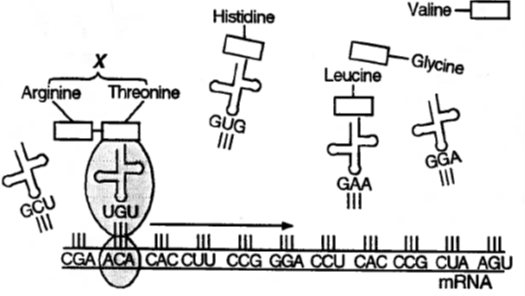
The structure X is a ________.

a)

ribosome

b)

nucleus

c)

tRNA

d)

DNA

72.

Which of these will complete the mRNA strand matching the DNA shown?

a)

C A G

b)

A U G

c)

G U C

d)

U A G

73.

What is the role of tRNA in translation?

a)

It carries specific amino acids to the ribosome

b)

It synthesizes new strands of mRNA

c)

It replicates DNA

d)

It forms peptide bonds between amino acids

74.
The diagram shows the process of
a)
Transcription
b)
Translation
c)
Replication
d)
Mitosis
75.
What process is going on in this photo? 
a)
Transcription 
b)
Translation 
c)
Replication 
d)
All the above 
76.

In the image, which number represents tRNA?

a)

1

b)

2

c)

3

d)

4

77.

In the image, which number represents an amino acid?

a)

1

b)

2

c)

3

d)

4

78.

In the image, which number represents mRNA?

a)

1

b)

2

c)

3

d)

4

79.

Which process is this?

a)

Transcription

b)

Translation

c)

DNA Replication

d)

Mutation

80.

What happens during the splicing of introns in mRNA processing?

a)

Introns are always inserted between exons

b)

Introns are linked together

c)

Introns are removed from the mRNA strand

d)

Introns are translated into proteins

81.

What happens during the splicing of exons in mRNA processing?

a)

Introns are inserted between exons

b)

Exons are removed from the mRNA strand

c)

Introns are translated into proteins

d)

Exons are linked together

82.

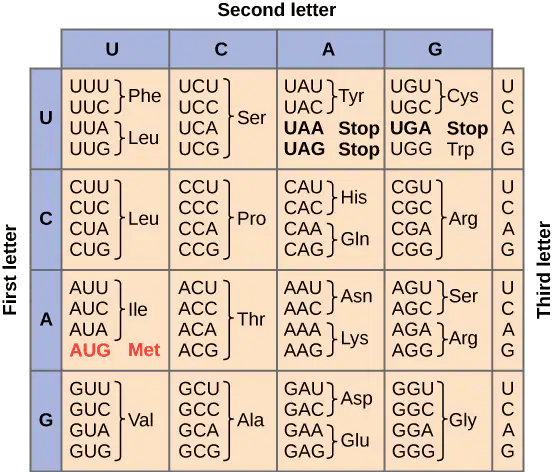
An mRNA strand contains the codon: UCU AUC CCU. What is the corresponding amino acids?

a)

SER ALA PRO

b)

SER ILE ARG

c)

SER ILE GLY

d)

SER ILE PRO