
 Worksheets
Causes of the Civil War
Total questions: 30
Worksheet time: 15mins
Which best describes the result of the passage of the Kansas-Nebraska Act?
Northerners were able to vote against the territory of Kansas becoming a state.
Abolitionists tried to steal weapons so they could attack the rebels at the border.
Violence between anti and pro-slavery forces became known as Bleeding Kansas
Ruffians were able to cast enough votes to prevent Kansas from becoming a slave territory.
The quote below is from Abraham Lincoln’s 1st Inaugural Address, March 4, 1861. "...the right of each State to order and control its own domestic institutions according to its own judgment exclusively, is essential to that balance of power on which the perfection and endurance of our political fabric depend..." Which "domestic institution" is Lincoln most likely referring to in his Inaugural Address?
slavery
religion
industry
education
What did the Southern states fear after the election of Abraham Lincoln as President in 1860?
They believed he would abolish slavery.
They believed he had not campaigned fairly.
They believed he would grant citizenship to Native Americans.
They believed he did not win the majority of the Electoral College votes.
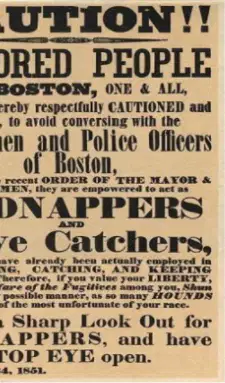
Below is a poster created by an abolitionist in Boston. Which legislation created the need for this poster?
The Crittenden Compromise
The Fugitive Slave Act
The 13th Amendment
The Emancipation Proclamation
What was a unifying reason Northern Democrats, Whigs, and Free Soil Westerns came together to create the Republican Party?
To support new forms of farm labor to replace slave labor in the South.
To defend the Constitutionality of slavery as decided in The Dred Scott Decision.
To continue popular sovereignty as the only way to decide the free/slave state issue.
To stop the spread of slavery into new territories as the country expanded westward.
Which best describes a primary cause of the Civil War?
Different state alliances with European countries.
Rivalries between states over slavery and states’ rights.
States had different views about America's role in the West.
Western territories being taxed without representation in Congress.
Which statement best describes the Northern and Southern economic systems prior to the Civil War?
The South relied on agriculture, while the North relied on slave labor.
The North relied on trade with England and the South traded with France.
The North relied on manufacturing, while the South relied on slave labor for agriculture.
The South relied on slave labor for manufacturing, while the North relied on indentured servants.
Why was John Brown’s raid on Harpers Ferry important?
Many slaves earned their freedom by revolting.
It helped return runaway slaves to their owners.
Abolitionists demonstrated their willingness to use violence.
The South was reassured that abolitionists would stop trying to free slaves.
Which best describes the ruling in the U.S. Supreme Court case Dred Scott v. Sanford?
Dred Scott won the case and was declared a free man.
Dred Scott lost the case, but the judge condemned slavery.
Dred Scott won the case, but was not set free because slaves were not considered citizens.
Dred Scott lost the case and the right to own slaves was ruled to be protected by the Constitution.
Below is a quote from the Lincoln-Douglas Debates. "But in the right to eat the bread... which his own hand earns, [an African American] is my equal and the equal of [Senator] Douglas, and the equal of every other man." -Abraham Lincoln, August 21, 1858. Which statement reflects Lincoln's opinion from the quote from the Lincoln-Douglas Debates?
all men are guaranteed certain basic rights and freedoms
slavery should be made legal in all states and territories
African Americans should have equal rights to white men
each state should decide for itself whether slavery would be allowed

Which of the following was a cause of the Civil War related to economic differences?
The South's economy was heavily dependent on agriculture, while the North was more industrialized
The North and the South disagreed on tax policies
The South wanted to adopt the gold standard
The North wanted to impose heavy tariffs on imported goods
Which of the following was NOT a part of the Compromise of 1850?
California was admitted as a free state
The slave trade was abolished in Washington D.C.
The Fugitive Slave Act was strengthened
Slavery was abolished in the New Mexico and Utah territories
What was the significance of the Dred Scott decision?
It declared that slaves were property and could not sue for their freedom.
It abolished slavery in the Northern states.
It established the principle of popular sovereignty.
It led to the immediate emancipation of all slaves in the United States.
How did "Uncle Tom's Cabin" influence American society in the 1850s?
It supported the expansion of slavery into the Western territories.
It depicted the harsh realities of slavery, increasing Northern opposition to it.
It encouraged the Southern states to secede from the Union.
It led to the immediate abolition of slavery in the Northern states.
How did the issue of slavery contribute to the concept of states' rights?
States wanted the right to decide for themselves whether to allow slavery.
States wanted the federal government to enforce the return of runaway slaves.
States wanted to abolish slavery on their own terms, without federal intervention.
States wanted the right to expand slavery into new territories without restriction.
What was the significance of the Kansas-Nebraska Act in the events leading up to the Civil War?
It allowed states to secede from the Union
It established the Fugitive Slave Law
It allowed territories to decide on the issue of slavery through popular sovereignty
It abolished slavery in the northern states
What was the main goal of the Abolitionist Movement?
To promote the use of slave labor in the North
To end slavery in the United States
To encourage the spread of slavery to the Western territories
To support the rights of Southern states
What was the primary purpose of the Fugitive Slave Act of 1850?
To abolish slavery in the Northern states
To provide freedom to escaped slaves in Canada
To require citizens to assist in the capture of escaped slaves
To establish a new slave trade route
How did Abraham Lincoln's election in 1860 contribute to the outbreak of the Civil War?
Lincoln immediately declared war on the Southern states.
Lincoln's stance against the expansion of slavery led Southern states to secede.
Lincoln's election was deemed illegitimate by the Southern states.
Lincoln promised to abolish slavery in all states immediately after his inauguration.


Which event directly followed Abraham Lincoln's election to the presidency in 1860?
The signing of the Emancipation Proclamation
The Battle of Gettysburg
The secession of South Carolina from the Union
The establishment of the Confederate States of America
The idea that political power belongs to the people is called_____________________, and allows the people to make decisions about who will represent them in government and what laws will be established.
Popular Sovereignty
Checks and Balances
Federalism
Separation of Powers
Where was the safest place for a runaway slaves to go after the passage of the Fugitive Slave Act in 1850?
Virginia
Canada
California
Pennsylvania

What was the name of the compromise over slavery that was written into the US Constitution?
1/3rd Compromise
3/5th's Compromise
2/3rd's Compromise
4/5th's Compromise

30 years after the MO Compromise, the question about the growth of slavery into new territories re-emerged after the...
Revolutionary War.
War of 1812.
Mexican War.
Civil War.

