
 Worksheets
6th History TCAP Review 2
Total questions: 115
Worksheet time: 59mins
How did the discovery of fire impact early hunter-gatherer civilizations?
It increased the power of religious groups
It allowed humans to cook meat for food
It prevented humans from being nomadic
It decreased the need for farming
The term Common Era (CE) replaced which designation?
Anno Domini (AD)
After Common Era (ACE)
Before Christ (BC)
Before Christian Era (BCE)
Why did most early hunter-gatherer civilizations live in temporary shelters?
They were polytheistic
They were traders
They were patriarchal
They were nomadic
Why did barter economies grow during the Agricultural Revolution?
Civilizations stopped practicing religion
Civilizations became more isolated
Civilizations created a surplus of goods
Civilizations became more nomadic
How were goods exchanged during the Agricultural Revolution?
through barter and trade
by using debt and credit
by using money and coins
through donations and charity
How do established systems of writing have a positive impact on civilizations?
They prevent religious groups from gaining power in civilizations
They increase the value of money in civilizations
They allow members of civilizations to own property
They allow members of civilizations to own property
Why was the region near the Tigris and Euphrates Rivers called the Fertile Crescent?
The region had strong farmlands
The region had harsh winters
The region had few natural boundaries
The region had low populations
How did seasonal flooding impact the Fertile Crescent?
It prevented rapid changes in climate
It caused erosion that destroyed natural habitats
It distributed silt that created rich soil
It created summer droughts
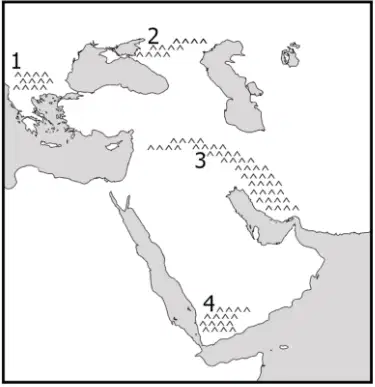
On this map of Mesopotamia, which number correctly identifies the location of the Zagros Mountains?
1
2
3
4
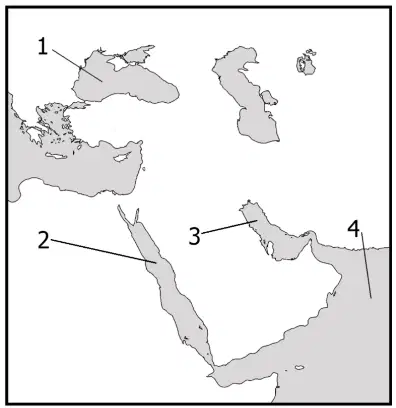
On this map of Mesopotamia, which number correctly identifies the location of the Persian Gulf?
1
2
3
4
What creation resulted from the advancement of agriculture in Sumer?
city-states
hunter-gatherer societies
language
monotheistic religion
How did the expansion of agriculture in Sumer impact the regional economy?
It strengthened the regional economy by increasing trade
It weakened the regional economy by increasing the prices of goods
It decreased the number of people involved in the regional economy
It increased the roles of religious leaders in the regional economy
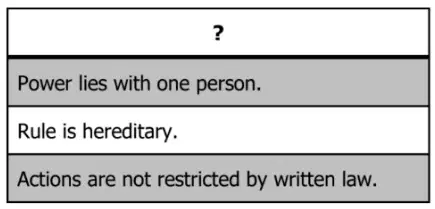
Which system of government is described in this chart?
Anarchy
Democracy
Monarchy
Oligarchy
Why did the growth of agriculture lead to advancements in transportation in Sumer?
Religious leaders needed to create schools
Traders needed to move goods over larger distances
Farmers needed to grow more crops
Government leaders needed to collect taxes
How did the use of slave labor impact the Agricultural Revolution?
It decreased the number of people creating new tools
It increased the number of people working on farms
It increased the costs of goods
It decreased the demand for food
Why did irrigation play an important role in the expansion of agriculture in Mesopotamia?
It decreased the number of plants that grew in the region
It created markets for selling crops
It increased the amount of people that needed food
It brought water to arid regions

This chart shows the relationship between deities in Mesopotamian culture. Which is true?
Mesopotamian deities had no human qualities
Mesopotamian deities had no influence on day-to-day life
Mesopotamian deities were unimportant to their religion
Mesopotamian deities were each responsible for different aspects of nature
What is polytheism?
belief in one singular deity
belief in technological advancement
belief in multiple deities
belief in scientific research
What is significant about the Epic of Gilgamesh?
It is a set of social laws
It is the oldest written epic
It is the first epic written in English
It is a holy book in Mesopotamian culture
What did Mesopotamians believe was a common aspect of their relationships with their deities?
They believed that their deities influenced day-to-day tasks
They believed that their political leaders created their deities
They believed that their priests could choose which deities had the most power
They believed that their deities were responsible for the prices of goods
How do established systems of writing have a positive impact on civilizations?
They prevent religious groups from gaining power in civilizations
They increase the value of money in civilizations
They allow members of civilizations to own property
They help members of civilizations communicate
What was the Code of Hammurabi?
collection of folk stories
monotheistic religion
trade agreement
series of written laws
How did the invention of cuneiform impact Mesopotamia?
It allowed people to build tall structures
It allowed people to grow large crops
It allowed people to create music
It allowed people to create written records
Based on this quote, which statement is true?
“If any one is committing a robbery and is caught, then he shall be put to death.”
Mesopotamians studied neighboring governments
Mesopotamians supported a strict justice system
Mesopotamians did not believe in private property
Mesopotamians believed in a weak government
How did the Sahara Desert impact the development of Ancient Egypt?
It made trade with West Africa less dangerous
It prevented interactions with Europe
It provided a natural border
It provided farmland
How did most enslaved people contribute to Ancient Egyptian society?
They sold goods as merchants
They built structures as physical laborers
They governed as politicians
They led communities as religious leaders
Why did the Ancient Egyptians develop a calendar?
to record and predict growing seasons
to decrease the power of religious leaders
to increase the value of trade
to document the lives of enslaved people
Why did Ancient Egypt develop irrigation systems?
to prevent flooding
to provide water for crops
to create military boundaries
to decrease trade
Why did Ancient Egyptian rulers order the construction of the pyramids?
to defend against invaders from Kush
to increase trade with Mali
to decrease the influence of religious leaders
to create large tombs for important leaders
According to Ancient Egyptian society, why were pharaohs given the power to rule?
It was believed that pharaohs were representatives of the artisan class
It was believed that pharaohs were living gods
Pharaohs were selected by the wealthy elite
Pharaohs were elected by the common people
What were common roles for slaves in Ancient Egypt? Select two that apply.
working in labor camps
leading governments
selling goods
assisting the wealthy
studying medicine
How were social classes organized in Ancient Egypt?
by taxes paid
by profession
by religious belief
by education
Why were wealthy Ancient Egyptians mummified after death?
They believed that animal spirits could live within their bodies
They believed that death was temporary
They believed that death caused new diseases
They believed that their bodies could be used in the afterlife
What were characteristics of Ancient Egyptian religion? Select three that apply.
Gods had human qualities
Gods gave power to the leader
It was monotheistic
It was polytheistic
All holy texts were written by one singular god
How did the discovery of Tutankhamun’s tomb contribute to the study of Ancient Egypt?
It provided detailed evidence of Ancient Egyptian educational techniques
It provided examples of written laws in Ancient Egypt
It provided an opportunity to study the roles of enslaved people in Ancient Egypt
It provided detailed evidence of Ancient Egyptian burial practices
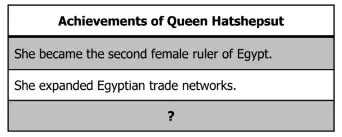
Which achievement best completes this chart?
She made Ancient Egypt a democratic republic
She helped Ancient Egypt expand its borders
She made Hebrew the official language of Ancient Egypt
She helped create an alliance between King Solomon and Ancient Egypt
How did the rule of Ramses the Great impact Ancient Egypt?
It expanded the land controlled by Egypt
It brought monotheism to Egypt
It increased democratic participation in Egypt
It decreased the value of trade in Egypt
What was one characteristic of Ancient Egyptian religion?
It was monotheistic
It was taught from the Bible
It was taught from the Qur’an
It was polytheistic
Which ruler is best known for expanding the territory of Ancient Egypt through military conquests?
Queen Cleopatra
Queen Hatshepsut
King Ramses the Great
King Tutankhamun
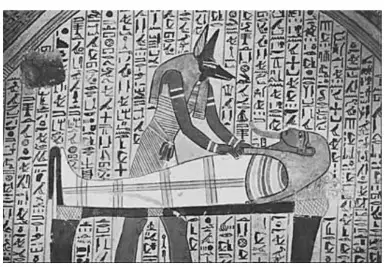
Based on this painting, what is true about mummification in Ancient Egypt?
It was a religious practice
It was inexpensive
It was a form of torture
It was forced upon other cultures
Why did Ancient Egyptians mummify Pharaohs?
They used mummification to punish cruel leaders
They used mummification to extend the lives of Pharaohs
They believed that mummification prevented the gods from coming to earth
They believed that mummification gave Pharaohs access to the afterlife
Which was a positive outcome from interactions between Ancient Egypt and Nubia?
Ancient Egypt and Nubia were valuable trading partners
Ancient Egyptian leaders controlled the Nubian senate
Nubia brought Judaism into Ancient Egypt
Nubia controlled the Ancient Egyptian military
How did the development of papyrus have a positive impact on Ancient Egypt?
It prevented records from being destroyed
It increased the political power of craftsmen
It allowed Egyptians to send messages over long distances
It decreased the number of people that could keep records
Which was invented in Ancient Egypt?
gunpowder
papyrus
silk
wheel
How did the invention of hieroglyphics impact Ancient Egypt?
It created a system of beliefs that supported Ancient Egyptian religion
It improved the effectiveness of the Ancient Egyptian military
It prevented Ancient Egyptians from exploring new lands
It allowed Ancient Egyptians to communicate through writing
Why was Ancient Israel created along the Jordan River?
It prevented the creation of water reservoirs
It increased the value of natural resources
It provided a valuable source of fresh water
It gave access to local religious sites
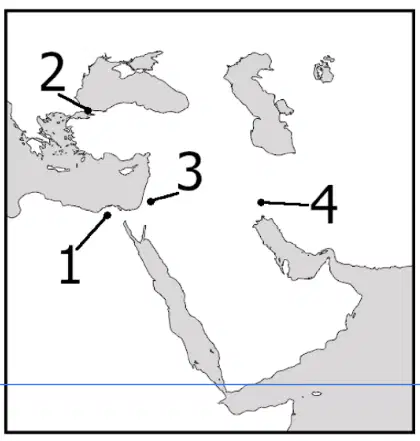
Which number correctly identifies the location of Jerusalem?
1
2
3
4
In what ways did King David have a lasting impact on Israel?
He prevented Roman governors from living in Israel
He made Jerusalem the capital of Israel
He made Islam the official religion of Israel
He expanded the borders of Israel
Why did the Kingdom of Israel break into two separate kingdoms?
Regional leaders voted to divide the military power of Israel into two separate armies
The increased trade between Israel and Egypt created wealth throughout the Middle East
Regional tensions increased between the northern and southern parts of Israel
The introduction of new religions decreased the popularity of Judaism within Jerusalem
How did King Saul have a significant impact on the history of Ancient Israel?
He codified Jewish law
He made a military alliance with Athens
He prevented the practice of Judaism in Ancient Israel
He was the first king of Ancient Israel
How is Judaism different from most other religions that were practiced in the ancient world?
It is monotheistic
It has no holy book
It is polytheistic
It has no temples
How did the leadership of Moses impact the Ancient Israelites?
He wrote the Torah
He led the Ancient Israelites out of Egypt
He conquered Ancient Egypt
He established a democratic government led by the Ancient Israelites
How did the Harappan civilization advance architecture?
It created the first ziggurats
It created the first brick buildings
It created the first canals
It created the first pyramids
How do monsoon winds impact India?
They cause earthquakes
They cause flooding
They cause forest fires
They cause tsunamis
Why is the Harappan civilization significant to Indian history?
It allowed Buddhism to spread outside of India
It prevented international trade in India
It was the first permanent agricultural civilization in India
It was the first monotheistic civilization in India
How are the Ganges River and Indus River similar?
They both flow into the Atlantic Ocean
They both flow out of the Zagros Mountains
They are both located in Egypt
They are both located in India

Which number correctly identifies the Himalaya Mountains?
1
2
3
4
Why are the Vedas particularly important to Hinduism?
They adapt the teachings of Buddhism into concepts compatible with Hinduism
They dictate which classes are prevented from joining the caste system
They outline several concepts and rituals essential to practicing Hinduism
They describe the power of the government
How did Siddhartha Gautama have a lasting impact on Asian cultures?
He wrote the Vedas
He established the Silk Road
He created Buddhism
He ended isolationism in China
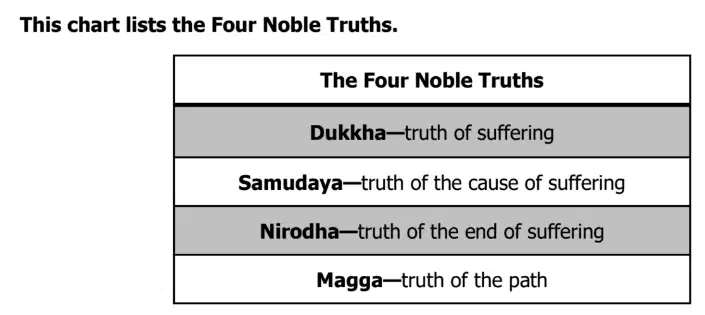
The Four Noble Truths had the greatest impact on which religion?
Buddhism
Christianity
Hinduism
Judaism
How does the belief in karma impact Hinduism?
It encourages Hindus to protect nature by celebrating ancestral spirits
It encourages Hindus to be good people by promising an afterlife
It encourages Hindus to go on pilgrimages by enforcing religious laws
It encourages Hindus to be good people by determining their reincarnation

Based on this quote, Buddhism claims that suffering is partly caused by what?
education
monarchies
possessions
science
Which two concepts are parts of Hinduism?
dharma
heaven
karma
purgatory
pilgrimage
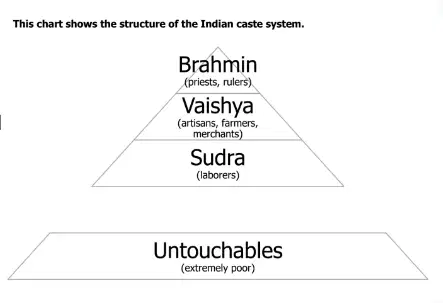
Based on this chart, how does the caste system impact Indian culture?
It divides culture into strict social classes
It decreases the influence of religion on society
It increases opportunities for social mobility
It allows for the exchange of ideas between cultures
How was the importance of social classes demonstrated in Ancient Indian culture?
The caste system was supported by religious teachings
Social mobility was supported by the monarchy
Local governments passed laws to make all social classes equal
Military leaders were drafted from all levels of the caste system
How did Ancient Indian civilizations have a lasting impact on modern society?
Most modern laws are based on Hindu teachings
Reincarnation is supported by most world religions today
Hindu-Arabic numerals are still used today
Most modern religions use the caste system
How did geography impact the development of Chinese civilizations?
Access to salt and gold mines increased the influence of Muslim traders
Large amounts of coal allowed Chinese civilizations to become the first to industrialize
Large plains made it easier for Christianity to spread throughout the region
Natural boundaries isolated Chinese civilizations from the outside world
The Gobi Desert is located in which country?
China
India
Japan
Vietnam
How did geography impact the development of Ancient Chinese civilization?
It isolated China from other cultures
It made China vulnerable to invasion
It decreased the role of trade in the region
It increased cultural diffusion in the region
How did Qin Shi Huangdi impact Chinese civilization?
He defeated the Mongolian Empire
He conquered Japan
He isolated China from the Silk Road
He unified China into an empire
Why did the concepts of legalism become popular in China?
Chinese leaders wanted to make their government more democratic
Chinese leaders found it difficult to rule over a large geographic area
Chinese leaders wanted to increase the influence of Buddhism
Chinese leaders were unable to close the Silk Road
How did the invention of the magnetic compass impact Chinese civilization?
It allowed Confucianism to become popular in China
It allowed the Chinese to explore the Indian Ocean
It allowed the Chinese to defend against Japanese invasions
It allowed Buddhism to spread into China
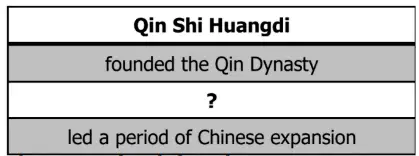
Which phrase completes this chart?
was the first scientist to discover gunpowder
was the first leader to unify China
was the first explorer to circumnavigate the globe
was the first leader to conquer Japan
Which was invented in the Han Dynasty?
combustion engine
irrigation
steel
woodblock printing
Which religions spread throughout Asia as a result of trade along the Silk Road? Select two that apply.
Buddhism
Islam
Judaism
traditional Greek religion
traditional Roman religion
The Analects were written to promote peace and order in China. Why were these ideas popular in China at the time of their writing?
The expansion of the Mongolian Empire created a period of peace in China
Christian monks built churches that created social conflict in China
The Warring States Period caused chaos in China
Buddhist armies attacked the southern border of China
How did Confucianism solve the cultural issues of Ancient China?
It taught mercantilism during the Age of Exploration
It taught militarism during a time of peace
It taught artistic expression during an economic depression
It taught order during the chaos of the Warring States Period
What was one lasting outcome of the Han Dynasty?
The Chinese population declined
Buddhism was banned from China
Confucianism was made the official religion of China
The Chinese economy became capitalist
How did the Silk Road impact China?
It increased European influence in China
It decreased the popularity of Buddhism in China
It created a classless society in China
It started several wars in China
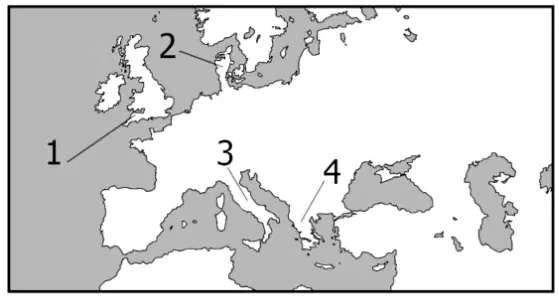
Which number correctly identifies the location of the Peloponnesian Peninsula?
1
2
3
4
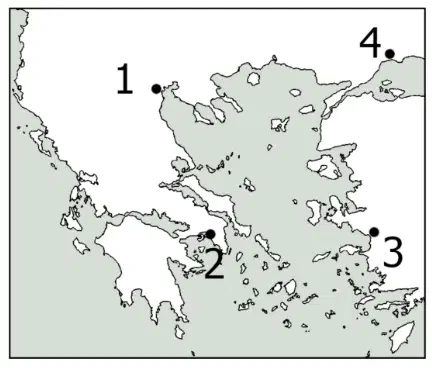
Which number correctly identifies Athens?
1
2
3
4
How did ancient Greece compensate for its lack of fertile land? Choose 2.
They developed fertilizer to use when farming
They established Mediterranean colonies
Their diets consisted of primarily seafood
They used the seas for trade
They used the city-state militaries to take what they needed
What contributed to Greece’s organization into city-states?
Greece’s mountainous terrain
Greece’s lack of fertile land
Greece’s need to use maritime trade
Greece’s need for a strong military
How did the concept of citizenship impact Ancient Greek government?
Democratic city-states allowed citizens to vote
Citizens were not allowed to own property
Citizens were forced to serve in the military
Authoritarian city-states prevented citizens from attending schools
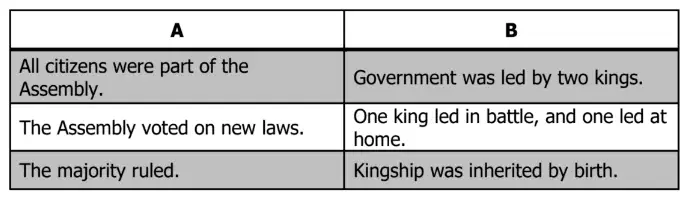
Column A describes which type of government in Ancient Greece?
democracy
empire
monarchy
oligarchy
The Greek city-state of Athens is best known for developing which concepts? Select two that apply.
architecture
colonization
democracy
isolationism
militarism
The concept of the Greek polis is most similar to which other concept?
city-state
economy
military
university
How is a direct democracy different from an oligarchy?
A direct democracy gives legislative power to royal families
A direct democracy allows citizens to vote on issues
A direct democracy allows a small group of elites to rule
A direct democracy gives legislative power to religious leaders
The Greek city-state of Sparta was best known for what?
arts
democracy
education system
strong military
How did the Persian Wars have a positive impact on Ancient Greece?
They united the city-states
They increased trade in Ancient Greece
They gave Ancient Greece control of the Mediterranean Sea
They left Ancient Greece vulnerable to invasion by Macedonia
How did the Peloponnesian Wars have a negative impact on Ancient Greece?
They forced Ancient Greece to invade Persia
They increased trade in Ancient Greece
They gave Ancient Greece control of the Mediterranean Sea
They left Ancient Greece vulnerable to invasion by Macedonia
What was one characteristic of Ancient Greek religion?
Religious practices were inspired by Buddha
Gods took the forms of humans
There was one singular god
Religious teachings came from the Bible
Why did ancient Greece have the Olympic Games?
To settle disputes between the city-states
To determine which city-state was the strongest
To honor the Greek god, Zeus
To compete for wives
How did the expansion of Ancient Greece under Alexander the Great impact the Middle East and Asia?
It prevented democratic ideas from spreading into the Middle East and Asia
It forced civilizations in the Middle East and Asia to adopt Buddhism
It spread Hellenistic culture into the Middle East and Asia
It isolated the Middle East and Asia from European influence
Why was the Parthenon built in Athens?
to defend against Macedonian invaders
to act as a market for traders from Carthage
to honor the goddess Athena
to house the polis of Athenian democracy
Why are the Iliad and the Odyssey historically significant?
They describe the lives of traders on the Silk Road
They provide translations of the Code of Hammurabi
They give insight into Ancient Greek culture
They explain the basic concepts of Buddhism
Socrates had the greatest impact on which field?
art
education
music
warfare
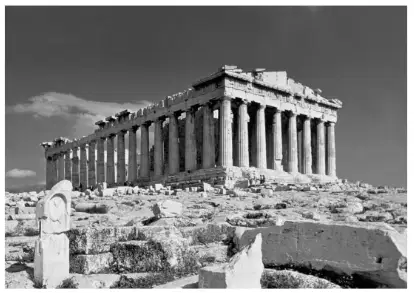
This is a photograph of the Greek Parthenon. What was the purpose of Greek structures like this one?
to be temples to the gods
to house military leaders
to support judicial courts
to house universities
Rome was built along which geographical feature?
Caucasus Mountains
Himalayan Mountains
Nile River
Tiber River
How did the geographic location of Rome help it expand?
Access to the Pacific Ocean increased the value of fishing
Access to the Mediterranean Sea increased trade
Being located in the Zagros Mountains isolated Rome
Being located near the Nile River allowed Rome to ally with Egypt
Which group had the greatest status in Roman society?
artisans
patricians
plebeians
slaves
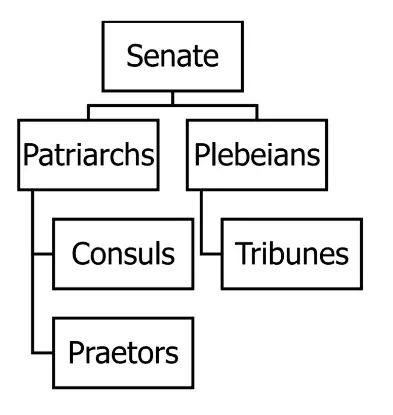
Which ancient government is shown in this chart?
Athenian democracy
Gupta imperialism
Mesopotamian monarchy
Roman democracy
Which group of people had the least social status in Ancient Rome?
consuls
patricians
plebeians
slaves
What was the purpose of checks and balances in the government of Ancient Rome?
prevent one branch of the government from becoming too powerful
separate different responsibilities that were necessary
to make sure that all people were subject to the same laws
required all citizens to participate in government
How did the Pax Romana impact the Roman Empire?
It decreased trade
It caused political tensions
It led to a period of growth
It sparked an economic depression
Julius Caesar became popular among the
Senate
patricians
plebeians
slaves
What was an effect of Julius Caesar's order to be made a dictator for life?
Rome grew its empire
He became a respected general
People in government feared he was becoming too powerful
He became very popular among the plebeians
What was the Pax Romana?
A government in ancient Rome
A period of stability in ancient Rome
The employment of civil servants in ancient Rome
The common currency in ancient Rome
Rome’s first emperor who established the Roman Empire was…
Julius Caesar
Augustus Caesar
Mark Antony
Augustus Julius
What was the role of gods in traditional Roman religion?
Gods were created from nature spirits
Gods had human qualities and controlled specific aspects of life
Gods lived within human beings who lived in Rome
Gods were the reincarnated spirits of ancient Roman leaders
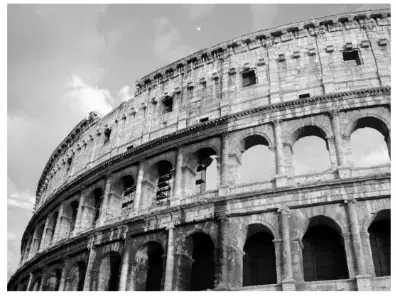
This is a photograph of the Roman Colosseum. Which building technique invented in Ancient Rome is seen in this photograph?
arch
dome
pillar
wheel
How is Christianity different from Judaism?
Christianity is monotheistic
Christianity originated in the Middle East
Christianity teaches from holy books
Christianity believes that Jesus Christ is the Messiah
What was the role of gods in traditional Roman religion?
Gods were created from nature spirits
Gods had human qualities and controlled specific aspects of life
Gods lived within human beings who lived in Rome
Gods were the reincarnated spirits of ancient Roman leaders
Why was the Roman Empire divided into two halves in the 4th century?
The empire had become too big to be ruled from Rome
The empire had suffered several military defeats
The Catholic Church had taken control of Rome
The value of international trade had increased
How did the expansion of the Roman Empire impact Jewish people?
It led to the creation of Jewish schools
It increased economic growth in their homelands
It forced them out of their homelands
It increased the popularity of Judaism

