
 Worksheets
Civil Rights
Total questions: 22
Worksheet time: 22mins
Which statement explains why Brown v. Board of Education was a landmark Supreme Court case?
It contributed to the dismantling of segregation in many states
It contributed to the dismantling of labor unions in many states
It began to improve job opportunities in most cities
It began to improve the transportation system in most cities
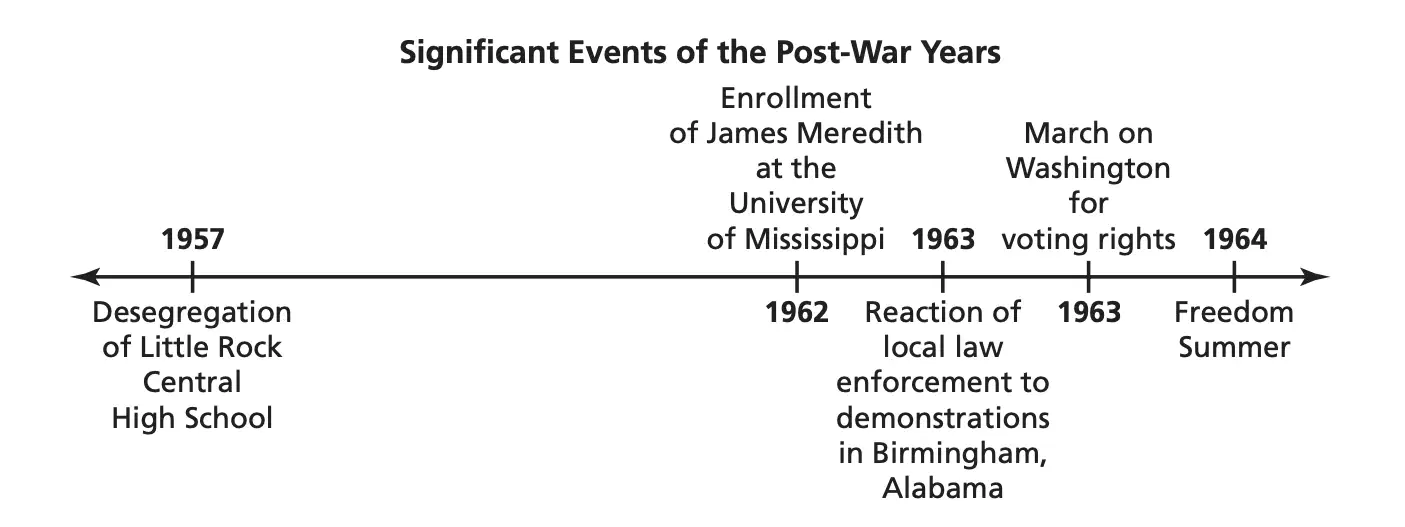
The national television broadcast of these events led to:
support for federal aid to education
increased public support for civil rights legislation
growth of the antiwar movement
reliance on newspaper coverage of current events
How did Dr. Martin Luther King, Jr.’s 1963 “I Have a Dream” speech affect U.S. politics?
By increasing pressure on political leaders to form a new minority-based political party
By persuading political leaders to introduce literacy tests for voting
By persuading political leaders to ratify an amendment that extends voting rights to women
By increasing pressure on political leaders to pass federal civil rights legislation
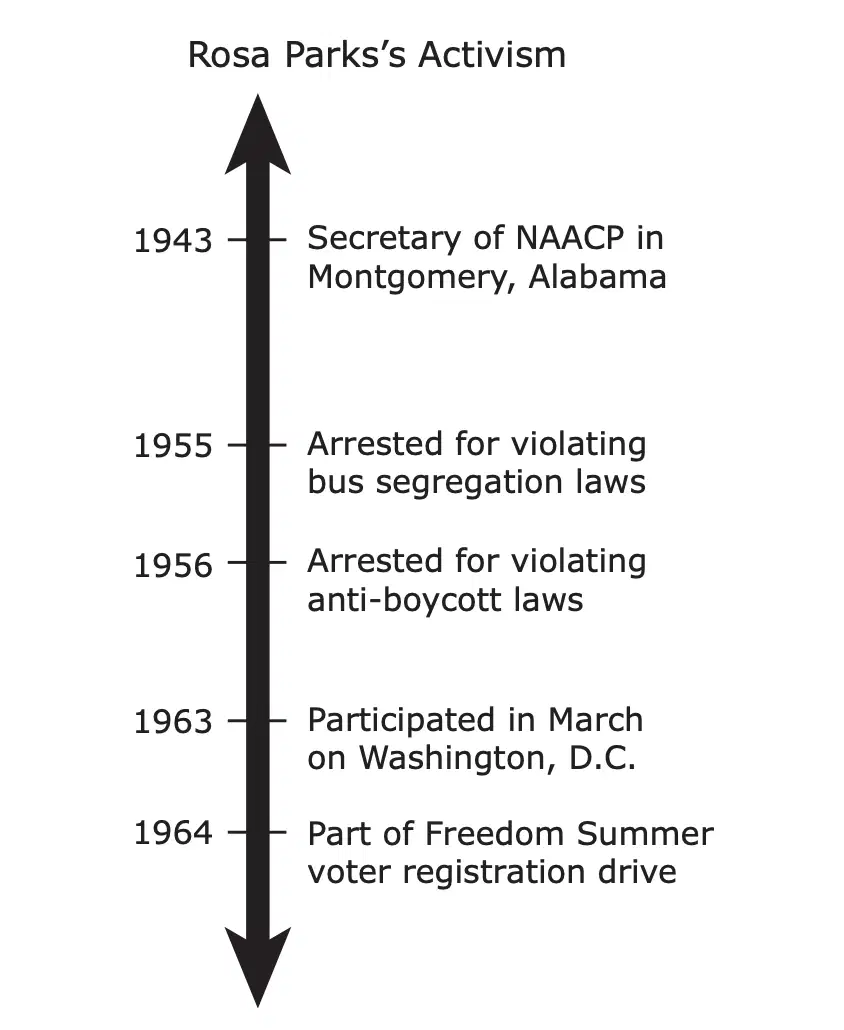
What does this time line imply about Rosa Parks’s activism during the Civil Rights era?
Rosa Parks acted independently from civil rights organizations
Rosa Parks continued her activism after the Montgomery bus boycott.
Rosa Parks completed a large portion of her activism while awaiting trial
Rosa Parks learned of civil rights issues following the Montgomery bus boycott
Malcolm X and the Black Panther Party are associated with ________.
civil disobedience
militancy ("by any means necessary")
cooperation
political lobbying
The important Civil Rights Act of 1964 calls for __________.
the end of discrimination in public areas
the integration of religious and state facilities
Jim Crows to continue
None of the above

This 1932 poster depicts an organization originally formed to advocate _______.
publicly funded health care for children
better economic treatment of migrant workers
a retirement system for farm laborers
equal employment opportunities for women

These murals were painted during the 1970s in California. This artistic movement demonstrates the contributions of which culture to U.S. art?
Mexican Americans
Chinese Americans
Irish Americans
African Americans
How did the Harlem Renaissance most contribute to the Civil Rights Movement of the 1950s and 1960s?
by bringing public awareness to segregation in the military
by electing African Americans to serve in government
by beginning the process of abolishing discriminatory laws
by promoting African-American culture as a source of pride
What were two goals of the March on Washington in 1963?
recovering property acquired through eminent domain
establishing fair employment policies
preventing the use of the military draft
desegregating the military
promoting adoption of civil rights legislation
Which two phrases best describe the 1960 Nashville sit-ins?
opposition of American Indians to government interference in tribal affairs
well-organized protests against racial segregation
peaceful protests against the Vietnam War
nonviolent events conducted by college students
strikes against big businesses by labor unions
What was the primary goal of the American Indian Movement?
to improve the federal government’s treatment of American Indians
to force state governments to give voting rights to American Indians
to force labor unions to protect the worker rights of American Indians
to encourage businesses to create better job opportunities for American Indians
What was the main impact of the Voting Rights Act of 1965 on the civil rights movement?
It led to a significant increase in the number of African American voters in the South
It resulted in the immediate end of all forms of racial discrimination
It caused a decrease in the number of African American politicians
It had no significant impact on the civil rights movement
Which of the following best describes the role of the Freedom Riders during the Civil Rights Movement?
They worked to desegregate interstate buses in the southern United States
They focused on voter registration drives in the northern cities
They led the charge for equal housing rights nationwide
They organized sit-ins at segregated lunch counters in the Midwest
What important value regarding inclusivity and diversity did the Civil Rights and Feminist Movements underscore?
The importance of exclusion
The value of a homogenous society
The significance of diverse voices and perspectives
The superiority of one culture over others
What was the goal of the Feminist Movement in the 1960s?
To secure equal rights for African Americans
To end racial segregation
To address gender-based discrimination and inequality
To promote economic growth
One success of AIM was that American public saw what life was like for Native Americans and became sympathetic to the actions of Native American activists. What goal did this achieve?
Gain actual self government
Awaken the American public to the horrible conditions on the reservations and improve conditions.
receive federal support for traditional tribal sovereignty
Receive new respect for Native American Culture
What organization created by W.E.B. Dubois sought immediate equality for minorities?
WAC
HUAC
NAACP
SNCC
What was the main purpose of the 24th Amendment
to protect the right of all citizens to vote
to guarantee freedom of speech
to increase government revenue
to limit the authority of the executive branch
When necessary to achieve justice, which method did Martin Luther King, Jr., urge his followers to employ?
using violence to bring about political change
engaging in civil disobedience
leaving any community in which racism is practiced
demanding that Congress pay reparations to African Americans

The changes shown in the chart were most directly the result of the
enactment of voting-reform laws by these southern states
Supreme Court decision in Brown v. Board of Education
passage of the Voting Rights Act of 1965
executive branch’s resistance to protecting the civil rights of minorities
What role did Arkansas governor Orval Faubus play in the Little Rock Crisis?
He helped minimize race-related violence
He refused help from the federal government
He challenged the authority of the federal government to desegregate
He vetoed legislation to establish separate schools

