
 Worksheets
Biology EOC Review
Total questions: 209
Worksheet time: 4hrs 36mins
When you step out into the cold, your body shivers in order to keep its temperature at 98.6F. Which characteristic of life does this represent?
All living things use energy
All living things contain cells
All living things maintain homeostasis
All living things grow
Which statement describes ALL living things?
They are composed of one or more cells.
They must reproduce sexually.
They have organ systems to carry out the processes of life.
They are capable of making their own food.
A baby song bird hatches from its egg with both parent songbirds watching. Which characteristic of life does this represent?
All living things reproduce
All living things maintain homeostasis
All living things use energy
All living things grow
The following are all characteristics of life EXCEPT:
made of cell(s)
eat food
respond stimuli
reproduce

Which of these is not true about all organisms?
all living things are multicellular
all living things obtain and use energy
all living things reproduce
Which item listed is NOT a characteristic of life?
adjusting to stimuli
getting and using energy
growing and developing
breathing
A group of individuals belonging to the same species living in the same general area at the same time.
population
community
ecosystem
biosphere
Why don't populations grow indefinitely?
limiting factors
only biotic factors
only abiotic factors
none of the above
One of the factors that can change the size of population is....
Name of schools
Number of dezs
Jobs
Numbers of births
The exponential graph is a graph that shows us population size increasing quickly, which one below shows us that


What is the carrying capacity mean?
The number of individuals an area can carry
the number of births
The number of deaths an area has
not sure

parasites, disease, predators, are examples of what type of limiting factors?
density dependent
density independent
survivorship
type 1 curve

What is the arrow pointing at?
carrying capacity
biotic potential
density-independent
density dependent
An S-shaped curve is known as
Exponential graph
Logistic Graph
Survivorship curves
Graphs

A bee receives nectar from a flower and carries the pollen to other flowers:
predation
parasitism
mutualism
commensalism
Mistletoe grows and spreads on trees, taking their nutrients:
predation
parasitism
mutualism
commensalism
What would be a good example of a primary consumer?
carnivore
detrivore
decomposer
herbivore

Which organisms would be at the top or last trophic level?
plant
herbivore
omnivore
carnivore

Barnacles do not affect whales as they grow, but receive the benefit of a food source. This is
parasitism
mutualism
commensalism
neutralism

Mice might grow in population and destroy the community by eating all of the berry bushes if
wolves and snakes were removed from the food web
another predator migrated in to the community
the snake population grew
none of these
A lion that eats a zebra that eats grass is a
primary consumer
secondary consumer
tertiary consumer
quaternary consumer

90% of the energy that gets lost as you move up a food pyramid or chain gets lost as
pollution to the environment
heat to the environment
energy for decomposers
gets recycled
What percentage of energy is passed on to the next trophic level?
5%
10%
50%
90%

Which of the following is a characteristic of both Eukaryotic and Prokaryotic cells?
ribosomes
nucleus
membrane bound organelles
simple
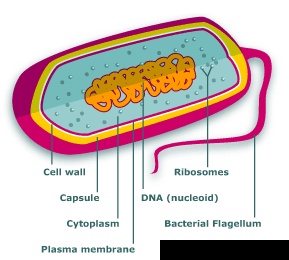
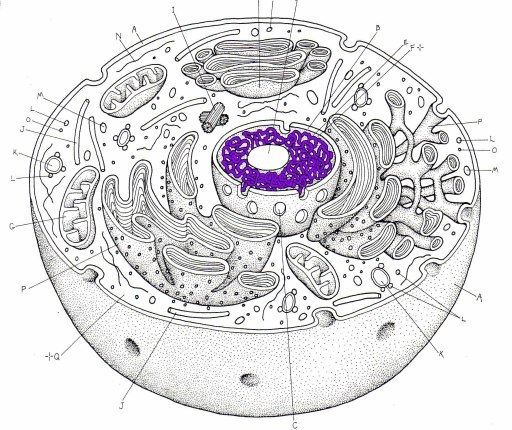
These cells have cytoplasm
Prokaryotic
Eukaryotic
Both

Fermentation enables ATP production to continue under

Energy used in cells for life processes
ADP
ATP
lipids
proteins

Anaerobic means without ________?
Nitrogen
Carbon Dioxide
Oxygen
Phosphorus
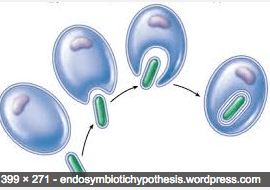
In this diagram, the endosymbiont (prokaryote being engulfed) is
blue
green
purple
How are mitochondria and chloroplasts like bacteria cells?
They divide by meiosis
They contain their own DNA
They have the same membrane-bound organelles
They can make their own food
Which type of biological macromolecule is the main component of the plasma membrane?
carbohydrate
lipid
protein
nucleic acid
when some molecules can cross the membrane while others cannot.
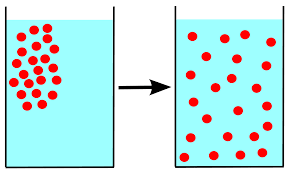

Why would the cell need energy to move molecules across the membrane?
the molecule is going against the concentration gradient
the molecule is to large to pass through the membrane
the lipid membrane requires energy anytime something is moving across the membrane
What is the definition of ACTIVE TRANSPORT?
Movement of molecules across the cell membrane against the concentration gradient
Diffusion of water through a selectively permeable membrane
Molecular structure that surrounds the cell and controls what enters and leaves the cell
Movement of molecules across the cell membrane from an area of high concentration to low concentration

Identify the following structure
Phospholipid
Cell
Cell membrane
Protein

What is the name of 'B' found on the structure below
Protein
Lipic bilayer
Phosphate hydrophilic heads
Lipid hydrophobic heads
In passive diffusion, substances always move...
from an area of higher concentration to an area of lower concentration
from an area with more of the molecules to an area with fewer of the molecules
from an area of lower concentration to an area of higher concentration
from an area with fewer of the molecules to an area with more of the molecules
If a gummy bear is placed in salt water, the mass of the gummy bear will decrease because water will move out of the gummy bear. What process does this represent?
osmosis
fermentation
respiration
diffusion


Which organic molecule would a long-distance runner most likely choose to eat two hours before a race?
A protein, because it builds muscle mass.
A lipid because it provides long term energy storage.
A carbohydrate because it releases energy quickly.
A protein, because it transports oxygen into the blood stream.
Monosaccharides are the building blocks of which group of biomolecules?
protein
lipid
carbohydrate
nucleic acid
Which biomolecules transport oxygen and other substances and also form part of most organelles?
Lipids
Carbohydrates
Proteins
Nucleic Acids
Which biomolecules provide quick energy for the cell and also provide materials to build the cell membrane/wall?
Carbohydrates
Proteins
Lipids
Nucleic Acids
Which biomolecules contains your genetic information?
Proteins
Lipids
Carbohydrates
Nucleic Acids
Amino Acids are the monomers of __________.
Nucleic Acids
Proteins
Carbohydrates
Lipids
Which biomolecules act as energy storage for the cell and also cushions and insulates organs?
Carbohyrdates
Lipids
Proteins
Nucleic Acids
The monomer of Nucleic Acids is known as _________.
Amino Acid
Fatty Acid
Nucleotide
Saccharide
Which of the following contains the most lipid?


Just under an orca's skin lies a thick layer of blubber. Blubber helps insulate a whale from heat loss. Based on this information, which biomolecule is blubber primarily made of?
Lipids
Nucleic Acids
Proteins
Carbohydrates
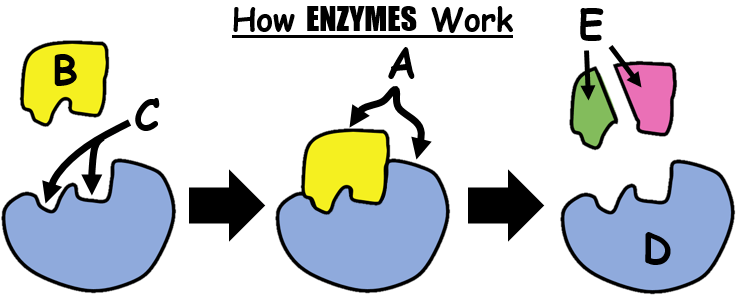
Enzymes are an example of
Lipids
Carbohydrate
Protein
Nucleic Acid
Undifferentiated cells that can become one or more specialized types of cell are called_________
Stem Cells
Somatic Cells
Body Cells
Zygotes
Arrange the following levels of hierarchy from LARGEST to SMALLEST
Organism, Organ, Tissue, Cell
Cell, Tissue, Organ, Organism
Organism, Cell, Tissue, Organ
Tissue, Cell, Organ, Organism
The growth phase of the cell cycle is called
Interphase
Telophase
Prophase
Anaphase
A continuous thread of DNA is called...
Chromosome
Chromatid
Gene
Nucleic Acid
What is a gene?
A section of DNA with instructions for making a protein
A section of DNA with instructions for making a carbohydrate
One nucleic acid chain that codes for DNA
One protein chain that codes for DNA
Two identical chromatids are called...
Daughter Chromatids
Sister Chromatids
Brother Chromatids
Twin Chromatids
How are the centromere and telomere different?
The centromere is the center of the chromosome, the telomeres are the ends
The centromere is at the ends of the chromosomes, the telomere is at the center
The centromere is larger than the telomere
The telomere is larger than the centromere
The division phase of the cell cycle is called...
Mitosis
Meiosis
Metaphase
Cytokinesis
What is the end result of mitosis?
2 identical body cells
2 gametes
2 zygotes
2 different body cells
Why do cells remain small in size? (Select ALL that apply)
Maintain high surface area to volume ratio
More energy efficient
Easier to destroy if something goes wrong
Smaller cells divide quicker
________________is a critical point where stop and go signals can regulate the cell cycle


In this phase of the cell cycle, the cell DNA is copied.
G1
S
G2
mitosis/cytokinesis
In this phase of the cell cycle, the cell grows bigger.
G1
S
G2
mitosis/cytokinesis
In this phase of the cell cycle, the cell prepares for cell division.
G1
S
G2
mitosis/cytokinesis
In general, the purpose of a checkpoint in the cell cycle is:
To allow the cell to rest
To check for any errors
To signal cell replication
To signal DNA replication
ATG TGA CAG

A process in which DNA has the unique ability to make an exact copy of itself.
Replication
Translation
Transcription
Protein Synthesis


What is the correct order of DNA replication?


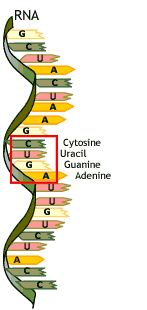
What mutation has occurred here?
T-G-A-C-C-A
T-G-A-G-C-A
Substitution
Deletion
Insertion
Frameshift
Which of the following would result in a frameshift mutation?
Insertions only
Substitution only
Deletion only
Insertions and Deletions
DNA molecule segment is : TTACGCAAG
The mutated DNA segment is TTCGCAAG. This is an example of ___ mutation.
Substitution
Deletion
Insertion
Inversion
A mutation is defined as:
A change in the cell's structure
Anything that changes in an embryo
Any change in the physical features of a human
A change in the DNA sequence
Why are insertion and deletion (frameshift) mutations so harmful?
They change all of the codons from the mutation on down the line, which changes the amino acid sequence
They insert things that an organism doesn't need.
They often delete things that organisms need.
Insertion and deletions are not any more harmful than substitution mutations.

Which mutation will cause translation to stop?
Mutations 1 and 3 only
Mutation 1 only
Mutation 2 only
Muations 1, 2, 3

A version of a gene is called a(n)
allele
characteristic
specific gene
trait

A trait that is expressed if one copy of the allele is present is a(n)
characteristic
dominant trait
gene
recessive trait

An organism’s genetic makeup; the pair of alleles for a trait is called a(n)
dominant trait
genotype
phenotype
recessive trait

An organism’s physical expression of a trait is called a(n)
dominant trait
genotype
phenotype
recessive trait

What is it called when both alleles in a genotype are the same?
Dominance
Heterozygous
Homozygous
Recessiveness

Which pair of alleles is an example of homozygous recessive?
bb
BB
Bb
The end result of mitosis is
4 Identical Cells are produced
4 genetically different cells are produced
2 identical cells are produced
2 genetically different cells are produced
The end result of meiosis is...
4 identical cells
4 genetically different cells
2 identical cells
2 genetically different cells
If an organism reproduces asexually, its offspring will most likely be...
genetically identical to the parent
genetically different from each other
produced from specialized cells known as gametes
A mutant
How many divisions are in meiosis?
46
23
2
4
What is the correct definition of a haploid cell?
A cell that only has a single set of chromosomes. (23 = n)
A cell that has 2 sets of chromosomes (46 = 2n)


What process results in the division of 1 cell into 2 identical daughter cells?
Mitosis
Meiosis
G1
Cross-Over

Colorblindness is a recessive X-linked disorder.
Which genotype represents a male with normal vision?
XN YN
Xn Yn
XN Y
Xn Y

What would the genotype be of a colorblind male?
XNY
XNYn
XnY
XnYn

Incomplete dominance occurs in cats, which allows them to be Black, White, or gray as shown on this Punnett square. What percentage of the offspring will be gray?
25
50
75
100

What goes in box 15
aabb
AABB
aaBB
AAbb

Based off this punnett square, what fraction of the offspring will have wrinkled, yellow seeds?
9/16
3/16
1/16
16/16
What is the genotype for a pea plant homozygous for round seeds (R), and heterozygous for yellow seeds?
RrYy
RRyy
RRYy
rryy


In preparation for an electrophoresis procedure, enzymes are added to DNA in order to
convert the DNA into gel
cut the DNA into fragments
change the color of the DNA
produce longer sections of DNA

A student performed a gel electrophoresis experiment. The results are represented in the diagram
below. Compared to the fragments at the top of the gel, the fragments at the lower end are
larger, and move slower
larger, and move faster
smaller, and move faster
smaller, and move slower


Guppies are small fish that live in South American rivers. They can have different- sized spots on their bodies.
The river bottoms are covered in rocks. Guppies with spots that are the same size as the rocks on the bottom are harder for bigger fish to see and catch.
The diagram below shows a population of guppies that live in a river. At time 1, the population had the same number of guppies with small and large spots. At time 2, after many generations, there were many more guppies with small spots and fewer guppies with large spots in the population.
How did the environment change between time 1 and time 2? How did the population change?
You cannot tell how the environment changed. With each generation, more guppies passed on the gene for small spots to their offspring.
The rocks became smaller. With each generation, more guppies with small spots survived long enough to pass on the gene for small spots to their offspring.
The rocks became smaller. Guppies with small spots are more likely to survive, so the guppies with large spots changed to have small spots.
The rocks became smaller. Guppies with small spots are more likely to survive, so both kinds of guppies passed on the gene for small spots to their offspring.
What is the process where animals live or die based on their adaptations to their environment.
Genetic Drift
Natural Selection
The Circle of Life
Mammoth
Which word best describes the following definition?
The process by which individuals that are better adapted to their environment are more likely to survive and reproduce than other members of the same species.
Trait
Generation
Adaptive Trait
Natural Selection
SELECT ALL THAT APPLY: Which of the following must be true in order for organisms to be considered the same species?
They must be able to mate
They must be able to produce viable offspring
They must have structural similaries
They must have the same bone structure

Genetic diversity is decreased through this process.
Gene Flow
Genetic Drift
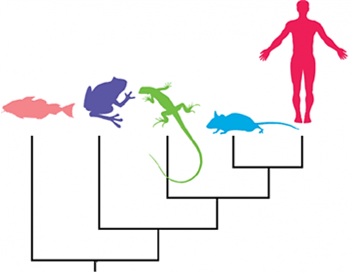
What is the human most closely related to?
Fish
mouse
Salamander
Human

Which group of animals on this tree are most closely related to birds?
Saurischian dinosaurs
Ornithischian dinosaurs
Crocodiles
None of these are related to birds

Where is the alligator and T. rex's common ancestor?
Point A
Point B
Point C
Point D
Which scientific name is TYPED correctly
carcharhinus melanopterus
Carcharhinus Melanopterus
Carcharhinus melanopterus
Carcharhinus melanopterus
Which taxa are used in a scientific name?
Domain
Genus
Phylum
Species
Class
What is the largest taxa?
Domain
Kingdom
Genus
Species

What is the common ancestor of Letters A, B, C, D, E?
1
2
3
4

What distinguishes zebras from from giraffes?
un-branching horns (in males)
even number of toes
fur
carnivorous teeth

arachnids and insects?

According to the cladogram, which organism is most distantly related to the chimpanzee?
salmon
salamander
lizard
hamster

Which trait should go where A is on the cladogram?
eyes
feet
lips
hat

Which trait(s) do conifers have?
vascular tissue only
vascular tissue and seeds
vascular tissue, seeds and flowers
seeds only