
 Worksheets
Solar System Presentation Quiz - AI Generated
Total questions: 89
Worksheet time: 48mins
Which planet is known for its prominent ring system?
Mercury
Venus
Saturn
Mars
Which is the largest planet in the Solar System?
Earth
Jupiter
Neptune
Uranus
What does our Solar System consist of?
The Sun, nine planets, moons, comets, and asteroids
The Sun, eight planets, moons, comets, and asteroids
The Sun, nine planets, moons, comets, asteroids, meteors, interplanetary gas, dust, and space
The Sun, eight planets, moons, comets, asteroids, meteors, interplanetary gas, dust, and space
What are the nine planets of the Solar System named after?
Greek and Roman philosophers
Greek and Roman Gods and Goddesses
Greek and Roman artists
Greek and Roman historians
Which of the following is an inner planet?
Jupiter
Saturn
Mars
Neptune
Which of the following is not an outer planet?
Uranus
Venus
Neptune
Pluto
Which planet is listed as both an inner and an outer planet in the image?
Earth
Mars
Jupiter
None of the above

What does this diagram represent?
The layers of the Earth's atmosphere
The structure of an atom
The solar system
The Milky Way galaxy
Which planet is the largest in the Solar System?
Saturn
Neptune
Jupiter
Uranus
Which of the following is not a planet in the Solar System?
Pluto & Charon
Sun
Neptune
Mercury
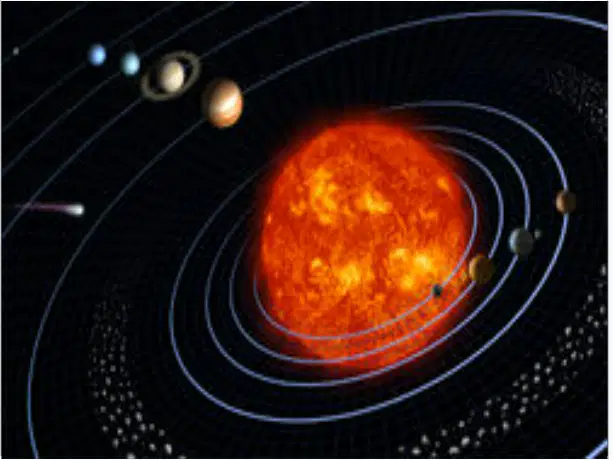
Which two celestial bodies are shown together at the far left in the image?
Neptune and Uranus
Jupiter and Saturn
Pluto and Charon
Earth and Mars
Based on the image, which planet appears to be the smallest?
Mercury
Mars
Pluto & Charon
Venus
Where does the sun's energy come from?
Photosynthesis
Nuclear fusion
Chemical reactions
Geothermal heat
What do stars produce?
Darkness
Sound
Light
Gravity
What do planets do with light?
Absorb light
Produce light
Reflect light
Magnify light
What determines a star's color?
Its distance from Earth
Its size
Its temperature
Its age
What color are the hottest stars?
Red
Yellow
Blue
White
What color are the coldest stars?
Blue
Green
Yellow
Red
According to the classification mentioned, which category does Earth belong to?
Gas giants
Small rocky planets
Dwarf planets
Not classified
Which of the following is NOT a gas giant?
Jupiter
Saturn
Neptune
Mars
How many main categories of planets are there according to the text?
One
Two
Three
Four
What are small rocky planets primarily made of?
Gas and ice
Rock and metal
Liquid and gas
Ice and metal
How would you describe the movement of small rocky planets in space?
They move quickly
They do not move
They move slowly
They move in a zigzag pattern
Do small rocky planets typically have rings?
Yes, they have many rings
No, they have no rings and few moons
Yes, they have rings and many moons
It is unknown if they have rings
What is the maximum diameter that small rocky planets can have?
Less than 5,000 km
Less than 13,000 km
Less than 20,000 km
Less than 30,000 km
How long is Mercury's revolution period around the sun?
88 days
365 days
224 days
687 days
The temperature range on Mercury is (a) .
0°F to 100°F
800°F (daytime) to -270°F (nighttim
32°F to -32°F
212°F to -100°F
Despite being the closest planet to the sun, what is found on Mercury that is unusual?
Lava
Ice
Vegetation
Liquid water
Why do people often mistake Venus for a star?
Because it has a moon that reflects sunlight
Because it is the only planet visible from Earth
Because its atmosphere reflects sunlight so well
Because it is the largest object in the night sky
What is the maximum surface temperature that Venus may reach?
100°F
500°F
900°F
1200°F
How many moons does Venus have?
How long does it take for Venus to complete an orbit around the Sun?
100 days
225 days
365 days
500 days
Which planet is known to support living organisms?
Mars
Venus
Jupiter
Earth
What percentage of Earth's surface is composed of water?
50%
71%
65%
80%
Why is water necessary on Earth?
It is used as fuel.
It helps in transportation.
It is necessary for life.
It is used for construction.
What role do the oceans play in relation to Earth's temperature?
They increase Earth's temperature.
They have no effect on Earth's temperature.
They decrease Earth's temperature.
They help maintain Earth's stable temperatures.
How many moons does Earth have?
Two
One
Three
None
What is a characteristic of Earth's atmosphere?
It is rich in carbon dioxide.
It is oxygen rich.
It is mostly nitrogen.
It contains no gases.
How long does it take for the moon to complete one rotation?
15 days
29 days
365 days
7 days
What is the moon's surface covered with?
Water and ice
Vegetation
Dust and rocky debris from meteor impacts
Lava flows
Match the following descriptions of the moon's atmosphere with the correct statement.
Yes, it has a thick atmosphere
Describes an atmosphere unlike Earth's, much denser and not applicable to the moon
Yes, but it's very thin
Correctly describes the moon's atmosphere as present but extremely sparse
No, it has no atmosphere
Incorrectly suggests the moon is completely devoid of an atmosphere
It has an atmosphere similar to Earth
Incorrectly suggests the moon's atmosphere is as dense and breathable as Earth's
What does the moon reflect onto the Earth's surface?
Its own light
Light from the sun
Light from the stars
Light from Earth
What causes Mars to appear red?
Its atmosphere
Iron oxide in its soil
Large oceans
Dense forests
How many moons does Mars have?
One
Two
Three
Four
What is the name of the largest volcano on Mars?
Elysium Mons
Olympus Mons
Arsia Mons
Pavonis Mons
Approximately how high is Olympus Mons?
5 miles
10 miles
15 miles
20 miles
How long does it take for Mars to complete an orbit around the Sun?
One year
Two years
Three years
Four years
What feature does Mars have that is similar to Earth?
Large oceans
Dense forests
Ice caps at its poles
Rings like Saturn
How many moons does Pluto have?
Two
Three
One
None
How long does it take for Pluto to orbit the sun?
365 days
100 years
249 years
150 years
When Pluto's orbit passes inside that of Neptune, what is its position in relation to the sun?
It is the closest to the sun
It is the second closest to the sun
It is the second farthest from the sun
It is the farthest from the sun
What year was Pluto located and named?
1920
1930
1940
1950
Is Pluto still considered a planet today?
Yes, it is still a planet
No, it is considered a dwarf planet
No, it is considered an asteroid
Yes, it is the ninth planet
What are Gas Giants primarily made up of?
Rocks and metals
Ice and water vapor
Hydrogen and helium
Carbon dioxide and methane
Compared to their size, how are Gas Giants described?
Very heavy
Very light
Very dense
Very small
What is a characteristic movement of Gas Giants in space?
They move slowly
They do not move
They move quickly
They move in a fixed position
Which of the following features do Gas Giants have?
Deserts and mountains
Rings and many moons
Oceans and continents
Forests and rivers
What is the maximum diameter of Gas Giants?
Less than 48,000 km
Less than 12,000 km
Less than 96,000 km
Less than 30,000 km
What is the largest and most massive planet in our solar system?
Earth
Mars
Jupiter
Saturn
How many times bigger is Jupiter's diameter compared to Earth's?
5 times bigger
11 times bigger
20 times bigger
8 times bigger
How long does it take for Jupiter to orbit the sun?
About 12 years
About 5 years
About 29 years
About 1 year
How many known moons does Jupiter have?
16
4
53
79
What is Saturn primarily composed of?
Oxygen and hydrogen
Hydrogen and helium
Nitrogen and oxygen
Carbon dioxide and methane
Saturn's rings are (a) wide.
How many known moons does Saturn have?
8
18
28
38
How long does it take for Saturn to orbit the sun?
About 12 years
About 30 years
About 60 years
About 90 years
Why is Uranus blue in color?
Because of the water in its atmosphere
Because of methane gas in its atmosphere
Because of the reflection of the ocean
Because of its surface ice
How many dark rings does Uranus have?
5
11
21
13
How many known moons does Uranus have?
11
27
21
13
How long does it take for Uranus to complete one orbit around the Sun?
76 years
84 years
100 years
50 years
What is the color of Neptune due to the presence of methane gas in its atmosphere?
Red
Green
Blue
Yellow
How long does it take for Neptune to orbit the sun?
100 years
165 years
200 years
365 years
How many moons does Neptune have?
4
8
12
16
What is the speed of the fastest winds on Neptune?
500 km/hr
1,000 km/hr
1,500 km/hr
2,000 km/hr

Match the following:
A
Mercury
B
Neptune
C
Earth
Label the four Jovian planets, also known as gas giants or ice giants.
Match the following

Jupiter

Neptune

Mars

Mercury

Earth
Match the following

Saturn

Uranus

Venus
Match the following:
Red planet that is 4th from the sun
Mars
Was a planet, now a dwarf planet
Pluto
5th and largest planet from the sun
Jupiter
Mercury, Venus, Earth, Mars
Terrestial Planets
There are _____ planets in our solar system
Eight

Check off the names of real planets in our solar system:
Mercury, Saturn, and Uranus
Venus, Neptune, and Jupiter
Earth and Mars
Pluto, Goofy, and Mickey

The arrow is pointing to which planet?
Mercury
Venus
Mars
Neptune

The arrow is pointing to which planet?
Earth
Mars
Saturn
Uranus

The arrow is pointing to which planet?
Mercury
Saturn
Mars
Neptune

The arrow is pointing to which planet?
Earth
Jupiter
Uranus
Mercury

What are the outer planets?
Mercury, Venus, Earth, Mars
Jupiter, Saturn, Uranus, Neptune

The arrow is pointing to which planet?
Earth
Mars
Jupiter
Saturn

The arrow is pointing to which planet?
Mercury
Venus
Mars
Neptune

The arrow is pointing to which planet?
Venus
Earth
Jupiter
Uranus

The arrow is pointing to which planet?
Mars
Jupiter
Mercury
Neptune

