
 Worksheets
The Reviewing Games on SpLDs
Total questions: 16
Worksheet time: 5hrs 0mins

According to the UK Department for Education Working Group in 2005, what does "SpLDs" stand for?
Specific Learning Differences
Specific Learning Difficulties
Specific Learning Disabilities
Specific Learning Dimensions

Annually 45,000 new entrants to UK HEIs report having at least one disability, SpLDs being the most common (QS, 2019). This does not include those diagnosed once HE studies have commenced.
True
False
As of 2019, what is the estimated proportion of UK HE students with dyslexia?
2%
5%
10%
15%
1.5 million people in the UK have a learning disability (Public Health England, 2016 & Office for National Statistics, 2019).
True
False

Between 33% and 50% of those with dyslexia also have visual stress (British Dyslexia Association, n.d.).
True
False
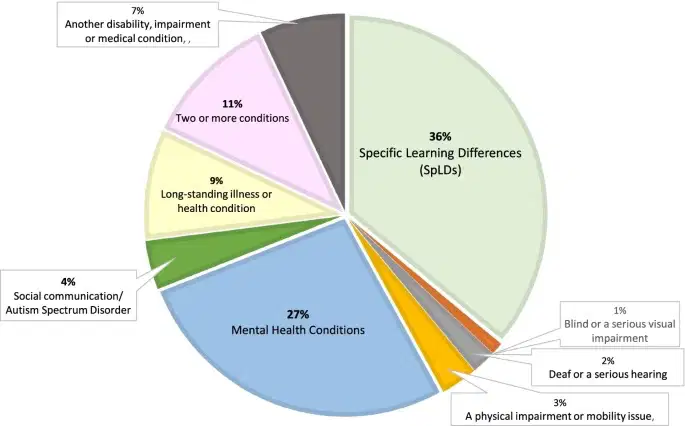
1 in 10 students require additional support provisions including for SpLDs (Office for Students, 2019).
True
False
Which of the following is a common adjustment made for students with SpLDs in UK higher education institutions?
Reduced course load
Extended time for exams
Priority registration for classes
All of the above

There are 195 countries in the world, each with its own culture. Cultural views on SpLDs are complex, with influences from different factors including: general awareness, government policies, teacher training, historical influences, teacher training, availability of assessments and interventions (Mather, White & Youman, 2020). Unfortunately, some cultures stigmatise SpLDs and this can dissuade students from seeking diagnosis or assistance at a UK university. Inclusive learning can help.
Agree
Disagree
According to Dr Binu P.M. in his book, it is estimated that there are 5-15% of schoolchildren suffering from scholastic backwardness or slow-learning difficulties.
Myth
Fact

According to a 2017 report by the Department of Education and Culture in Kutai Kartanegara, East Kalimantan, Indonesia, there were at least three slow learners in a classroom with 30-45 students failing classes and even being dropouts. Nevertheless, most parents, teachers, institutions were unaware because slow learners look as healthy as ordinary children. They are not different in appearance and can function normally in most learning situations. It is only through good observation and proper assessment that educators can identify them.
Myth
Fact
Most researchers and psychologists agree that slow learners only have 75-90 per cent of intelligence of an average student of their age. They achieve the ability to read only one year later than most children, and their rate of learning is about 4/5 to 9/10 of the standard rate. They can be really slow at spelling, memorising, reading, counting, writing, and/or articulating without effective learning strategies and teaching methods. In fact, slow learners require extra time, repetitions, and resources from their teachers.
Myth
Fact
Some people are light or colour sensitive. Bright sunlight or fluorescent lights may bother them.
It may be helpful NOT to have?
Black print on shiny white paper
Coloured paper for writing
Coloured overlays for reading
Tinted lenses in glasses for both reading and writing
The colours and brightness on computer screens can be adjusted to suit individuals
All students are individuals, and everyone experiences their SpLD(s) differently. While there are some common patterns with SpLDs, these vary in severity and significance for each individual.
What are your thoughts on this?
Common signs of dyslexia are the same as common EFL errors so can be extremely difficult to tell them apart (Kormos, 2016). If a student is being tested for dyslexia, then it must be in their native language for this reason. To what extent do you agree or disagree with this statement?
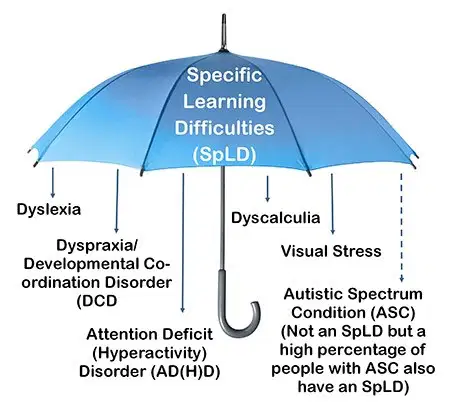
Match the following!
Dyslexia
difficulty with reading
Dysgraphia
difficulty with writing
Attention Deficit Hyperactivity Disorder (ADHD)
difficulty with attention
Dyscalculia
difficulty with math
Dyspraxia or Developmental Coordination Disorder (DCD)
difficulty with motor co-ordination

Reorder the stages of spelling development!
Pre-communicative spelling (Drawings of shapes of letters)
Phonetic/Alphabetic (Consistent phoneme-grapheme mappings)
Orthographic (Fully developed and automatic word-level spelling skills)

Reorder the Illustration of the Phonological Deficit Hypothesis (Stanovich, 1988; Vellutino, 1979)!
Impaired phonological representations
Reduced phonological awareness (syllabic and phonemic knowledge)
Word-reading difficulties

SpLD students need to use efficient learning strategies to encode words in long-term memory and retrieve them with ease. What are the basic principles of teaching vocabulary to students with Specific Learning Differences?
Limited amount of new vocabulary in a lesson and teach sound-meaning correspondence first
Explicit teaching and extensive practice
Productive practice tasks that require retrieval
Multi-sensory presentation and practice techniques with frequent revision
Separate similar sounding words and words with a similar meaning

