Wayground logo

Free Printable Worksheets

Font size

S
M
L
XL
Worksheets

4TH QUARTER QUIZ GRADE 7

Total questions: 84

Worksheet time: 59mins

Name
Class
Date
1.

I am an object that represents one specific location in space. What am I?

a)

point

b)

line

c)

segment

d)

plane

2.

Points P and Q lie in plane A.  How many lines contain P and Q?

a)

1.  Line PQ

b)

2. Lines PQ and QP

c)

3. The 2 lines PQ and QP plus another line that does not lie in plane A.

d)

∞\infty  . We can't name them all!

3.

If a plane and a line intersect, their intersection will be a ________.

a)

Point

b)

Line

c)

Plane

d)

Segment

4.

Name two planes that contain line QP.

a)

Planes PSR, QNM

b)

Planes SPL, QRM

c)

Planes NML, QPR

d)

Planes PRQ, SLP

5.

Points X and Y line in both plane P and plane Q. What object defines that intersection of the two planes?

a)

Line XY

b)

Segment XY

c)

Plane P

d)

All of 3-dimensional space

6.

How many point are required to name a specific plane

a)

3

b)

2

c)

∞\infty

d)

1

e)

0

7.

Points that define a plane must have what property?

a)

Non-collinearity

b)

Collinearity

c)

Coplanarity

d)

Non-coplanarity

8.

How many points does a line segment contain?

a)

∞\infty

b)

2

c)

3

d)

some large number

9.

Opposite rays are rays that share an endpoint and point in opposite directions. Both rays together form a(n) __________.

a)

Line

b)

Plane

c)

Intersection point

d)

Acute angle

10.

Name a point that is coplanar with line DF but not collinear

a)

G

b)

H

c)

E

11.
A part of a line with two endpoints
a)
Line
b)
Ray
c)
Angle
d)
Line Segment
12.
A part of a line that has one endpoint and goes on forever in the other direction
a)
Line
b)
Ray
c)
Line Segment
d)
Angle
13.
What is a line segment?
a)
A set of points that goes on forever in both directions
b)
A curved line that goes on in one direction forever
c)
A part of a line between two endpoints
14.
These figures share the same initial point and extend in opposite directions on the same line.
a)
Angles
b)
Opposite Rays
c)
Lines
d)
Line segments
15.
A _______ consists of an infinite number of points which form a flat surface that extends in all directions forever.
a)
Point
b)
Line
c)
Line segment
d)
Plane
16.
How do we name lines?
a)
a lower case letter OR two uppercase letters
b)
an uppercase letter
c)
two lowercase letters OR two uppercase letters
d)
capital cursive letter
17.
the wall is an example of a ___________.
a)
point
b)
line
c)
plane
d)
term
18.
Give another name for line b
a)
a
b)
R
c)
KL
d)
HK
19.

Name two planes that contain line QP.

a)

Planes PSR, QNM

b)

Planes SPL, QRM

c)

Planes NML, QPR

d)

Planes PRQ, SLP

20.

Name a point that is coplanar with line DF but not collinear

a)

G

b)

H

c)

E

21.

A subset of a line that has two endpoints.

a)

Line Segment

b)

Ray

c)

Half Line

d)

Point

22.

A subset of a line that has one endpoint and extends infinitely on one direction.

a)

Line Segment

b)

Ray

c)

Point

d)

Intersecting Lines

23.

Points that do not lie on the same plane

a)

Collinear Points

b)

Coplanar Points

c)

Non-collinear points

d)

Non-coplanar points

24.

Two lines intersect at a _______________.

a)

Point

b)

Line

c)

Plane

d)

Ray

25.

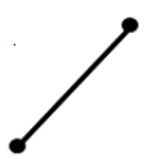
What is this?

a)

Line

b)

Parallel

c)

Point

d)

Line Segment

26.

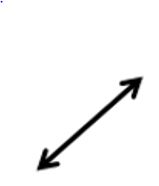
What is this?

a)

parallel

b)

vertex

c)

Line

d)

Line segment

27.

What is this?

a)

vertical

b)

Line

c)

Line Segment

d)

horizontal

28.
This point divides a line segment into 2 equal parts.
a)
point
b)
vertex
c)
midpoint
d)
segment
29.
What is the name of the PURPLE line?
a)
AB
b)
BC
c)
BD
d)
AD
30.
Baymax's eyes make a...
a)
Line
b)
Line segment
c)
Ray
d)
Angle
31.
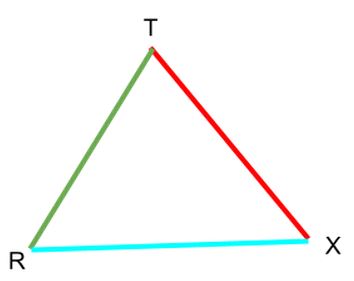
What is the name of the GREEN line?
a)
RT
b)
RX
c)
TX
32.
What is the name of this ray?
a)
Ray AB
b)
Ray BA
c)
Ray ABC
d)
Ray AC
33.

A flat surface is called a...

a)

plane

b)

line

c)

point

d)

ray

34.
What is it called when points lie on the same line.
a)
Midpoint
b)
Coplanear
c)
Segment Bisector
d)
Collinear
35.
smallest unit of geometric measure 
a)
millimeter 
b)
point
c)
ray
36.

1. Identify the angle given in the below figure:

a)

Obtuse angle

b)

acute angle

c)

straight angle

d)

right angle

37.

2. A right angle is always ______________ degrees.

a)

90

b)

less than 90

c)

greater than 90

d)

none of these

38.

3. Identify the angle given in the below figure:

a)

acute

b)

Obtuse

c)

right

d)

straight

39.

1. Name the angles A, B, C

a)

Acute, obtuse and right

b)

Obtuse, acute and right

c)

Right, acute and Obtuse

40.
  1. At 3’o’clock, what is the angle formed in the clock?
a)

Straight angle

b)

Acute angle

c)

Obtuse angle

d)

right angle

41.
Two angles added together to produce 90 degrees
a)
Supplementary
b)
Complementary
c)
Right
d)
Vertical
42.
These angles are...
a)
Complementary
b)
Supplementary
c)
Neither
43.
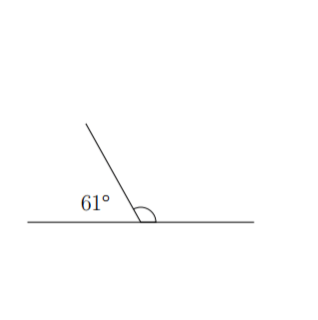
Find the missing angle.
a)
60
b)
70
c)
50
d)
140
44.
Find the missing angle.
a)
41
b)
32
c)
51
d)
31
45.
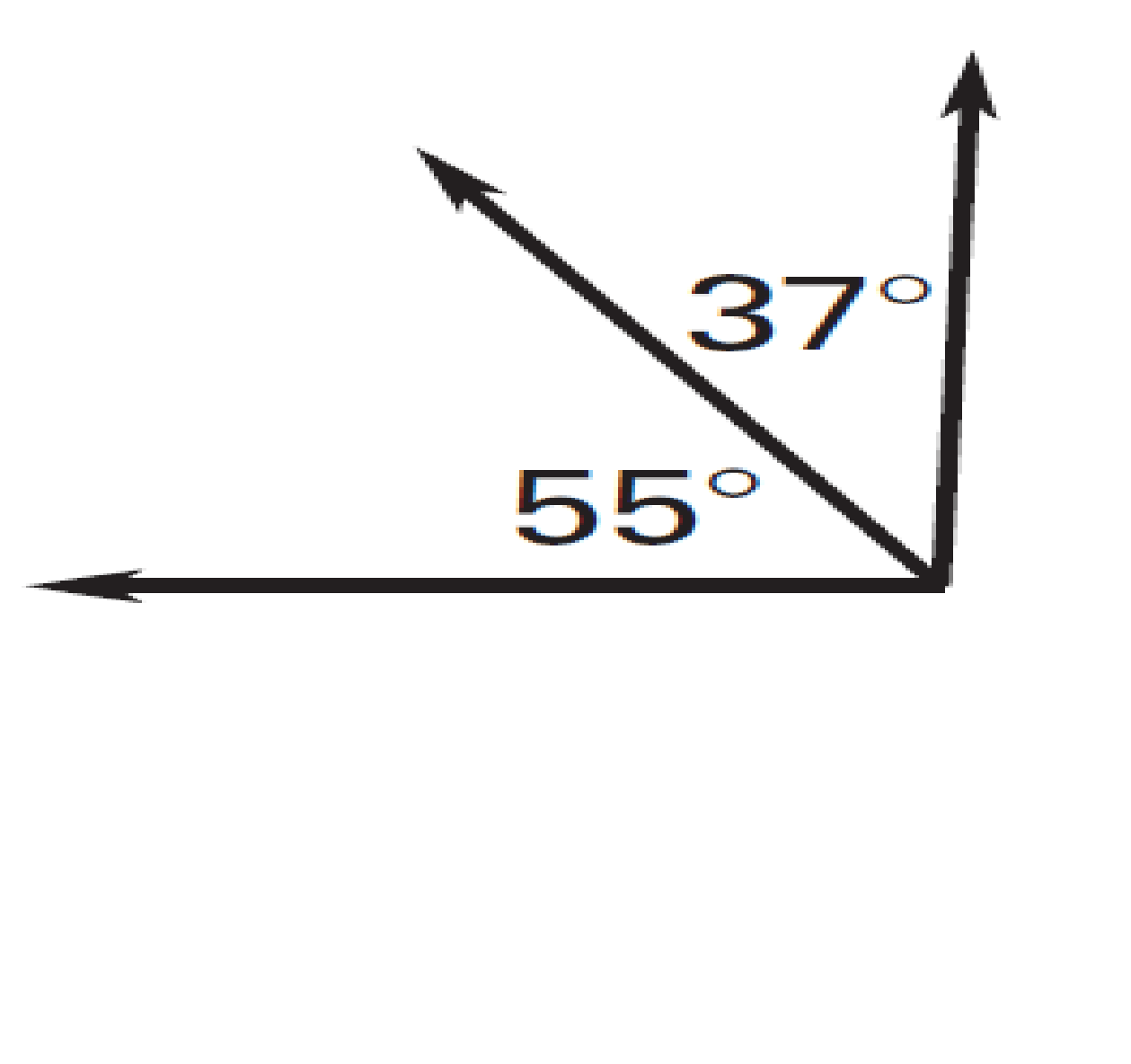
Find the missing angle.
a)
45
b)
65
c)
75
d)
55
46.
What is the measure of the missing angle?
a)
76
b)
86
c)
166
d)
156
47.
What kind of angles are shown?(45 + 135 = 180)
a)
complementary
b)
supplementary
c)
adjacent
d)
corresponding
48.
∠1 and ∠3 can best be described as - (opposite angles formed by intersecting lines.)
a)
complementary angles
b)
supplementary angles
c)
vertical angles
d)
adjacent angles
49.
Are these angles an example of complementary, supplementary, or neither?
a)
Complementary
b)
Supplementary
c)
Neither
50.
Are these angles an example of complementary, supplementary, or neither?
a)
Complementary
b)
Supplementary
c)
Neither
51.
What are supplementary angles?
a)
Angles that add up to 180°
b)
Angles that add up to 90°
c)
Angles that are equal to each other
d)
Angles that are opposite of each other when lines intersect
52.
Are these angles an example of complementary, supplementary, or neither?
a)
Complementary
b)
Supplementary
c)
Neither
53.
What is the measure of the missing angle?
a)
39
b)
129
c)
119
d)
129
54.
Find the value of x. 
a)
17
b)
28
c)
68
d)
39.5
55.
Find the value of x. 
a)
14
b)
112
c)
108
d)
104
56.

In the drawing, line l || m. What is true of angles 1 and 2 and why?

a)

They are supplementary by same side interior angles theorem.

b)

They are congruent by alternate interior angles theorem

c)

They are congruent by alternate exterior angles theorem.

d)

They are congruent by corresponding angles theorem.

57.

In the drawing, which pair of angles are alternate interior angles.

a)

1 and 2

b)

2 and 4

c)

3 and 5

d)

1 and 5

58.

l || m

a)

True

b)

False

59.

Which theorem according to the drawing indicates lines CD and EF are parallel?

a)

Converse of Corresponding angles theorem

b)

Converse of Same side interior angles theorem

c)

Converse of Alternate exterior angles theorem

d)

Converse of Alternate interior angles theorem

60.

If angle 3 measures 47 degrees what is the measure of angle 6 is lines a and b are parallel?

a)

47

b)

133

c)

43

d)

90

61.
State the angle relationship and find the measure of angle 1
a)
Corresponding
110
b)
Alternate Exterior
110
c)
Corresponding
70
d)
Alternate Exterior
70
62.
Find the measure of angle 1.
a)
28o
b)
136o
c)
44o
d)
6o
63.
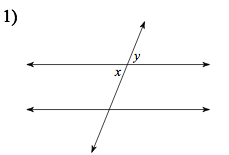
What is the relationship of the angles
a)
Alternate Interior
b)
Alternate Exterior
c)
Corresponding
d)
Vertical
64.
For alternate exterior angles to be congruent, the two lines must be _____________
a)
congruent
b)
parallel
c)
perpendicular
d)
bisectors
65.

Classify angle 1 and 8

a)

corresponding

b)

Alternate Interior

c)

Alternate Exterior

d)

Consecutive Exterior

e)

Linear Pair

66.

Are these vertical angles (yes/no)

a)

yes

b)

no

67.

Are these Vertical Angles?

a)

yes

b)

no

68.

Are these vertical angles?

a)

yes

b)

no

69.

Are these vertical angles?

a)

yes

b)

no

70.

Are these vertical angles?

a)

yes

b)

no

71.

Are these vertical angles?

a)

yes

b)

no

72.

What is the measure of the missing angle

a)

47

b)

133

73.

What is the measure of angle y?

a)

76

b)

104

74.

Which angle is congruent (equal) to the marked 

54°54\degree  angle?

a)

∠1\angle1  

b)

∠2\angle2  

c)

∠3\angle3  

75.
a)

adjacent angles

b)

vertical angles

c)

linear pair

d)

supplementary

76.
a)

acute angles

b)

vertical angles

c)

linear pair

d)

Complementary

77.
a)

18°18\degree  

b)

28°28\degree  

c)

162°162\degree  

d)

172°172\degree  

78.
a)

18°18\degree  

b)

28°28\degree  

c)

162°162\degree  

d)

172°172\degree  

79.
a)

123°123\degree  

b)

57°57\degree  

c)

133°133\degree  

d)

47°47\degree  

80.
a)

123°123\degree  

b)

57°57\degree  

c)

133°133\degree  

d)

47°47\degree  

81.
a)

76°, Linear Pair76\degree,\ Linear\ Pair  

b)

76°,Vertical Angles76\degree,Vertical\ Angles  

c)

104°, Linear Pair104\degree,\ Linear\ Pair  

d)

104° , Vertical Angles104\degree\ ,\ Vertical\ Angles   

82.
a)

76°, Linear Pair76\degree,\ Linear\ Pair  

b)

76°,Vertical Angles76\degree,Vertical\ Angles  

c)

104°, Linear Pair104\degree,\ Linear\ Pair  

d)

104° , Vertical Angles104\degree\ ,\ Vertical\ Angles   

83.
a)

∠1, ∠4, ∠5, ∠6\angle1,\ \angle4,\ \angle5,\ \angle6  

b)

∠1, ∠4, ∠7, ∠8\angle1,\ \angle4,\ \angle7,\ \angle8  

c)

∠2, ∠3, ∠6, ∠7\angle2,\ \angle3,\ \angle6,\ \angle7  

d)

∠4, ∠5, ∠6, ∠7\angle4,\ \angle5,\ \angle6,\ \angle7  

84.
a)

60°60\degree  

b)

120°120\degree  

c)

50°50\degree  

d)

110°110\degree