
 Worksheets
Discussion 4/19
Total questions: 10
Worksheet time: 6mins
The Venus flytrap has leaf blades with hinges in the middle. When an insect touches tiny hairs on the leaf, the leaf snaps shut, trapping the animal inside. Gradually, the leaf secretes enzymes that digest the animal and release its nutrients into the plant. This situation is an example of –
commensalism
mutualism
parasitism
predation
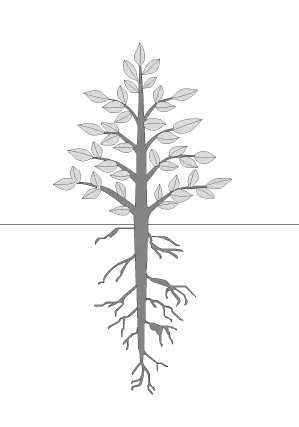
Leaves of plants commonly found in a grassland biome grow up from horizontal underground stems rather than from vertical above ground stems. Why would this be an advantage?
The plant can rapidly grow new leaves after being eaten.
The plant can survive in soil that provides no nutrients.
The plant requires more moisture than other plants in the biome.
The plant needs less sunlight than other similar plants.
In a prairie ecosystem, the producers are grass. These are consumed by grasshoppers which are in turn consumed by mice. The mice are consumed by snakes and snakes are consumed by hawks. Which of these organisms in the prairie ecosystem is a tertiary consumer?
grasshoppers
mice
snakes
hawks
In the summer of 1980, an infestation of gypsy moths hit New England. The following spring, their eggs hatched and the young gypsy moth caterpillars began feeding. Within 72 hours, forest habitats were stripped completely bare of leaves by the caterpillars. With no additional food available, the gypsy moth population is most likely to –
continue to rise dramatically
stabilize at this end
increase slowly
drop sharply
Although organisms from every kingdom play a role in all biogeochemical cycles, which essential role can only be performed by bacteria?
transpiration of water vapor
combustion of carbon compounds
decomposition of organic matter
fixing of nitrogen into nitrates
Which organisms in this food web can be described as a tertiary consumer?
A certain type of toad resembles tree bark with its brown color and rough skin. A certain type of frog, has a bright yellow-green color with red toes and smooth skin. How does the appearance of each organism most likely help them survive?
Both appearances act as camouflage.
Both appearances scare off predators.
The toad's appearance is to avoid detection, while the frog's appearance is to scare off predators.
The toad's appearance is to scare off predators, while the frog's appearance is to avoid detection.
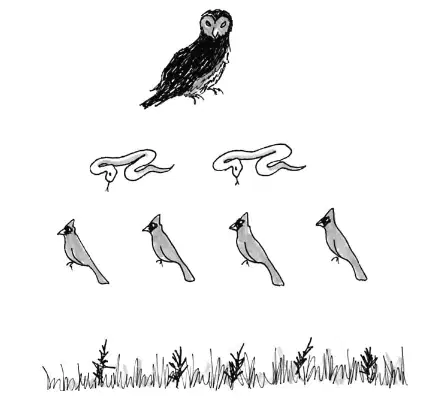
If this were an energy pyramid and the kilocalories available at Trophic Level 1 is 10,000 Kcal, how many Kcal would be available to the owl?
10,000
1,000
100
10
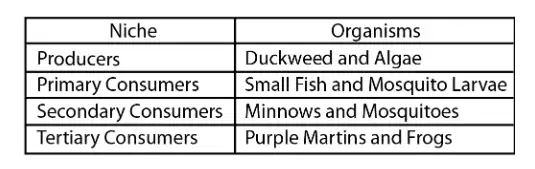
A person living near this pond notices that the mosquito population has decreased dramatically over the past two weeks. Referencing the mosquito population included in this food web, what is a plausible reason for the decrease in mosquito population?
mosquito larvae were eaten by the duckweed
conditions led to rapid increase in the number of minnows
many of the martin houses were destroyed by a recent storm
the frog population decreased because of a recent storm
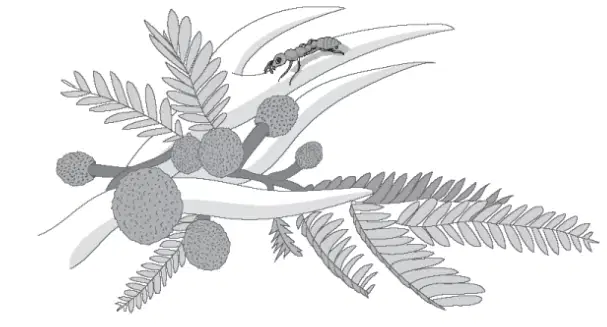
The acacia ant (Pseudomyrmex ferruginea) lives in the bullshorn acacia plant, as shown below. The acacia ant nests and feeds in the plant’s hollow thorns. The ant helps protect the bullshorn acacia by attacking insects and grazing animals that come near the plant. The relationship between the acacia ant and the bullshorn acacia is an example of which of the following?
Commensalism
Mutualism
Neutralism
Parasitism

