
 Worksheets
EARTH
Total questions: 80
Worksheet time: 1hrs 14mins
Name
Class
Date
1.
Which layer of the earth is in the very center?
a)
Crust
b)
Mantle
c)
Outer Core
d)
Inner Core
2.
Which layer of the earth is between the core and the crust?
a)
Crust
b)
Mantle
c)
Outer Core
d)
Inner Core
3.
Which layer of the earth has the lowest temperature?
a)
Crust
b)
Mantle
c)
Outer Core
d)
Inner Core
4.
Which layer of the earth is under the highest pressure?
a)
Crust
b)
Mantle
c)
Outer Core
d)
Inner Core
5.
What is the name of the layer that contains the uppermost mantle and crust
a)
Asthenosphere
b)
Mesosphere
c)
Lithosphere
d)
Transosphere
6.
What are the two types of crust
a)
continental and oceanic
b)
ocean and upper
c)
lower and upper
d)
pizza and subway
7.
Which crust is thicker
a)
ocean
b)
continental
c)
bread
d)
pizza
8.
Scientists determine what Earth’s interior looks like by using:
a)
Volcanoes
b)
Seismic Waves
c)
Continental Drift
d)
Convection Currents
9.
What observation can we make about Earth’s lithosphere AND asthenosphere?
a)
The asthenosphere floats on top of the lithosphere.
b)
The crust and the core make up the lithosphere.
c)
The crust and mantle make up the asthenosphere.
d)
The lithosphere floats on top of the asthenosphere
10.
What is the inner core composed of?
a)
Basalt
b)
Granite
c)
Iron and Nickel
d)
Molten (liquid) Metals
11.
If you traveled from the center of Earth to the surface, the pressure would...
a)
increase
b)
decrease
c)
stay the same
d)
unsure
12.
The asthenosphere is part of which layer?
a)
Inner core
b)
Outer Core
c)
Mantle
d)
Crust
13.
What was the name given to all the continents when they were joined as one super continent
a)
Supreme Continent
b)
United States
c)
Eurasia
d)
Pangea
14.
Contains molten (hot liquid) iron and nickel.
a)
outer core
b)
inner core
c)
mantle
d)
crust
15.
This layer is made up of igneous, metamorphic, and sedimentary rock.
a)
outer core
b)
mantle
c)
crust
d)
inner core
16.

What is a high tide?
a)
Sea pulled TOWARD the moon where Earth is CLOSEST to the moon
b)
Sea pulled AWAY from the moon where Earth is FARTHEST to the moon
c)
Sea pulled AWAY from the moon where Earth is CLOSEST to the moon
17.
Where you will find the ozone layer.
a)
stratosphere
b)
thermosphere
c)
exosphere
d)
mesosphere
18.
Where weather occurs.
a)
stratosphere
b)
thermosphere
c)
troposphere
d)
mesosphere
19.
The coldest layer.
a)
troposphere
b)
thermosphere
c)
exosphere
d)
mesosphere
20.
The hottest layer.
a)
troposphere
b)
thermosphere
c)
exosphere
d)
mesosphere
21.
The most common gas in the atmosphere (78%).
a)
Nitrogen
b)
Oxygen
c)
Carbon Dioxide
d)
Trace gases
22.
Which order is correct from the earth to space?
a)
thermosphere
troposphere
exosphere
mesosphere
stratosphere
ionosphere
troposphere
exosphere
mesosphere
stratosphere
ionosphere
b)
thermosphere
troposphere
stratosphere
exosphere
mesosphere
ionosphere
troposphere
stratosphere
exosphere
mesosphere
ionosphere
c)
exosphere
ionosphere
thermosphere
mesosphere
stratosphere
troposphere
ionosphere
thermosphere
mesosphere
stratosphere
troposphere
d)
troposphere
thermosphere
troposphere
stratosphere
exosphere
mesosphere
thermosphere
troposphere
stratosphere
exosphere
mesosphere
23.
What does the earth's atmosphere do?
a)
help to regulate the temperature on Earth
b)
Help UV rays to reach the Earth's surface
c)
Creates meteors in the sky
d)
Keep ocean waters cold
24.
As you go higher in the troposphere, the temperature _______________.
a)
decreases
b)
increases
c)
stays the same
d)
gets very hot
25.
As you go higher in the stratosphere, the temperature _______________.
a)
decreases
b)
increases
c)
stays the same
d)
gets very hot
26.
What is the function of the ozone layer?
a)
to allow UV rays to get to Earth
b)
to block UV rays from getting to Earth
c)
To keep oxygen in
d)
to allow meteors to get to Earth
27.
Which layer has the highest pressure?
a)
thermosphere
b)
stratosphere
c)
troposphere
d)
ionosphere
28.
Which of these layers has the lowest pressure?
a)
thermosphere
b)
stratosphere
c)
troposphere
d)
mesosphere
29.
This gas makes up 21% of the atmosphere
a)
ozone
b)
oxygen
c)
nitrogen
d)
water vapor
30.
Which of the following activities contributes the most to carbon emissions globally?
a)
Deforestation
b)
Agriculture
c)
Burning fossil fuels
d)
Respiration
31.
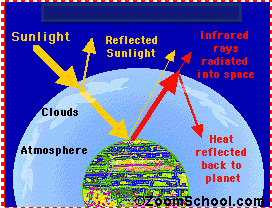
What does this diagram illustrate?
a)
Ozone Layer
b)
The Greenhouse Effect
c)
Ultraviolet Radiation
d)
Layers of the atmosphere
32.
What type of eclipse occurs when the moon blocks the sun's light and cast a shadow on earth?
a)
solar
b)
lunar
33.
What type of eclipse occurs when the earth's shadow is cast on a full moon?
a)
solar
b)
lunar
34.
What moon phase occurs during a solar eclipse?
a)
Full moon
b)
new moon
c)
1st quarter
d)
waxing gibbous
35.
What moon phase occurs during a lunar eclipse?
a)
full moon
b)
new moon
c)
3rd quarter
d)
waxing crescent
36.
What is in the middle during a solar eclipse?
a)
moon
b)
earth
c)
sun
37.
What type of eclipse occurs when the moon doesn't completely cover the sun?
a)
partial solar eclipse
b)
total solar eclipse
c)
total lunar eclipse
d)
partial lunar eclipse
38.
What part of the shadow must I be in to see a total solar eclipse?
a)
umbra
b)
penumbra
39.
What must happen in order for there to be an eclipse?
a)
the sun, earth, and moon must perfectly align
b)
A full moon occurs
c)
The earth must be higher than the sun and moon
d)
The moon must be beside the earth
40.

What type of eclipse is this?
a)
Solar eclipse
b)
Lunar eclipse
41.

What type of eclipse is this?
a)
Solar Eclipse
b)
Lunar Eclipse
42.
Why do eclipses not occur with every new and full moon?
a)
The moon's orbit is tilted.
b)
The earth is tilted.
c)
The moon doesn't always come in between the sun and moon during new moons.
d)
The moon is too far from earth.
43.
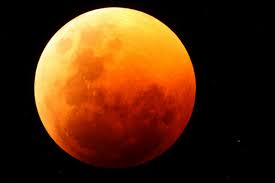
This image is an example of
a)
Lunar Eclipse
b)
New Moon
c)
Solar Eclipse
d)
Full Moon
44.
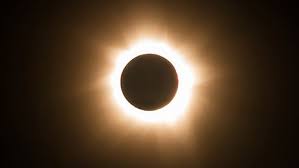
During a solar eclipse...
a)
The sun is blocked by the moon
b)
The Earth is blocked moon
c)
The moon is blocked by the sun
d)
You are blocked
45.

What is the darkest inner part of the shadow cone called, where a total eclipse can be viewed.
a)
Total
b)
Umbra
c)
Penumbra
46.
Which of the following is NOT true about a total solar eclipse?
a)
It can be viewed from every spot on earth
b)
It is dangerous to look at without the proper device
c)
When it happens, the moon blocks all of the sun except the corona
d)
You must be within the moon's umbra to see it
47.

What type of eclipse is occuring inthe diagram?
a)
solar
b)
lunar
48.

What type of eclipse is being shown in the diagram?
a)
Total solar eclipse
b)
Total lunar eclipse
c)
partial solar eclipse
d)
partial lunar eclipse
49.
An eclipse in space is when....
a)
one object passes through the shadow of another object.
b)
two shadows collide.
c)
the moon is in the waxing crescent phase.
d)
the Sun and Moon are side by side.
50.
What is the bigger, less dark part of the shadow called in an eclipse?
a)
Penumbra
b)
Penumbrella
c)
Umbrella
d)
Umbra
51.
What kind of eclipse happens more often and can be seen by more people?
a)
Solar
b)
Lunar
52.
Two gases that make up 99% of Earth's atmosphere
a)
carbon dioxide & oxygen
b)
nitrogen & carbon dioxide
c)
nitrogen & oxygen
d)
nitrogen & water vapor
53.
Layer of Earth's atmosphere where most of the water vapor and carbon dioxide is found
a)
thermosphere
b)
mesosphere
c)
stratosphere
d)
troposphere
54.
Layer of Earth's atmosphere where weather occurs
a)
thermosphere
b)
mesosphere
c)
stratosphere
d)
troposphere
55.
Uppermost layer of Earth's atmosphere
a)
thermosphere
b)
mesosphere
c)
stratosphere
d)
troposphere
56.
This gas makes up 21% of the atmosphere
a)
ozone
b)
oxygen
c)
nitrogen
d)
water vapor
57.
What is the hottest layer in the atmosphere?
a)
Ionosphere
b)
Stratosphere
c)
Thermosphere
d)
Mesosphere
58.
What layer is the Ozone in?
a)
Ozone Layer
b)
Startosphere
c)
Troposphere
d)
It's not in one, it has its own
59.
The _____ protects us from the harmful UV rays of the sun.
a)
Troposphere
b)
Ozone Layer
c)
Exosphere
d)
Stratosphere
60.
The force of a column of air pressing down is called what?
a)
Air Mass
b)
Air Pressure
c)
Air
d)
Heavy
61.
Considered to be a part of the thermosphere.
a)
ionosphere
b)
thermosphere
c)
troposphere
d)
mesosphere
62.
The coldest layer.
a)
troposphere
b)
thermosphere
c)
exosphere
d)
mesosphere
63.
Where satellites orbit.
a)
troposphere
b)
thermosphere
c)
exosphere
d)
mesosphere
64.
Where you will find Aurora Borealis (Northern Lights)
a)
troposphere
b)
ionsophere
c)
exosphere
d)
mesosphere
65.
Which order is correct from the earth to space (bottom to top)?
a)
thermosphere
troposphere
exosphere
mesosphere
stratosphere
ionosphere
troposphere
exosphere
mesosphere
stratosphere
ionosphere
b)
thermosphere
troposphere
stratosphere
exosphere
mesosphere
ionosphere
troposphere
stratosphere
exosphere
mesosphere
ionosphere
c)
exosphere
ionosphere
thermosphere
mesosphere
stratosphere
troposphere
ionosphere
thermosphere
mesosphere
stratosphere
troposphere
d)
troposphere
thermosphere
troposphere
stratosphere
exosphere
mesosphere
thermosphere
troposphere
stratosphere
exosphere
mesosphere
66.
What happens to the air pressure the higher up in space you go?
a)
the air pressure increases
b)
the air pressure decreases
c)
the air pressure stays the same
d)
there is no air pressure
67.
As you go higher in the troposphere, the temperature _______________.
a)
decreases
b)
increases
c)
stays the same
d)
gets very hot
68.
Which layer has the highest pressure?
a)
thermosphere
b)
stratosphere
c)
troposphere
d)
ionosphere
69.
What causes ocean currents in the Northern Hemisphere to curve to the right?
a)
Earth's orbit around the Sun
b)
Earth's spinning on its axis
c)
Earth's magnetic field
d)
Earth's force of gravity
70.
Where is ocean water the densest.
a)
The surface
b)
The middle
c)
The bottom
d)
Lake Michigan
71.
Two types of ocean currents are
a)
local and global
b)
sea and land
c)
surface and deep
d)
warm and cold
72.
Temperature and salinity differences in ocean water cause:
a)
Mid-ocean ridges
b)
Deep Currents
c)
Surface Currents
d)
High tide and low tide
73.
The Gulf stream carries _____________ water from the east coast of The United States to the West coast of Europe.
a)
Cold
b)
Warm
c)
Freezing
d)
Fresh
74.
As you go deeper in the ocean, the water is colder and less salty.
a)
True
b)
False
75.
Due to the Coriolis Effect, water in the northern hemisphere moves
a)
clockwise
b)
counter clockwise
c)
both
d)
neither
76.
Warm ocean currents generally come from
a)
The North Pole
b)
The South Pole
c)
The Equator
d)
Both A and B
77.
A horizontal movement of ocean water that is caused by wind and that occurs at or near the ocean's surface.
a)
Gulf Stream
b)
Global Conveyor Belt
c)
Surface Current
d)
Gyre
78.
What process brings the deep cold ocean currents up to the surface?
a)
Conduction
b)
Global Wind Patterns
c)
Convection Currents
d)
Temperature and salinity
79.
Why are surface currents at the surface of the ocean?
a)
colder temperature
b)
colder temperature & more salinty
c)
warmer temperature & less salinty
d)
less salinty
80.
Ocean water is more dense than fresh water at the same temperature due to differences in:
a)
Wind patterns
b)
Lifeforms
c)
Currents
d)
Salinity
100 %

