
 Worksheets
STAAR REVIEW - SCIENCE
Total questions: 25
Worksheet time: 27mins
Which statement describes how fossil fuels are made?
Oil from Earth's core slowly rises to the Earth's surface and forms ponds
Lava within some volcanoes becomes so hot that it transforms into fossil fuels
Dead and decomposing organisms are exposed to extreme heat and pressure transforms them into fossil fuels
When mountains form on top of coal, the pressure liquefies the coal creating fossil fuels
How are organisms, such as snakes, cacti and coyotes able to survive in harsh desert conditions?
Over thousands of years these organisms have developed adaptations to survive in arid climates
These organisms migrate out of the desert during the summer months
These organisms work together to find sources of food and water
Snakes, cacti and coyotes are all aquatic species that live in ponds and rivers during the hot day

A student helped his father prepare soup for dinner. His father asked him to use a wooden spoon to stir the soup as it heated.
Why would the student's father ask him to use a wooden spoon?
The wooden spoon is able to float in the soup
the wooden spoon is able to sink in the soup
the wooden spoon is a good conductor of thermal energy
The wooden spoon is a good insulator of thermal energy

When using a solar-powered calculator, what source of energy is being used to power the calculator?
Electrical Energy
Light Energy
Mechanical Energy
Sound Energy
If a person is describing the daily changes in temperature and perception, they are referring to an area's--
weather
climate
geography
geology
Over a period of 40 years, the amount of rain that fell in the central Texas area was measured and recorded. Monitoring and tracking rainfall over a long period gives the most accurate information about--
amount of humidity
weather
climate
high temperature
What is one difference between weather and climate?
weather describes conditions near the ground, but climate does not.
Climate describes energy from the sun, but weather does not.
weather includes precipitation, but climate does not.
Climate describes long-term conditions over an entire region, but weather does not.
Which event best describes an example of evaporation?
Water flows downhill after a storm
Dark clouds form in the sky
Rain water oaks into the ground
Solar energy heats water at the ocean's surface.

In the water cycle, the Sun's energy is directly responsible for causing the process at location---
A
B
C
D

Which of the following best illustrates the direction of energy flow through the food web above?
Spider to Grasshopper to Grass
Hognose snake to toad to grasshopper
Grass to rabbit to hawk
mouse to spider to toad

In the food chain above, the role of the grasshopper can best be described as--
a consumer that eats producers
a herbivore that produces its own energy
a producer that provides energy for the mouse
an omnivore that eats grasses and small animals

What most likely happened to the dead plants and animals?
They were eaten by scavengers.
They were washed away by water.
They became fossil fuels.
They became an underground aquifer.

A student places 250 g samples of clay, sand, gravel, and silt in separate flower pots. The pots are set on a wire rack, and dishes are placed beneath the pots so that water can drip through holes and collect. The student then pours 100 mL of water over the sample in each pot. The student measures the time it takes for water to begin dripping from the bottom of each pot.What property of soils is the student most likely examining with this procedure?
The amount of time it takes different soils to dry
How well different soils retain water
How much water is needed to dissolve different soils
The differences in texture between wet and dry soils

Which statement correctly describes the transfer of energy in a food chain in this wetland?
Energy is transferred from hawks to shrews to grasshoppers to marsh grasses.
Energy is transferred from marsh grasses to crickets to hawks to frogs.
Energy is transferred from grasshoppers to crickets to frogs to hawks.
Energy is transferred from cattails to crickets to shrews to hawks.
A bright-red male cardinal comes to a school bird feeder every morning. Like other cardinals, this bird makes a sharp chirping sound as it hops around the bird feeder. Which of these is a learned behavior of this bird?
Having red feathers
Eating seeds during the day
Coming to the bird feeder each morning
Making a chirping sound

The abalone is a type of sea snail. Adult abalones slowly crawl over rocks near the shore, while larvae float in the water. Which organisms have a life cycle that is most like that of abalones?
Frogs
Humans
Snakes
Birds
A family was vacationing in the mountains in a cabin that had no electrical power. They needed boiling water in order to prepare dried soup mix. With no electrical energy available, which method would most likely provide enough thermal energy to quickly heat the water to boiling?
Using a microwave oven to heat water in a glass jar for 3 minutes
Shining a battery-powered flashlight on a metal container of water for 10 minutes
Placing a metal pot of water over glowing charcoal in an outdoor grill for 10 minutes
Shaking the water in a closed, insulated plastic bottle for 3 minutes
Erosion is major process in the formation of sedimentary rock. What is erosion?
Rocks are broken into smaller pieces that remain the in same location.
Pressure compacts layers of sediment and turns them into rock.
Pieces of soil or rock are carried from one place to another.
Sediment falls to the bottom of a lake to form sedimentary layers.
How long does it take Earth to rotate on its axis once?
365 days
1 year
24 hours
4 weeks

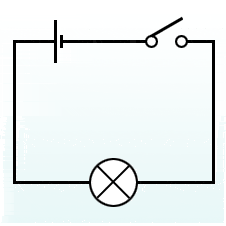
When the switch is closed in the illustration above, the bulb will glow. This is because the battery sends what kind of energy through the wire?
Mechanical
Electrical
Sound
Thermal

When Switch 1 is closed and Switches 2 and 3 are open, both bulbs will light.
When Switches 1 and 3 are closed and Switch 2 is open, only Bulb Y will light.
When Switches 2 and 3 are closed and Switch 1 is open, only Bulb X will light.
When Switches 1 and 2 are closed and Switch 3 is open, neither bulb will light.
Sedimentary rocks form from
Compaction and Cementation
Melting and Solidifcation
Weathering and Erosion
Heat and Pressure
carrying away of sediments
weathering
compaction
erosion
cementation
the process by which dissolved minerals in the water glue particles of sediment together into one rock.
fossils
compaction
cementation
weathering

